
18F-氟脱氧葡萄糖正电子发射断层扫描-计算机断层扫描(18F-FDG PET-CT)成像的代谢参数在预测放射性碘难治性分化型甲状腺癌无进展生存期方面的作用:一项单中心研究
Role of Metabolic Parameters of 18F-Fluorodeoxyglucose Positron Emission Tomography-Computed Tomography (18F-FDG PET-CT) Imaging in Predicting Progression-Free Survival of Radioiodine-Refractory Differentiated Thyroid Cancer: A Single-Center Study.
作者信息
Khatami Alireza, Sutherland Duncan, Romsa Jonathan
机构信息
Division of Nuclear Medicine and Molecular Imaging, Department of Medicine, The Ottawa Hospital, University of Ottawa, Ottawa, CAN.
Medical Imaging, London Health Sciences Centre, Western University, London, CAN.
出版信息
Cureus. 2025 May 28;17(5):e84998. doi: 10.7759/cureus.84998. eCollection 2025 May.
INTRODUCTION
Most cases of thyroid cancer are differentiated thyroid cancers, which typically have a high survival rate due to the effectiveness of radioactive iodine (RAI) therapy. However, a subset of these cancers, known as radioactive iodine-refractory differentiated thyroid cancer (RR-DTC), is resistant to RAI and is associated with lower survival rates, necessitating alternative therapeutic approaches. As RR-DTC develops, there is an increase in glucose utilization and metabolic activity of the tumor. The technique of 18F-fluorodeoxyglucose positron emission tomography-computed tomography (18F-FDG PET/CT) is well-known for assessing the metabolic activity of tumors, and in this case, the RR-DTC. This study explores the relationship between 18F-FDG PET/CT imaging and associated metabolic parameters of RR-DTC to progression-free survival (PFS).
METHODS
A retrospective analysis was performed on 22 patients diagnosed with RR-DTC who underwent 18F-FDG PET-CT imaging between 2010 and 2021. Metabolic PET parameters, including total lesion volume (TLV), total lesion glycolysis (TLG), maximum standardized uptake value (SUVmax), and the biomarker thyroglobulin (Tg), along with thyroglobulin doubling time (TgDT), were extracted and analyzed for potential associations with PFS. Means and standard deviations (SD) were reported for continuous variables, and percentages for categorical variables. Student's t-test and Fisher's exact test were used to compare imaging parameters and biomarker variables between patients with and without disease progression. Progression-free survival (PFS) was evaluated using univariate and multivariate Cox proportional hazards models, and the Kaplan-Meier method with log-rank test was used to assess the impact of various variables on PFS. All statistical analyses were performed using SPSS software version 28.1.1, with a two-sided significance level set at P < 0.05.
RESULTS
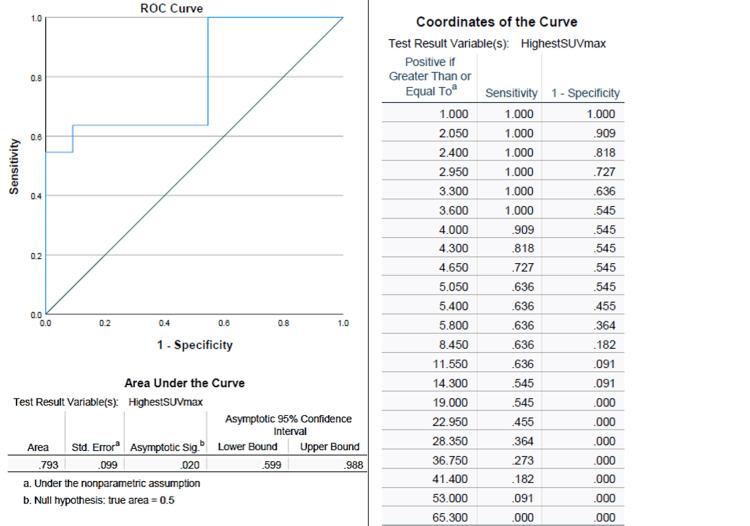
The patients' ages ranged from 38 to 83 years, 15 out of 22 (68%) were male, and 13 out of 22 (59.1%) exhibited distant metastases. The follow-up period varied from 21 to 452 months; the median follow-up was 32 months, and the mean follow-up was 116 months. Of the 22 patients, 11 (50%) demonstrated disease progression, with a mean time-to-progression of 74 months. The mean SUVmax and TLV were higher in patients with metastatic disease compared to those with localized disease in surgical beds and regional lymph nodes (p-values of 0.045 and 0.01, respectively). Univariate Cox analysis revealed that SUVmax > 10 had a hazard ratio (HR) of 4.97 (CI: 1.39-17.8, p-value = 0.014), TLV > 5 had an HR of 11.6 (CI: 2.51-53.4, p-value = 0.002), Tg > 10 had an HR of 5.70 (CI: 1.44-22.6, p-value = 0.013), and TgDT ≤ 100 days had an HR of 17.9 (CI: 1.89-161.8, p-value = 0.01), all correlated with worse PFS. Multivariate Cox analysis demonstrated that TgDT ≤ 100 days with an HR 63.9 (CI: 9.33- 743, p-value=0.02) was the sole predictor of reduced PFS. Kaplan-Meier analysis showed that SUVmax >10, TLG >10, Tg > 10, and TgDT ≤ 100 days corresponded to worse PFS, and TgDT ≥300 days corresponded to best PFS.
CONCLUSION
In this data set, the metabolic parameters obtained from PET-CT imaging are predictive for PFS in RR-DTC patients when used with other imaging and biomarkers.
引言
大多数甲状腺癌病例为分化型甲状腺癌,由于放射性碘(RAI)治疗的有效性,其通常具有较高的生存率。然而,这些癌症中的一部分,即放射性碘难治性分化型甲状腺癌(RR-DTC),对RAI耐药且生存率较低,因此需要替代治疗方法。随着RR-DTC的发展,肿瘤的葡萄糖利用率和代谢活性会增加。18F-氟脱氧葡萄糖正电子发射断层扫描-计算机断层扫描(18F-FDG PET/CT)技术以评估肿瘤的代谢活性而闻名,在本研究中则用于评估RR-DTC。本研究探讨18F-FDG PET/CT成像与RR-DTC的相关代谢参数对无进展生存期(PFS)的关系。
方法
对2010年至2021年间接受18F-FDG PET-CT成像的22例诊断为RR-DTC的患者进行回顾性分析。提取并分析代谢PET参数,包括总病变体积(TLV)、总病变糖酵解(TLG)、最大标准化摄取值(SUVmax)以及生物标志物甲状腺球蛋白(Tg),连同甲状腺球蛋白倍增时间(TgDT),以分析其与PFS的潜在关联。连续变量报告均值和标准差(SD),分类变量报告百分比。采用学生t检验和Fisher精确检验比较疾病进展患者和未进展患者之间的成像参数和生物标志物变量。使用单因素和多因素Cox比例风险模型评估无进展生存期(PFS),并采用Kaplan-Meier方法和对数秩检验评估各种变量对PFS的影响。所有统计分析均使用SPSS软件28.1.1版进行,双侧显著性水平设定为P<0.05。
结果
患者年龄在38岁至83岁之间,22例中有15例(68%)为男性,22例中有13例(59.1%)出现远处转移。随访期从21个月至452个月不等;中位随访时间为32个月,平均随访时间为116个月。22例患者中,11例(50%)出现疾病进展,平均进展时间为74个月。与手术床和区域淋巴结局限性疾病患者相比,转移性疾病患者的平均SUVmax和TLV更高(p值分别为0.045和0.01)。单因素Cox分析显示,SUVmax>10的风险比(HR)为4.97(CI:1.39 - 17.8,p值 = 0.014),TLV>5的HR为11.6(CI:2.51 - 53.4,p值 = 0.002),Tg>10的HR为5.70(CI:1.44 - 22.6,p值 = 0.013),TgDT≤100天的HR为17.9(CI:1.89 - 161.8,p值 = 0.01),所有这些均与较差的PFS相关。多因素Cox分析表明,TgDT≤100天且HR为63.9(CI:9.33 - 743,p值 = 0.02)是PFS降低的唯一预测因素。Kaplan-Meier分析显示,SUVmax>10、TLG>10、Tg>10和TgDT≤100天对应较差的PFS,而TgDT≥300天对应最佳的PFS。
结论
在本数据集中,当与其他成像和生物标志物一起使用时,从PET-CT成像获得的代谢参数可预测RR-DTC患者的PFS。

 Zotero 插件