
3D打印的螺旋状支架可实现用于更绿色基础设施的坚固且隔热的菌丝体结合复合材料。
3D printed gyroid scaffolds enabling strong and thermally insulating mycelium-bound composites for greener infrastructures.
作者信息
Sharma Deepak, Le Ferrand Hortense
机构信息
School of Mechanical and Aerospace Engineering, Nanyang Technological University, 50 Nanyang Avenue, Singapore, 639798, Singapore.
School of Materials Science and Engineering, Nanyang Technological University, 50 Nanyang Avenue, Singapore, 639798, Singapore.
出版信息
Nat Commun. 2025 Jul 1;16(1):5775. doi: 10.1038/s41467-025-61369-x.
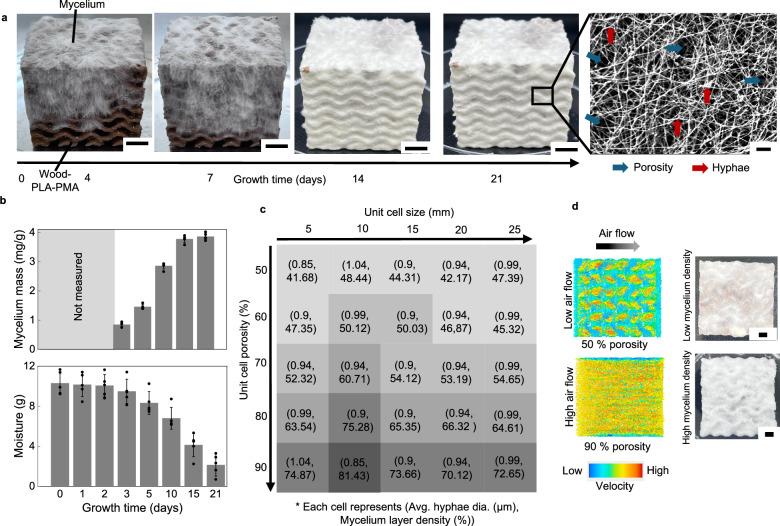
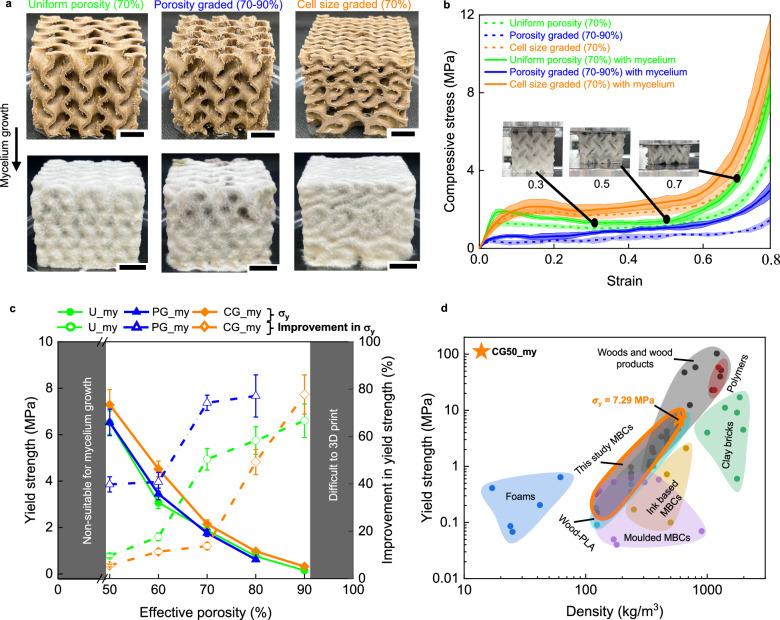
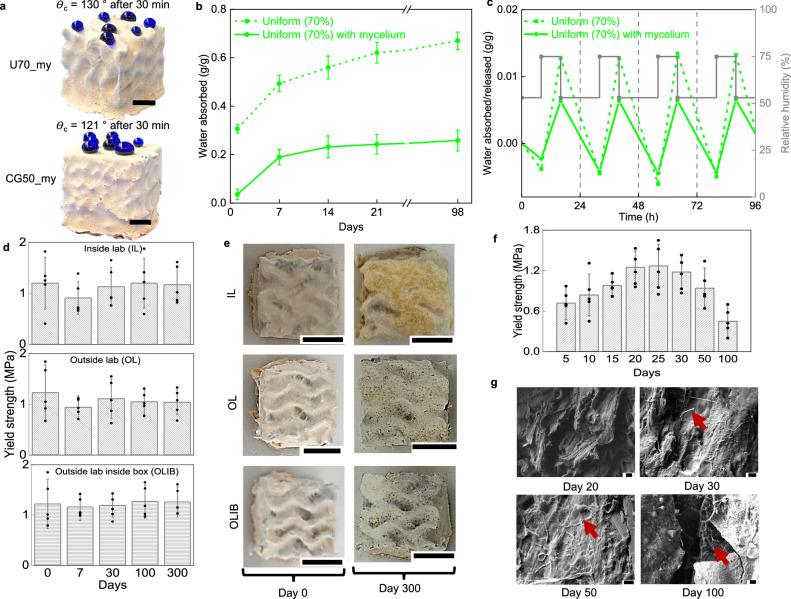
Mycelium-bound composites (MBCs) grown from fungi onto solid lignocellulosic substrates offer a sustainable alternative to petroleum-based materials. However, their limited mechanical strength and durability are often insufficient for practical applications. In this work, we report a method for designing and developing strong and thermally insulating MBCs. The method grows mycelium onto 3D-printed stiff wood-Polylactic Acid (PLA) porous gyroid scaffolds, enhancing the strength of the scaffold while imparting other functional properties like thermal insulation, fire resistance, hydrophobicity, and durability. The extent of improvement in MBCs' performance is directly dependent on the mycelium growth, and the best growth is observed at 90% porosity. We observe yield strength (σ) of 7.29 ± 0.65 MPa for 50% porosity MBC, and thermal conductivity (K) of 0.012 W/mK for 90% porosity MBC. Maximum improvement in σ (50.4-77.7%) between before and after mycelium growth is observed at medium (70%)-high (90%) porosity. The MBCs also exhibit design-dependent improved fire-resistance and durability compared to the base wood-PLA scaffold, further enhancing their suitability for practical applications. Our findings show that integration of 3D printing, design, and biomaterials enables the development of sustainable bio-based composites to replace pollution-causing materials from the construction industry.
由真菌在固体木质纤维素基质上生长而成的菌丝体结合复合材料(MBCs)为石油基材料提供了一种可持续的替代品。然而,它们有限的机械强度和耐久性往往不足以满足实际应用的需求。在这项工作中,我们报告了一种设计和开发坚固且隔热的MBCs的方法。该方法是让菌丝体在3D打印的硬质木材-聚乳酸(PLA)多孔类螺旋体支架上生长,增强支架的强度,同时赋予其隔热、防火、疏水和耐用等其他功能特性。MBCs性能的改善程度直接取决于菌丝体的生长情况,在孔隙率为90%时观察到最佳生长效果。我们观察到孔隙率为50%的MBCs的屈服强度(σ)为7.29±0.65兆帕,孔隙率为90%的MBCs的热导率(K)为0.012瓦/米·开尔文。在中等(70%)至高(90%)孔隙率下,观察到菌丝体生长前后σ的最大改善幅度为50.4 - 77.7%。与基础木材-PLA支架相比,MBCs还表现出与设计相关的改进的防火性和耐久性,进一步提高了它们在实际应用中的适用性。我们的研究结果表明,3D打印、设计和生物材料的整合能够开发出可持续的生物基复合材料,以替代建筑行业中造成污染的材料。



 Zotero 插件