
青少年眼中的食物环境:探索社会生态因素以及健康与可持续食物选择的机会
The food environment through the eyes of adolescents: exploring socioecological factors and opportunities for healthy and sustainable food choices.
作者信息
Mesch Anouk, Hoefnagels Femke, Gulikers Judith, Wesselink Renate, Winkens Laura H H, Raghoebar Sanne, Haveman-Nies Annemien
机构信息
Education & Learning Sciences, Wageningen University & Research, Wageningen, Netherlands.
Consumption & Healthy Lifestyles, Wageningen University & Research, Wageningen, Netherlands.
出版信息
BMC Public Health. 2025 Jul 1;25(1):2177. doi: 10.1186/s12889-025-23441-5.
BACKGROUND
Although it is evident that current food environments do not facilitate healthy and sustainable diets, it is still largely unknown how adolescents navigate their food environments during the school week. This study explored how adolescents, in rural and urban areas, interact with their food environment, the factors influencing this interaction and the opportunities they perceive to get healthy and sustainable food.
METHODS
A mixed-methods study was conducted among 305 adolescents, aged 12-16, of which 54% identified as female, 43% as male, and 3% as non-binary or other. Adolescents from 13 classes at four Dutch secondary schools in rural and urban areas participated. Participants completed a questionnaire and a food environment mapping assignment. Next, 50 focus groups were conducted with 5-8 participants each. Questionnaire and assignment data were analysed using descriptive statistics. Focus groups were analysed inductively, through a thematic analysis, to identify socioecological factors influencing adolescents' interaction with their environment.
RESULTS
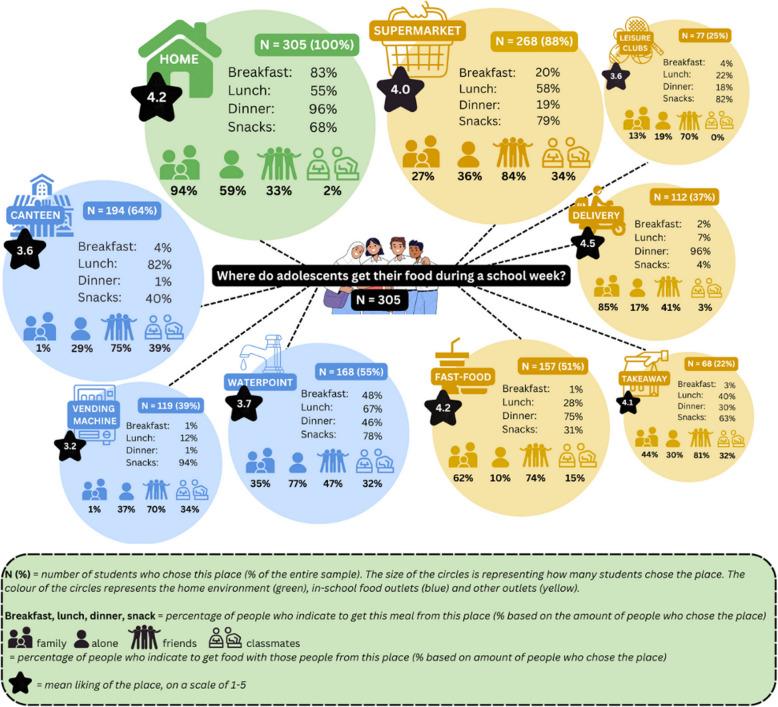
Of all food outlets, adolescents marked their home (n = 305), the supermarket (n = 268), and the school canteen (n = 194) as the most visited locations to obtain food during a school week. The home was perceived as a safe and pleasant place to eat, as well as a place where healthy and sustainable food is available and consumed. In out-of-home settings, adolescents perceived more freedom to make their own choices and fewer adolescents indicated that they obtain healthy and sustainable food themselves. Focus groups revealed 18 factors underlying adolescents' food choices in their environment, including the need for autonomy, the social function of food among peers, the influence of caregivers, the importance of a diverse and appealing food offer, and the price of food. Differences between rural and urban areas were mainly found in the presence and use of fast-food outlets and delivery services.
CONCLUSIONS
While navigating the food offer in their homes, schools and other food outlets, adolescents balance more healthy and sustainable food choices at home with more autonomous, but less healthy and less sustainable, choices outside of their homes. To support adolescents in making more healthy and sustainable choices, environments in and around schools should be designed to promote healthy and sustainable options that are affordable, while also facilitating a social mealtime and giving adolescents space to express autonomy in their food choices.
背景
尽管目前的食物环境显然不利于健康和可持续饮食,但青少年在上学周如何在其食物环境中进行活动仍很大程度上未知。本研究探讨了农村和城市地区的青少年如何与他们的食物环境互动、影响这种互动的因素以及他们认为获得健康和可持续食物的机会。
方法
对305名12至16岁的青少年进行了一项混合方法研究,其中54%为女性,43%为男性,3%为非二元性别或其他性别。来自荷兰农村和城市地区四所中学13个班级的青少年参与了研究。参与者完成了一份问卷和一项食物环境绘图任务。接下来,进行了50个焦点小组讨论,每个小组有5至8名参与者。问卷和任务数据使用描述性统计进行分析。焦点小组通过主题分析进行归纳分析,以确定影响青少年与环境互动的社会生态因素。
结果
在所有食物供应场所中,青少年将他们的家(n = 305)、超市(n = 268)和学校食堂(n = 194)标记为上学周获取食物最常去的地方。家被视为一个安全且宜人的用餐场所,也是一个有健康和可持续食物供应及消费的地方。在家庭以外的场所,青少年感觉有更多自由做出自己的选择,且更少青少年表示他们自己能获取健康和可持续食物。焦点小组揭示了青少年在其环境中食物选择背后的18个因素,包括对自主性的需求、食物在同伴间的社交功能、照顾者的影响、多样且吸引人的食物供应的重要性以及食物价格。农村和城市地区的差异主要体现在快餐店和外卖服务的存在及使用方面。
结论
在家庭、学校和其他食物供应场所中,青少年在家中平衡更多健康和可持续的食物选择,而在家庭以外则做出更自主但不太健康和不太可持续的选择。为了支持青少年做出更健康和可持续的选择,学校及其周边环境应设计成能促进提供价格合理的健康和可持续选择,同时也便于进行社交用餐,并给予青少年在食物选择中表达自主性的空间。
 Zotero 插件