
发热伴血小板减少综合征回顾性分析及死亡危险因素列线图预测模型构建
Retrospective Analysis of Severe Fever With Thrombocytopenia Syndrome and Construction of a Nomogram Prediction Model for Mortality Risk Factors.
作者信息
Chen Gang, Du Yuchen, Ma Xiuchang, Liang Yaowen, Chen Apeng, Wei Jie, Wu Jinhuan, Qian Wenxian, Xie Shuqin, Yan Yi, Hu Zheng, Zheng Yishan, Tian Man, Yi Changhua
机构信息
Department of Pediatrics, The First People's Hospital of Lianyungang, Xuzhou Medical University Affiliated Hospital of Lianyungang (Lianyungang Clinical College of Nanjing Medical University), Lianyungang, China.
The Second Hospital of Nanjing, Affiliated Hospital to Nanjing University of Chinese Medicine, Nanjing, China.
出版信息
Open Forum Infect Dis. 2025 Jun 2;12(7):ofaf318. doi: 10.1093/ofid/ofaf318. eCollection 2025 Jul.
BACKGROUND
Severe fever with thrombocytopenia syndrome (SFTS) is an emerging zoonotic infectious disease caused by the SFTS virus and is characterized by a high mortality rate. The primary objective of this study was to investigate high-mortality risk factors in SFTS and to create a nomogram model for personalized prediction.
METHODS
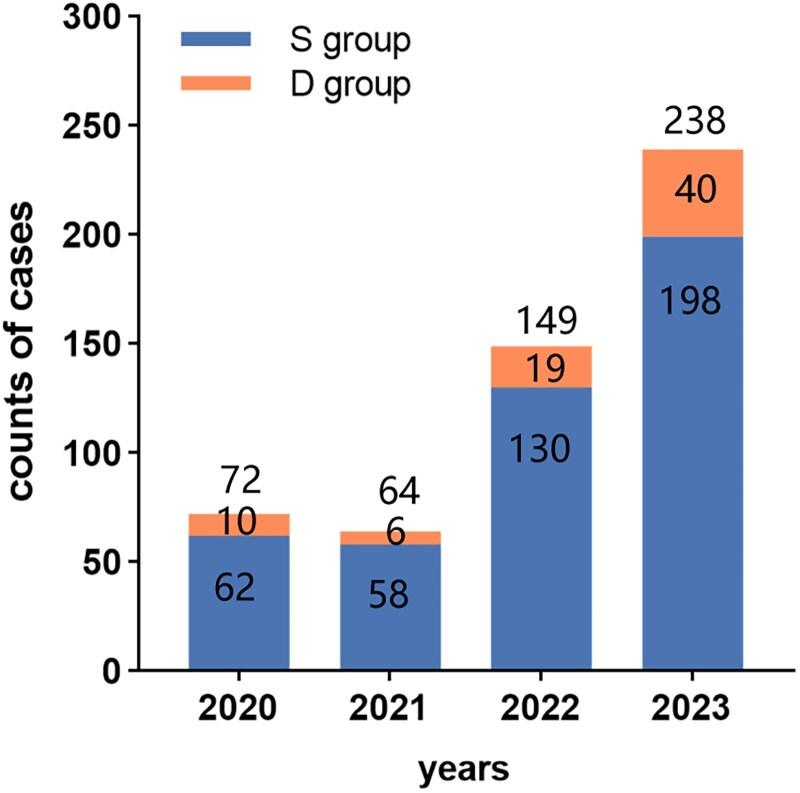
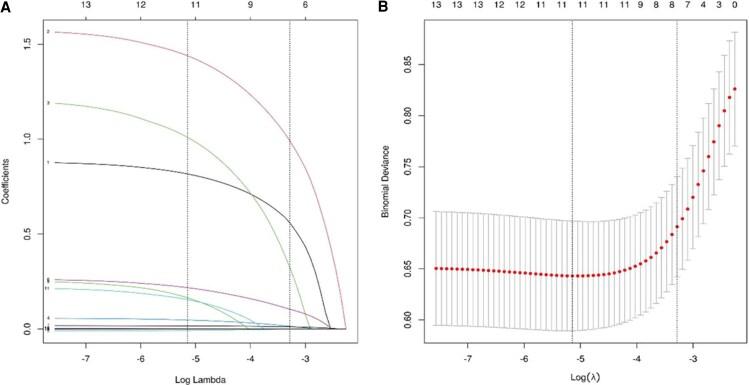
A total of 523 patients with SFTS who were admitted to the Second Hospital of Nanjing, Nanjing University of Chinese Medicine, between January 2020 and December 2023 were retrospectively analyzed: 75 cases were classified in the death group and 448 cases in the survival group. Development of a predictive nomogram model was based on the independent risk factors that were stepwise screened through univariate analysis, LASSO analysis (least absolute shrinkage and selection operator), and multivariate logistic regression analysis.
RESULTS
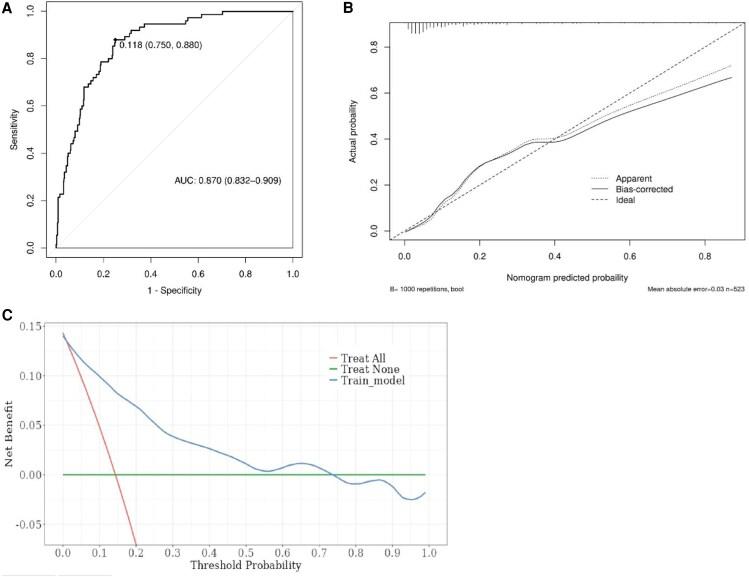
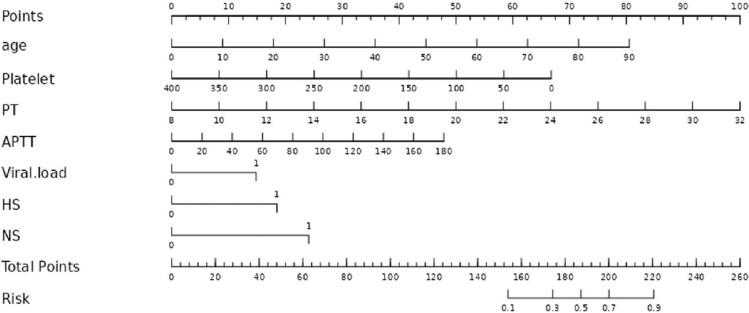
Based on stepwise variable screening by univariate analysis, LASSO analysis, and multivariate logistic regression, the following were independent mortality risk factors in patients with SFTS: age (odds ratio [OR], 1.06; 95% CI, 1.03-1.10; < .001), hemorrhagic symptoms (OR, 3.39; 95% CI, 1.31-8.78; = .012), neurologic symptoms (OR, 4.89; 95% CI, 2.72-8.77; < .001), platelet count (OR, 0.99; 95% CI, .98-.99; = .045), prothrombin time (OR, 1.32; 95% CI, 1.11-1.56; = .001), activated partial thromboplastin time (OR, 1.02; 95% CI, 1.01-1.03; = .007), and viral load ≥10copies/mL (OR, 2.66; 95% CI, 1.36-5.20; = .004). The area under the curve (0.87; 95% CI, .832-.909) showed excellent predictive power. Calibration curves showed the accuracy of the assessed nomograms. Decision curve analysis results showed a greater net benefit when the threshold probability of patient death was between 0.02 and 0.75.
CONCLUSIONS
A nomogram model consisting of 7 risk factors was successfully constructed, which can be used to predict SFTS mortality risk factors early.
背景
发热伴血小板减少综合征(SFTS)是一种由SFTS病毒引起的新发人畜共患传染病,死亡率高。本研究的主要目的是调查SFTS的高死亡风险因素,并创建一个列线图模型用于个性化预测。
方法
回顾性分析2020年1月至2023年12月期间在南京中医药大学附属南京第二医院收治的523例SFTS患者:75例被归类为死亡组,448例为存活组。基于通过单因素分析、LASSO分析(最小绝对收缩和选择算子)和多因素逻辑回归分析逐步筛选出的独立危险因素,开发预测列线图模型。
结果
通过单因素分析、LASSO分析和多因素逻辑回归进行逐步变量筛选,SFTS患者的以下因素为独立死亡风险因素:年龄(比值比[OR],1.06;95%可信区间[CI],1.03 - 1.10;P <.001)、出血症状(OR,3.39;95% CI,1.31 - 8.78;P =.012)、神经症状(OR,4.89;95% CI,2.72 - 8.77;P <.001)、血小板计数(OR,0.99;95% CI,.98 -.99;P =.045)、凝血酶原时间(OR,1.32;95% CI,1.11 - 1.56;P =.001)、活化部分凝血活酶时间(OR,1.02;95% CI,1.01 - 1.03;P =.007)以及病毒载量≥10拷贝/mL(OR,2.66;95% CI,1.36 - 5.20;P =.004)。曲线下面积(0.87;95% CI,.832 -.909)显示出良好的预测能力。校准曲线显示了评估列线图的准确性。决策曲线分析结果表明,当患者死亡的阈值概率在0.02至0.75之间时,净效益更大。
结论
成功构建了一个由7个风险因素组成的列线图模型,可用于早期预测SFTS死亡风险因素。

 Zotero 插件