
阿尔茨海默病协作研究 - 日常生活活动依赖评分:评估阿尔茨海默病严重程度全谱患者依赖程度的算法的修订与验证
The Alzheimer's Disease Cooperative Study - Activities of Daily Living dependence score: revision and validation of an algorithm evaluating patient dependence across the spectrum of AD severity.
作者信息
Chandler Julie M, Lansdall Claire J, Ye Wenyu, McDougall Fiona, Belger Mark, Toth Balazs, Mi Xiaojuan, Sink Kaycee M, Atkins Alexandra S
机构信息
Eli Lilly and Company, Indianapolis, Indiana, USA.
F. Hoffman-LaRoche AG, Basel, Switzerland.
出版信息
J Prev Alzheimers Dis. 2025 Sep;12(8):100261. doi: 10.1016/j.tjpad.2025.100261. Epub 2025 Jul 1.
BACKGROUND
Increasing dependence on informal and formal caregivers in Alzheimer's disease (AD) contributes to high societal cost. Treatments that delay time to increased dependence/care needs would be clinically meaningful, but these outcomes are rarely collected in early AD clinical trials. The 2015 ADCS-ADL dependence algorithm was created to estimate level of dependence in AD.
OBJECTIVES
To revise the original dependence algorithm to improve accuracy of dependence scores (DS) across AD severity, including early symptomatic AD.
DESIGN
Secondary data analysis SETTING: Community cohort; randomized clinical trial PARTICIPANTS: 14,000 participants enrolled across GERAS-EU observational study and 12 AD clinical trials.
MEASUREMENTS
Three-phase algorithm revision: 1) reassess ADCS-ADL items to identify those appropriate for assessing dependence; 2) (a) assign individual item responses to degrees of assistance and (b) to operationalize assignment of DS based on extent of total assistance needed; and 3) validate revised algorithm in multiple datasets across AD severity from mild cognitive impairment due to AD to moderate-severe AD.
RESULTS
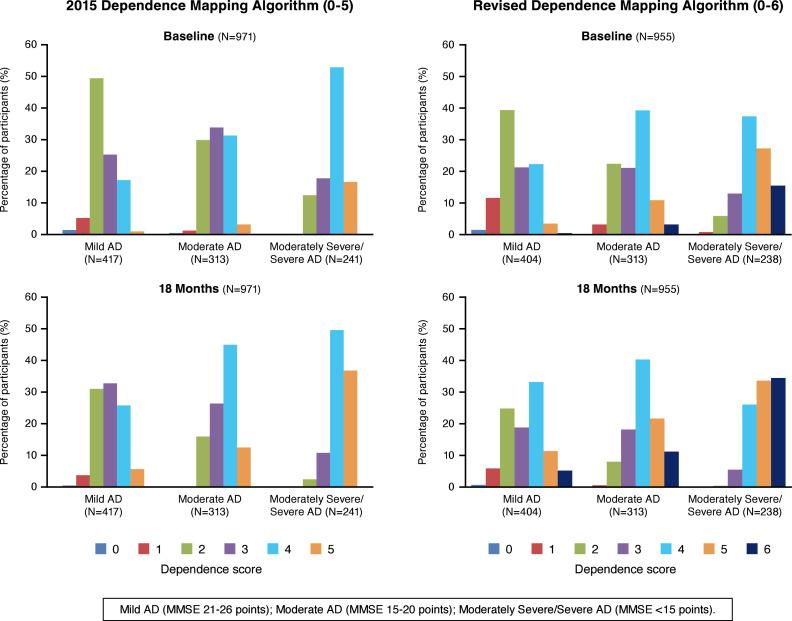
The revised DS (0-6) algorithm classified most participants with early symptomatic AD as independent or moderately independent (DS<3) at baseline. With disease progression over time, the proportion of participants who were mildly to fully dependent (DS≥3) increased across AD severity. Increased DS was associated with incremental worsening of clinical outcomes.
CONCLUSIONS
The revised ADCS-ADL DS algorithm provides a supplementary approach to evaluate the impact of emerging treatments on independence/care needs in AD and may be useful in clinical trials where the ADCS-ADL has been collected.
CLINICAL TRIAL REGISTRATION INFORMATION
EXPEDITION 1 NCT00905372; EXPEDITION 2 NCT00904683; EXPEDITION 3 NCT01900665; AMARANTH NCT02245737; TRAILBLAZER-ALZ NCT03367403; TRAILBLAZER-ALZ 2 NCT04437511; GRADUATE I NCT03444870; GRADUATE II NCT03443973; CREAD NCT02670083; CREAD 2, NCT03114657; TAURIEL NCT03289143; LAURIET NCT03828747.
背景
在阿尔茨海默病(AD)中,对非正式和正式照料者的依赖日益增加,导致了高昂的社会成本。能够延迟依赖程度/照料需求增加时间的治疗方法在临床上具有重要意义,但这些结果在早期AD临床试验中很少被收集。2015年创建的ADCS-ADL依赖算法用于估计AD中的依赖程度。
目的
修订原始的依赖算法,以提高AD严重程度(包括早期有症状的AD)中依赖评分(DS)的准确性。
设计
二次数据分析
设置
社区队列;随机临床试验
参与者
GERAS-EU观察性研究和12项AD临床试验中招募的14,000名参与者。
测量
分三个阶段修订算法:1)重新评估ADCS-ADL项目,以确定适合评估依赖程度的项目;2)(a)将单个项目的回答分配为不同程度的协助,(b)根据所需总协助程度实施DS分配;3)在从AD所致轻度认知障碍到中度至重度AD的多个AD严重程度数据集中验证修订后的算法。
结果
修订后的DS(0 - 6)算法在基线时将大多数早期有症状的AD参与者分类为独立或中度独立(DS<3)。随着疾病随时间进展,在AD的各个严重程度中,轻度至完全依赖(DS≥3)的参与者比例增加。DS增加与临床结果的逐渐恶化相关。
结论
修订后的ADCS-ADL DS算法为评估新出现的治疗方法对AD中独立性/照料需求的影响提供了一种补充方法,并且可能在已收集ADCS-ADL的临床试验中有用。
临床试验注册信息
EXPEDITION 1 NCT00905372;EXPEDITION 2 NCT(此处原文有误,应为NCT00904683);EXPEDITION 3 NCT01900665;AMARANTH NCT02245737;TRAILBLAZER-ALZ NCT03367403;TRAILBLAZER-ALZ 2 NCT04437511;GRADUATE I NCT03444870;GRADUATE II NCT03443973;CREAD NCT02670083;CREAD 2,NCT03114657;TAURIEL NCT03289143;LAURIET NCT03828747。

 Zotero 插件