
1990 - 2021年全球、区域和时间范围内饮食所致慢性肾脏病的负担及不平等情况
Burden and inequalities of chronic kidney disease attributable to diet globally, regionally and temporally, 1990-2021.
作者信息
Wei Nana, Yang Miao, Zheng Pingping, Xu Jian
机构信息
Department of General Medicine, The First Affiliated Hospital of Bengbu Medical University, Bengbu, Anhui, China.
Department of Pharmacy, The First Affiliated Hospital of Bengbu Medical University, Bengbu, Anhui, China.
出版信息
Front Nutr. 2025 Jun 18;12:1592389. doi: 10.3389/fnut.2025.1592389. eCollection 2025.
BACKGROUND
Modifiable dietary habits are a crucial means of reducing the risk of CKD. However, there is currently a lack of global-scale analysis on the burden of CKD attributable to diet. This study aimed to examine the burden of CKD potentially associated to diet globally, regionally and temporally.
METHOD
Our research utilized data sourced from the 2021 edition of the Global Burden of Disease (GBD) study. We gathered information on the worldwide impact of diet-related CKD spanning from 1990 to 2021, categorizing this impact based on various factors including gender, age, GBD geographical regions, and individual countries. To assess the evolving trend of diet-attributable CKD burden over this period, we employed the Joinpoint regression model, calculating the average annual percent change (AAPC) for a comprehensive understanding. Cluster analysis was employed to classify countries into distinct dietary risk categories.
RESULTS
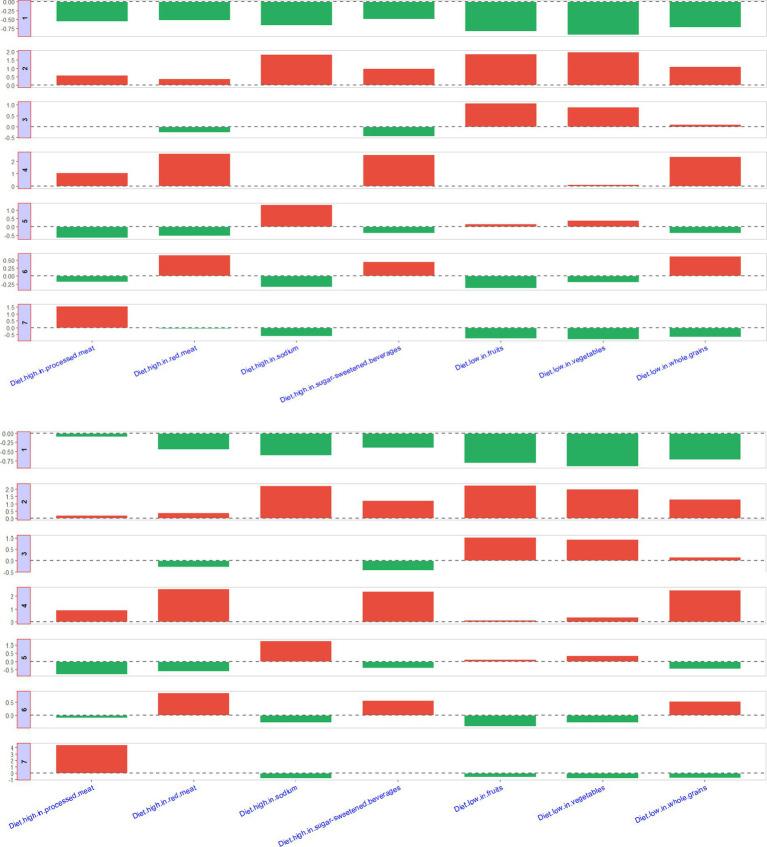
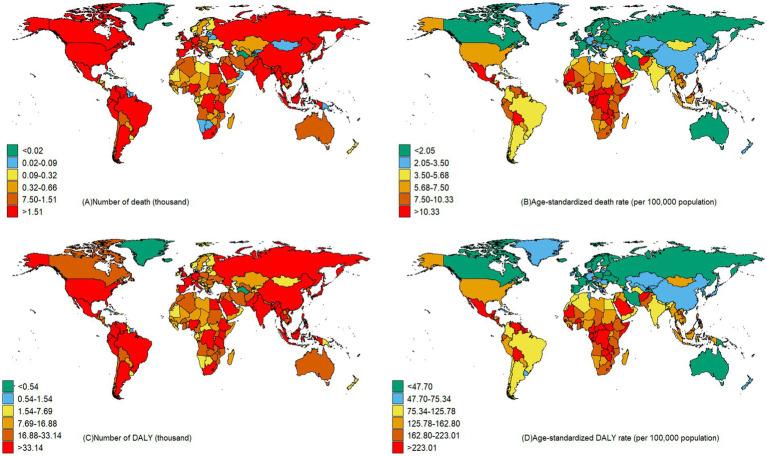
In 2021, globally, CKD burden potentially associated to diet resulted in 317,010 deaths (95% UI: 185,370-454,850) and 7,971,280 DALYs lost (95%UI: 4,630,030-11,451,430). These figures accounted for 20.75% of all CKD-related deaths and 17.93% of all CKD-related DALYs. The age-standardized mortality and DALY rates potentially associated to diet rose notably, reaching 3.83 (95%UI: 2.25-5.49) and 93.52 (95%UI: 54.29-134.38) per 100,000 population, respectively. However, significant regional variations were observed in these rates, with Central Sub-Saharan Africa experiencing the highest and Eastern Europe the lowest. High-income North America experienced a particularly steep increase, with an AAPC of 2.93% (95% CI: 2.85, 3.01%) for deaths and 2.51% (95%CI: 2.44, 2.56%) for DALYs. Among dietary factors, insufficient intake of fruits and vegetables emerged as the primary contributor to the CKD burden. By cluster analysis, seven clusters of dietary risk patterns were identified.
CONCLUSION
Diet may play a substantial role in the burden of CKD, with notable variations across different regions. It is imperative to implement enhanced dietary guidelines, with particular attention to mitigating the challenges faced by low-income countries and reversing the upward trend in high-income countries.
背景
可改变的饮食习惯是降低慢性肾脏病(CKD)风险的关键手段。然而,目前缺乏对饮食所致CKD负担的全球范围分析。本研究旨在探讨全球、区域和时间上与饮食潜在相关的CKD负担。
方法
我们的研究利用了来自《2021年全球疾病负担(GBD)研究》的数据。我们收集了1990年至2021年期间饮食相关CKD的全球影响信息,并根据性别、年龄、GBD地理区域和各个国家等多种因素对这种影响进行分类。为评估这一时期饮食所致CKD负担的演变趋势,我们采用了Joinpoint回归模型,计算平均年度百分比变化(AAPC)以全面了解情况。采用聚类分析将各国分为不同的饮食风险类别。
结果
2021年,在全球范围内,与饮食潜在相关的CKD负担导致317,010人死亡(95%不确定区间:185,370 - 454,850)和7,971,280伤残调整生命年(DALY)损失(95%不确定区间:4,630,030 - 11,451,430)。这些数字分别占所有CKD相关死亡的20.75%和所有CKD相关DALY的17.93%。与饮食潜在相关的年龄标准化死亡率和DALY率显著上升,分别达到每10万人3.83(95%不确定区间:2.25 - 5.49)和93.52(95%不确定区间:54.29 - 134.38)。然而,这些比率存在显著的区域差异,撒哈拉以南非洲中部地区最高,东欧最低。高收入的北美地区增长尤为陡峭,死亡人数的AAPC为2.93%(95%置信区间:2.85, 3.01%),DALY的AAPC为2.51%(95%置信区间:2.44, 2.56%)。在饮食因素中,水果和蔬菜摄入不足是CKD负担的主要促成因素。通过聚类分析,确定了七类饮食风险模式。
结论
饮食可能在CKD负担中起重要作用,不同地区存在显著差异。必须实施强化饮食指南,尤其要关注减轻低收入国家面临的挑战并扭转高收入国家的上升趋势。



 Zotero 插件