
预测乳腺癌腋窝淋巴结转移的放射组学模型及放射组学特征的生物学意义分析
Radiomics models to predict axillary lymph node metastasis in breast cancer and analysis of the biological significance of radiomic features.
作者信息
Li Xinhua, Hong Minping, Lu Zhendong, Liu Zilin, Lin Lifu, Xu Hongfa
机构信息
Oncology Center, Department of Radiology, Affiliated Hospital of Guangdong Medical University, Zhanjiang, China.
Department of Radiology, Jiaxing Hospital of Traditional Chinese Medicine Affiliated to Zhejiang Chinese Medical University, Jiaxing, Zhejiang, China.
出版信息
Front Oncol. 2025 Jun 19;15:1546229. doi: 10.3389/fonc.2025.1546229. eCollection 2025.
OBJECTIVES
To explore the effectiveness of radiomics in predicting axillary lymph node metastasis (ALNM) and the relationship between radiomics features and genes.
METHOD
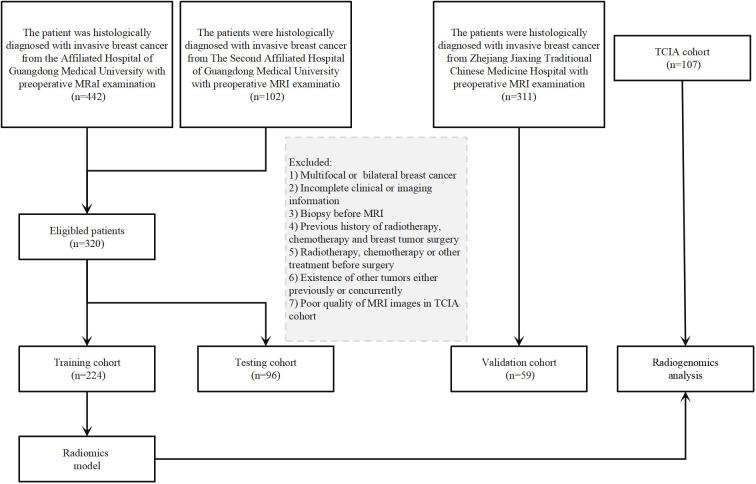
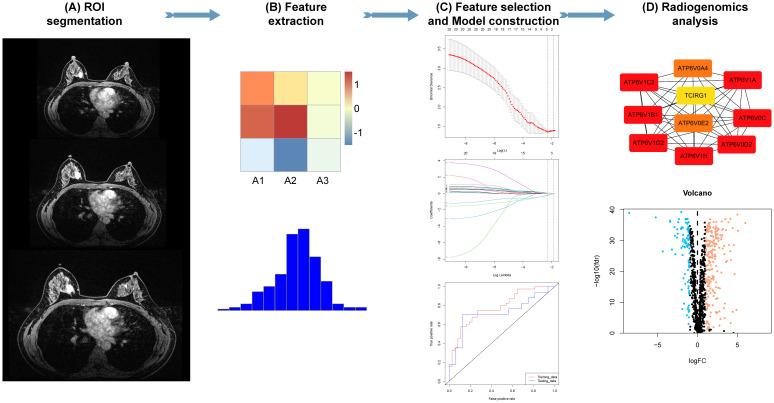
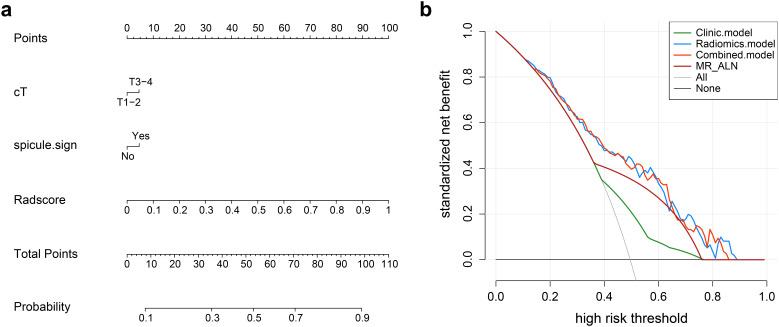
The 379 patients with breast cancer (186 ALNM-positive and 193 ALNM-negative) recruited from three hospitals were divided into the training (n=224), testing (n=96), and validation (n=59) cohorts. The Cancer Imaging Archive-The Cancer Genome Atlas (TCIA-TCGA) group included 107 patients with breast cancer. A total of 1888 intratumoral and peritumoral radiomics features were extracted from DCE-MRI sequences. Radiomics models were established using a multivariate regression algorithm for each region and their combinations. Clinical and combined nomogram models integrating the Radscore with clinical risk factors were constructed. The biological significance of the radiomic features was analyzed by combining the TCIA database.
RESULTS
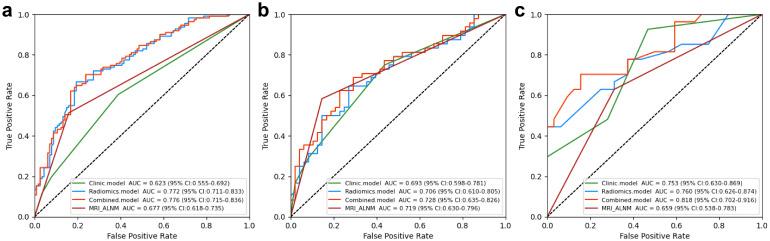
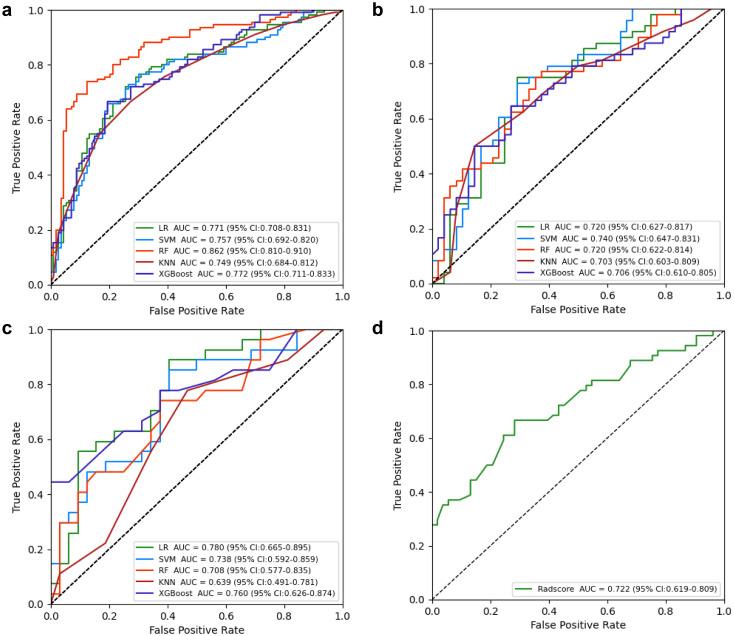
The area under the ROC curve (AUC) of radiomics model in the external validation was 0.760 (95% confidence interval [CI]: 0.626-0.874). The performance of the nomogram combined model (AUC: 0.818; 95% CI:0.702-0.916) surpassed those of both the radiomics and clinical models (AUC: 0.753; 95% CI: 0.630-0.869). Additionally, the DCA results demonstrated the usefulness of the radiomics and nomogram model.
CONCLUSION
MRI-based radiomics has the potential to predict the ALNM status in patients with invasive breast cancer. Additionally, radiogenomic analysis demonstrated a correlation between radiomic features and the immune microenvironment.
目的
探讨放射组学在预测腋窝淋巴结转移(ALNM)中的有效性以及放射组学特征与基因之间的关系。
方法
从三家医院招募的379例乳腺癌患者(186例ALNM阳性和193例ALNM阴性)被分为训练组(n = 224)、测试组(n = 96)和验证组(n = 59)。癌症影像存档-癌症基因组图谱(TCIA-TCGA)组包括107例乳腺癌患者。从DCE-MRI序列中提取了总共1888个瘤内和瘤周放射组学特征。使用多变量回归算法为每个区域及其组合建立放射组学模型。构建了将Radscore与临床危险因素相结合的临床和联合列线图模型。通过结合TCIA数据库分析放射组学特征的生物学意义。
结果
放射组学模型在外部验证中的ROC曲线下面积(AUC)为0.760(95%置信区间[CI]:0.626 - 0.874)。列线图联合模型的性能(AUC:0.818;95%CI:0.702 - 0.916)超过了放射组学模型和临床模型(AUC:0.753;95%CI:0.630 - 0.869)。此外,DCA结果证明了放射组学和列线图模型的实用性。
结论
基于MRI的放射组学有潜力预测浸润性乳腺癌患者的ALNM状态。此外,放射基因组分析表明放射组学特征与免疫微环境之间存在相关性。


 Zotero 插件