
针对认知障碍老年人的认知训练移动应用程序:应用商店搜索与质量评估
Cognitive Training Mobile Apps for Older Adults With Cognitive Impairment: App Store Search and Quality Evaluation.
作者信息
Wu Leyi, Pan Jiajuan, Dou Chuwen, Gu An, Huang An, Tao Hong, Wang Xiaoyan, Zhang Chen, Wang Lina
机构信息
School of Medicine, Huzhou Key Laboratory of Precise Prevention and Control of Major Chronic Diseases, Huzhou University, Erhuan East Road 759, Longquan Street, Wuxing District, Huzhou, 313000, China, 86 13587278357.
Center for Whole-Person Research, AdventHealth Whole-Person Research, Orlando, FL, United States.
出版信息
JMIR Mhealth Uhealth. 2025 Jul 4;13:e69637. doi: 10.2196/69637.
BACKGROUND
As the population ages, cognitive impairment is becoming increasingly prevalent. Mobile apps offer a scalable platform for delivering cognitive training interventions. However, their variable quality and lack of rigorous evaluation underscore the need for further research to guide optimization and ensure their effective application in improving cognitive health outcomes.
OBJECTIVE
This study aimed to evaluate the characteristics and quality of cognitive training apps designed for older adults with cognitive impairment.
METHODS
A comprehensive search of the Google Play Store and Apple App Store was conducted using predefined terms and inclusion criteria, with the search completed on July 13, 2024. Eligible apps were assessed for quality by two independent reviewers using the Mobile App Rating Scale (MARS), with interrater reliability evaluated via quadratic weighted kappa (К). The Kruskal-Wallis test analyzed differences in MARS scores across subgroups for each dimension, and Spearman correlation was applied to examine the relationship between user star ratings and overall mean scores.
RESULTS
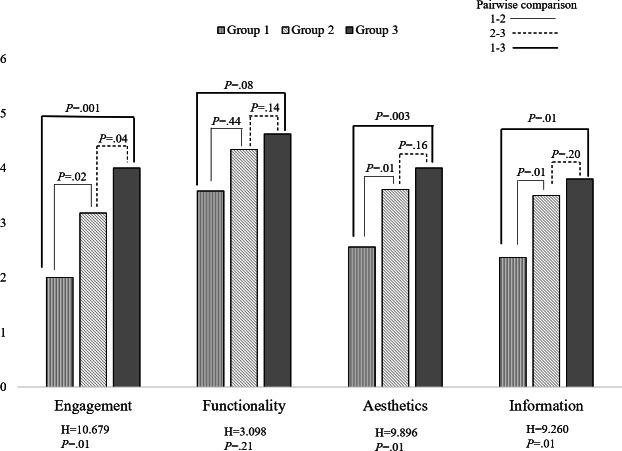
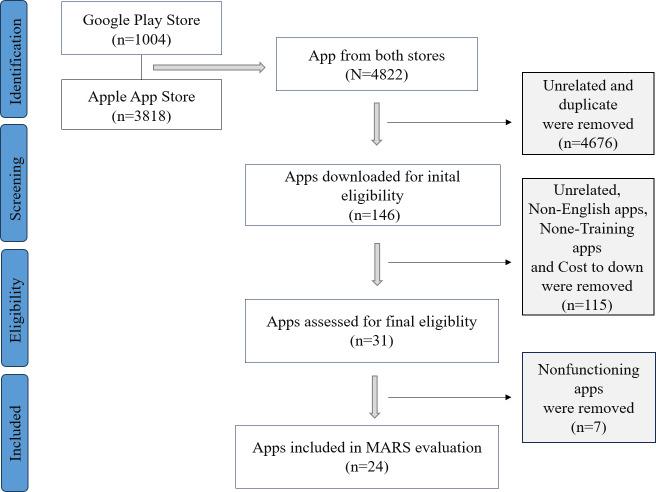
A total of 4822 potential apps were identified, of which 24 met eligibility criteria. Among these, 13 (54%) were available on both platforms, 5 (21%) were exclusive to the Google Play Store, and 6 (25%) to the Apple App Store. Notably, 5 (20.8%) apps offered user-tailored training modules and 8 (33%) involved medical professionals in development. Interrater agreement was high (k=0.88; 95% CI, 0.80-0.95). Global quality scores based on the MARS dimensions ranged from 2.38 to 4.13, with a mean (SD) of 3.57 (0.43) across 24 apps, indicating generally acceptable quality. The functionality dimension received the highest score, while engagement scored the lowest. Brain HQ and Peak had scores above 4 and were rated as good, whereas Memory Trainer, Cognitive Skill Training, and Ginkgo Memory & Brain Training scored below 3 and were rated as insufficient. Spearman correlation showed no significant association between mean score and app rating.
CONCLUSIONS
Current cognitive training apps for older adults with cognitive impairment demonstrate moderate quality with considerable variability. Improvements are needed in the engagement and information dimensions. Future development should prioritize enhancing user engagement, incorporating personalized features, and involving health care professionals and experts to align with evidence-based guidelines.
背景
随着人口老龄化,认知障碍日益普遍。移动应用程序为提供认知训练干预措施提供了一个可扩展的平台。然而,它们质量参差不齐且缺乏严格评估,这凸显了进一步研究以指导优化并确保其在改善认知健康结果方面有效应用的必要性。
目的
本研究旨在评估为有认知障碍的老年人设计的认知训练应用程序的特征和质量。
方法
使用预定义的术语和纳入标准对谷歌Play商店和苹果应用商店进行全面搜索,搜索于2024年7月13日完成。两名独立评审员使用移动应用程序评分量表(MARS)对符合条件的应用程序进行质量评估,并通过二次加权kappa(К)评估评分者间的可靠性。Kruskal-Wallis检验分析了每个维度各亚组间MARS评分的差异,并应用Spearman相关性分析来检验用户星级评分与总体平均评分之间的关系。
结果
共识别出4822个潜在应用程序,其中24个符合纳入标准。其中,13个(54%)在两个平台上均有提供,5个(21%)仅在谷歌Play商店提供,6个(25%)仅在苹果应用商店提供。值得注意的是,5个(20.8%)应用程序提供用户定制的训练模块,8个(33%)在开发过程中有医学专业人员参与。评分者间的一致性较高(k = 0.88;95% CI,0.80 - 0.95)。基于MARS维度的总体质量评分在2.38至4.13之间,24个应用程序的平均(标准差)评分为3.57(0.43),表明质量总体上可以接受。功能维度得分最高,而参与度得分最低。Brain HQ和Peak得分高于4,被评为良好,而Memory Trainer、Cognitive Skill Training和Ginkgo Memory & Brain Training得分低于3,被评为不足。Spearman相关性分析显示平均评分与应用程序评级之间无显著关联。
结论
当前为有认知障碍的老年人设计的认知训练应用程序质量中等,差异较大。在参与度和信息维度方面需要改进。未来的开发应优先提高用户参与度,纳入个性化功能,并让医疗保健专业人员和专家参与,以符合循证指南。
 Zotero 插件