
移动健康干预对抑郁症的疗效、安全性及评估标准:系统评价
Efficacy, Safety, and Evaluation Criteria of mHealth Interventions for Depression: Systematic Review.
作者信息
Duarte-Díaz Andrea, Perestelo-Pérez Lilisbeth, Gelabert Estel, Robles Noemí, Pérez-Navarro Antoni, Vidal-Alaball Josep, Solà-Morales Oriol, Sales Masnou Ariadna, Carrion Carme
机构信息
Canary Islands Health Research Institute Foundation (FIISC), El Rosario, Spain.
Network for Research on Chronicity, Primary Care and Health Promotion (RICAPPS), Madrid, Spain.
出版信息
JMIR Ment Health. 2023 Sep 27;10:e46877. doi: 10.2196/46877.
BACKGROUND
Depression is a significant public health issue that can lead to considerable disability and reduced quality of life. With the rise of technology, mobile health (mHealth) interventions, particularly smartphone apps, are emerging as a promising approach for addressing depression. However, the lack of standardized evaluation tools and evidence-based principles for these interventions remains a concern.
OBJECTIVE
In this systematic review and meta-analysis, we aimed to evaluate the efficacy and safety of mHealth interventions for depression and identify the criteria and evaluation tools used for their assessment.
METHODS
A systematic review and meta-analysis of the literature was carried out following the recommendations of the PRISMA (Preferred Reporting Items for Systematic Reviews and Meta-Analyses) statement. Studies that recruited adult patients exhibiting elevated depressive symptoms or those diagnosed with depressive disorders and aimed to assess the effectiveness or safety of mHealth interventions were eligible for consideration. The primary outcome of interest was the reduction of depressive symptoms, and only randomized controlled trials (RCTs) were included in the analysis. The risk of bias in the original RCTs was assessed using version 2 of the Cochrane risk-of-bias tool for randomized trials.
RESULTS
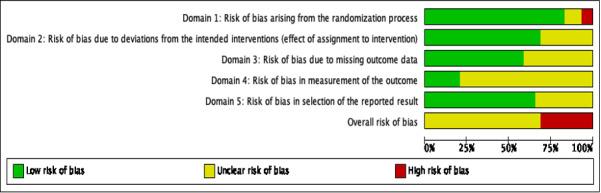
A total of 29 RCTs were included in the analysis after a comprehensive search of electronic databases and manual searches. The efficacy of mHealth interventions in reducing depressive symptoms was assessed using a random effects meta-analysis. In total, 20 RCTs had an unclear risk of bias and 9 were assessed as having a high risk of bias. The most common element in mHealth interventions was psychoeducation, followed by goal setting and gamification strategies. The meta-analysis revealed a significant effect for mHealth interventions in reducing depressive symptoms compared with nonactive control (Hedges g=-0.62, 95% CI -0.87 to -0.37, I=87%). Hybrid interventions that combined mHealth with face-to-face sessions were found to be the most effective. Three studies compared mHealth interventions with active controls and reported overall positive results. Safety analyses showed that most studies did not report any study-related adverse events.
CONCLUSIONS
This review suggests that mHealth interventions can be effective in reducing depressive symptoms, with hybrid interventions achieving the best results. However, the high level of heterogeneity in the characteristics and components of mHealth interventions indicates the need for personalized approaches that consider individual differences, preferences, and needs. It is also important to prioritize evidence-based principles and standardized evaluation tools for mHealth interventions to ensure their efficacy and safety in the treatment of depression. Overall, the findings of this study support the use of mHealth interventions as a viable method for delivering mental health care.
TRIAL REGISTRATION
PROSPERO CRD42022304684; https://www.crd.york.ac.uk/prospero/display_record.php?RecordID=304684.
背景
抑郁症是一个重大的公共卫生问题,可导致严重残疾和生活质量下降。随着技术的发展,移动健康(mHealth)干预措施,尤其是智能手机应用程序,正成为应对抑郁症的一种有前景的方法。然而,这些干预措施缺乏标准化的评估工具和循证原则仍然令人担忧。
目的
在这项系统评价和荟萃分析中,我们旨在评估mHealth干预措施治疗抑郁症的疗效和安全性,并确定用于评估的标准和评估工具。
方法
按照PRISMA(系统评价和荟萃分析的首选报告项目)声明的建议,对文献进行了系统评价和荟萃分析。招募表现出抑郁症状加重的成年患者或被诊断为抑郁症的患者并旨在评估mHealth干预措施有效性或安全性的研究符合纳入考虑标准。感兴趣的主要结局是抑郁症状的减轻,分析仅纳入随机对照试验(RCT)。使用Cochrane随机试验偏倚风险工具第2版评估原始RCT中的偏倚风险。
结果
在全面检索电子数据库和手工检索后,分析共纳入29项RCT。使用随机效应荟萃分析评估mHealth干预措施减轻抑郁症状的疗效。总共有20项RCT的偏倚风险不明确,9项被评估为具有高偏倚风险。mHealth干预措施中最常见的要素是心理教育,其次是目标设定和游戏化策略。荟萃分析显示,与非活性对照相比,mHealth干预措施在减轻抑郁症状方面有显著效果(Hedges g=-0.62,95%CI -0.87至-0.37,I²=87%)。发现将mHealth与面对面治疗相结合的混合干预措施最有效。三项研究将mHealth干预措施与活性对照进行了比较,并报告了总体阳性结果。安全性分析表明,大多数研究未报告任何与研究相关的不良事件。
结论
本评价表明,mHealth干预措施可有效减轻抑郁症状,混合干预措施效果最佳。然而,mHealth干预措施的特征和组成部分存在高度异质性,这表明需要采用个性化方法,考虑个体差异、偏好和需求。同样重要的是,要优先考虑mHealth干预措施的循证原则和标准化评估工具,以确保其在抑郁症治疗中的疗效和安全性。总体而言,本研究结果支持将mHealth干预措施作为提供心理健康护理的一种可行方法。
试验注册
PROSPERO CRD42022304684;https://www.crd.york.ac.uk/prospero/display_record.php?RecordID=304684



 Zotero 插件