
基于生物发光的活细胞内源性蛋白质相互作用定量分析方法。
Bioluminescence-based assays for quantifying endogenous protein interactions in live cells.
作者信息
Niles Andrew L, Dibble Michael R C, Machleidt Thomas, Martino Kelli, Swiatnicki Matthew R, Vu Elizabeth H, Schwinn Marie K
机构信息
Research and Development, Promega Corporation, Madison Wisconsin, USA.
Research and Development, Promega Corporation, Madison Wisconsin, USA.
出版信息
J Biol Chem. 2025 Jul 4;301(8):110454. doi: 10.1016/j.jbc.2025.110454.
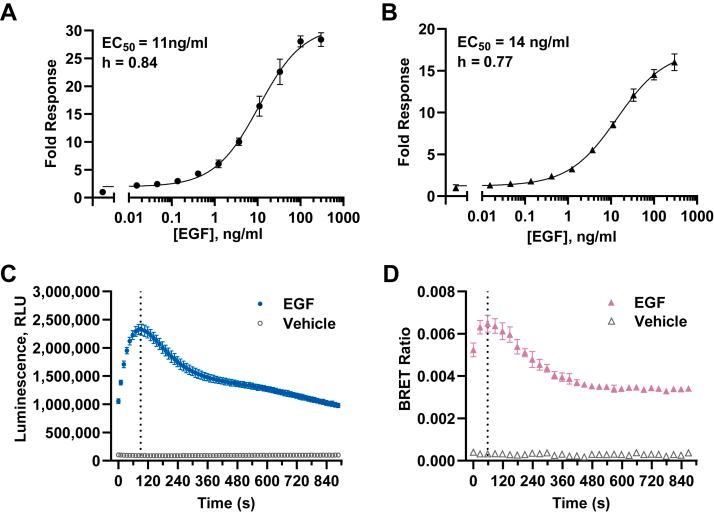
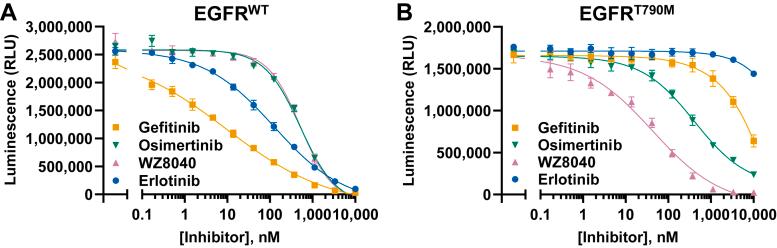
Protein-protein interactions (PPIs) are integral to cellular signaling networks and are frequently disrupted in cancer, neurodegeneration, inflammation, and metabolic disorders. Targeting dysregulated PPIs presents a promising strategy for the development of therapeutic compounds. However, traditional drug discovery platforms often rely on plasmid-driven overexpression models that fail to replicate the complexity and dynamics of PPI in native cellular contexts. This study aims to evaluate the use of NanoLuc Binary Technology (NanoBiT) and NanoLuc Bioluminescence Resonance Energy Transfer (NanoBRET) for quantifying interactions of endogenously regulated proteins in live cells. To achieve this, CRISPR-mediated genome engineering was used to integrate NanoBiT and NanoBRET fusion tags at the loci for EGFR/GRB2 and KRas/CRAF in DLD-1 and HCT 116 cell lines. Assays using the engineered cell lines were then conducted in monolayer cultures using endpoint and kinetic measurements, as well as luminescence imaging. The approach was further expanded to investigate PPI in cancer-associated isogenic cell lines and 3D spheroid models that better preserve additional aspects of cellular organization. Collectively, these findings establish a robust and modular workflow for generating endogenously regulated PPI reporter cell lines to improve the relevance and predictive power of live-cell assays. By capturing interaction dynamics in a more representative background, this approach offers a potentially valuable tool for elucidating signaling mechanisms and characterizing therapeutic compounds targeting PPIs.
蛋白质-蛋白质相互作用(PPIs)是细胞信号网络的核心组成部分,在癌症、神经退行性疾病、炎症和代谢紊乱中经常被破坏。针对失调的PPIs是开发治疗性化合物的一种有前景的策略。然而,传统的药物发现平台通常依赖于质粒驱动的过表达模型,这些模型无法在天然细胞环境中复制PPI的复杂性和动态性。本研究旨在评估使用纳米荧光素二元技术(NanoBiT)和纳米荧光素生物发光共振能量转移(NanoBRET)来定量活细胞中内源性调节蛋白的相互作用。为了实现这一目标,使用CRISPR介导的基因组工程在DLD-1和HCT 116细胞系中的EGFR/GRB2和KRas/CRAF基因座处整合NanoBiT和NanoBRET融合标签。然后,使用工程细胞系在单层培养物中进行测定,采用终点法和动力学测量以及发光成像。该方法进一步扩展到研究癌症相关的同基因细胞系和3D球体模型中的PPI,这些模型能更好地保留细胞组织的其他方面。总的来说,这些发现建立了一个强大且模块化的工作流程,用于生成内源性调节的PPI报告细胞系,以提高活细胞测定的相关性和预测能力。通过在更具代表性的背景中捕捉相互作用动态,这种方法为阐明信号传导机制和表征靶向PPIs的治疗性化合物提供了一个潜在有价值的工具。




 Zotero 插件