
用于处理生存结局估计治疗效果时残余混杂偏倚的高维疾病风险评分
High-Dimensional Disease Risk Score for Dealing With Residual Confounding Bias in Estimating Treatment Effects With a Survival Outcome.
作者信息
Hossain Md Belal, Wong Hubert, Sadatsafavi Mohsen, Cook Victoria J, Johnston James C, Karim Mohammad Ehsanul
机构信息
School of Population and Public Health, University of British Columbia, Vancouver, British Columbia, Canada.
Centre for Advancing Health Outcomes, St. Paul's Hospital, Vancouver, British Columbia, Canada.
出版信息
Pharmacoepidemiol Drug Saf. 2025 Jul;34(7):e70172. doi: 10.1002/pds.70172.
PURPOSE
Health administrative databases often contain no information on some important confounders, leading to residual confounding in the effect estimate. We aimed to explore the performance of high-dimensional disease risk score (hdDRS) to deal with residual confounding bias for estimating causal effects with survival outcomes.
METHODS
We used health administrative data of 49 197 individuals in British Columbia to examine the relationship between tuberculosis infection and time-to-development of cardiovascular disease (CVD). We designed a plasmode simulation exploring the performance of eight hdDRS methods that varied by different approaches to fit the risk score model and also examined results from high-dimensional propensity score (hdPS) and traditional regression adjustment. The log-hazard ratio (log-HR) was the target parameter with a true value of log(3).
RESULTS
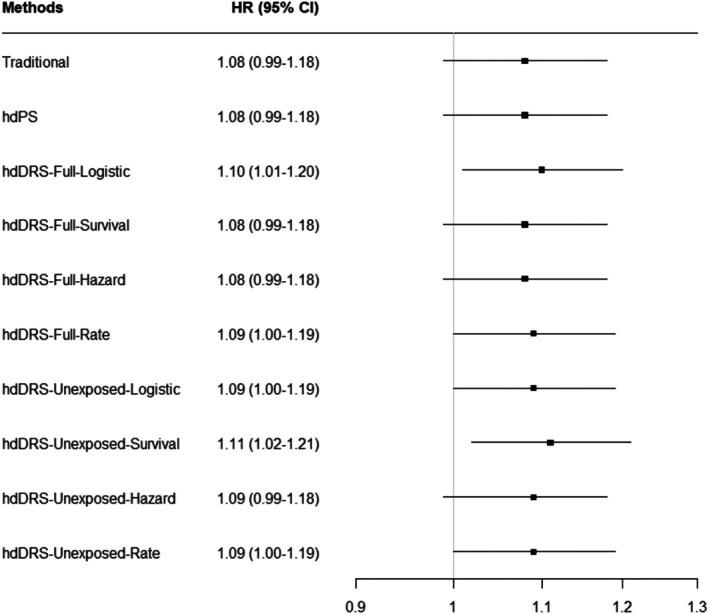
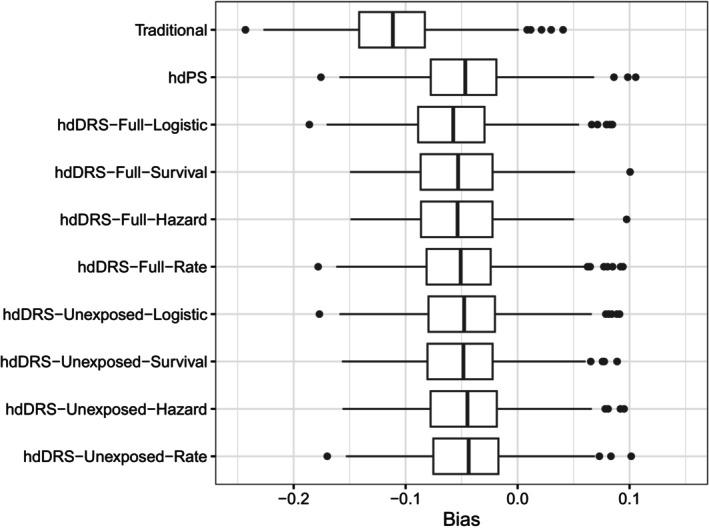
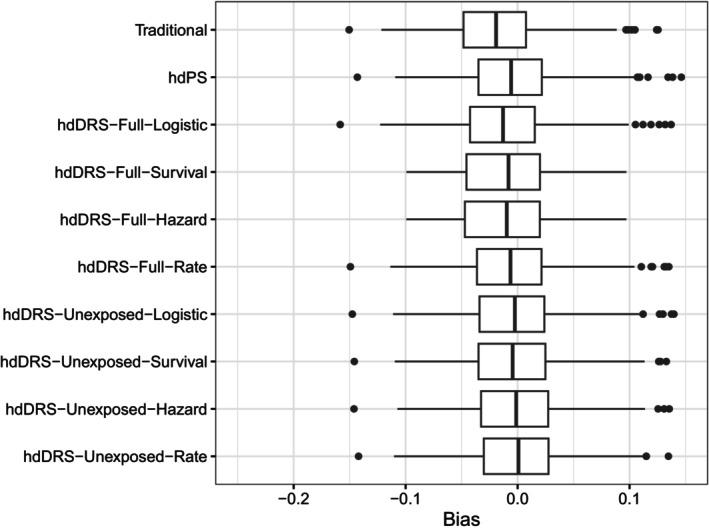
In the presence of strong unmeasured confounding, the bias observed was -0.11 for the traditional method and -0.047 for the hdPS method. The bias ranged from -0.051 to -0.058 for hdDRS methods when risk score models were fitted to the full cohort and -0.045 to -0.049 when risk score models were fitted only to unexposed individuals. All methods showed comparable standard errors and nominal bias-eliminated coverage probabilities. With weak unmeasured confounding, hdDRS and hdPS produced approximately unbiased estimates. Our data analysis, after addressing residual confounding, revealed an 8%-11% higher CVD risk associated with tuberculosis infection.
CONCLUSIONS
Our findings support the use of selected hdDRS methods to address residual confounding bias when estimating treatment effects with survival outcomes. In particular, the hdDRS method using rate-based risk score modeling on unexposed individuals consistently exhibited the least bias. However, the hdPS method showed comparable performance across most evaluated scenarios. We share reproducible R codes to facilitate researchers' adoption and further evaluation of these methods.
目的
卫生行政数据库通常不包含某些重要混杂因素的信息,从而导致效应估计中出现残余混杂。我们旨在探讨高维疾病风险评分(hdDRS)在处理残余混杂偏倚以估计生存结局因果效应方面的性能。
方法
我们使用不列颠哥伦比亚省49197名个体的卫生行政数据,研究结核病感染与心血管疾病(CVD)发病时间之间的关系。我们设计了一个模拟实验,探讨八种hdDRS方法的性能,这些方法因拟合风险评分模型的不同方法而有所差异,同时还研究了高维倾向评分(hdPS)和传统回归调整的结果。对数风险比(log-HR)是目标参数,其真实值为log(3)。
结果
在存在强烈未测量混杂因素的情况下,传统方法观察到的偏倚为-0.11,hdPS方法为-0.047。当风险评分模型拟合整个队列时,hdDRS方法的偏倚范围为-0.051至-0.058;当风险评分模型仅拟合未暴露个体时,偏倚范围为-0.045至-0.049。所有方法均显示出可比的标准误差和名义上消除偏倚的覆盖概率。在未测量混杂因素较弱的情况下,hdDRS和hdPS产生的估计值近似无偏。我们在解决残余混杂后的数据分析显示,结核病感染与CVD风险高8%-11%相关。
结论
我们的研究结果支持在估计生存结局的治疗效果时,使用选定的hdDRS方法来解决残余混杂偏倚。特别是,对未暴露个体使用基于率的风险评分建模的hdDRS方法始终表现出最小的偏倚。然而,hdPS方法在大多数评估场景中表现出可比的性能。我们分享可重复使用的R代码,以方便研究人员采用和进一步评估这些方法。
 Zotero 插件