
阻塞性睡眠呼吸暂停作为多囊卵巢综合征患者体外受精和胚胎移植结局的预测指标:一项前瞻性队列研究
Obstructive sleep apnea as a predictive indicator for in vitro fertilization and embryo transfer outcomes in patients with polycystic ovary syndrome: a prospective cohort study.
作者信息
Li Nidong, Yang Rui, Zhao Yue, Wang Yuanyuan, Tang Qiaoya, Li Jing, Huang Yali, Huang Yongwei, Zhang Liqiang, Wang Ying, Li Rong, Qiao Jie
机构信息
State Key Laboratory of Female Fertility Promotion, Center for Reproductive Medicine, Department of Obstetrics and Gynecology, Peking University Third Hospital, No. 49 North Garden Road, Haidian District, Beijing, 100191, China.
National Clinical Research Center for Obstetrics and Gynecology (Peking University Third Hospital), Beijing, 100191, China.
出版信息
Sleep Breath. 2025 Jul 8;29(4):237. doi: 10.1007/s11325-025-03399-9.
PURPOSE
This study aimed to investigate the impact of obstructive sleep apnea (OSA) on in vitro fertilization (IVF) and embryo transfer outcomes in infertile patients with polycystic ovary syndrome (PCOS).
METHODS
We conducted a prospective observational cohort study of 360 infertile PCOS patients scheduled for IVF with either fresh or frozen embryo transfer at The Reproductive Medical Center of Peking University Third Hospital between January 2019 and September 2022. All participants underwent home sleep apnea test (HSAT) prior to IVF treatment. We collected clinical characteristics and reproductive outcomes, analyzing the association between OSA and IVF results using univariate and logistic regression analyses.
RESULTS
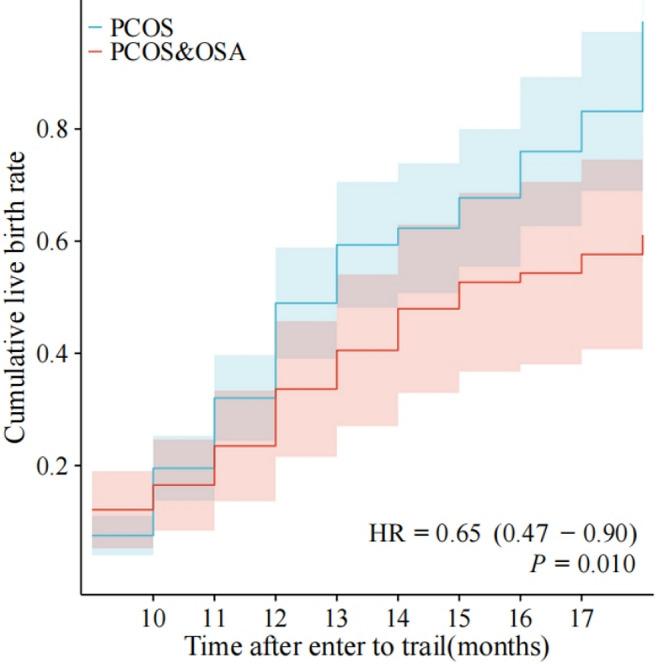
Among the 360 PCOS patients, OSA prevalence was 30.0%. Univariate analysis revealed significantly lower clinical pregnancy and live birth rates during the first embryo transfer cycle in PCOS&OSA patients compared to non-OSA PCOS patients. Logistic regression confirmed OSA as an independent risk factor for reduced live birth rates in PCOS patients undergoing IVF. PCOS&OSA patients also demonstrated lower anti-Müllerian hormone (AMH) levels and higher rates of insulin resistance, hyperlipidemia, and metabolic syndrome. These metabolic disturbances associated with OSA likely contribute to poorer IVF outcomes in PCOS patients.
CONCLUSION
Our findings demonstrate a negative association between OSA and IVF outcomes in PCOS patients, particularly regarding clinical pregnancy and live birth rates. Reproductive endocrine and metabolic disorders appear to play a critical role in these adverse outcomes.
目的
本研究旨在探讨阻塞性睡眠呼吸暂停(OSA)对多囊卵巢综合征(PCOS)不孕患者体外受精(IVF)及胚胎移植结局的影响。
方法
我们对2019年1月至2022年9月期间在北京大学第三医院生殖医学中心计划进行新鲜或冷冻胚胎移植的360例PCOS不孕患者进行了一项前瞻性观察队列研究。所有参与者在IVF治疗前均接受了家庭睡眠呼吸暂停测试(HSAT)。我们收集了临床特征和生殖结局,采用单因素分析和逻辑回归分析来分析OSA与IVF结果之间的关联。
结果
在360例PCOS患者中,OSA患病率为30.0%。单因素分析显示,与非OSA的PCOS患者相比,PCOS合并OSA患者在首次胚胎移植周期中的临床妊娠率和活产率显著降低。逻辑回归证实OSA是接受IVF的PCOS患者活产率降低的独立危险因素。PCOS合并OSA患者还表现出较低的抗苗勒管激素(AMH)水平以及较高的胰岛素抵抗、高脂血症和代谢综合征发生率。这些与OSA相关的代谢紊乱可能导致PCOS患者的IVF结局较差。
结论
我们的研究结果表明,PCOS患者中OSA与IVF结局之间存在负相关,尤其是在临床妊娠和活产率方面。生殖内分泌和代谢紊乱似乎在这些不良结局中起关键作用。



 Zotero 插件