
评估脸书招募的在线调查中的自我选择偏差:来自新冠疫情健康行为调查的证据。
Assessing self-selection biases in Facebook-recruited online surveys: Evidence from the COVID-19 Health Behavior Survey.
作者信息
Donzowa Jessica, Perrotta Daniela, Zagheni Emilio
机构信息
Department of Digital and Computational Demography, Max Planck Institute for Demographic Research, Rostock, Mecklenburg Western Pomerania, Germany.
Faculty of Sociology, Bielefeld University, Bielefeld, Northrhine-Westphalia, Germany.
出版信息
PLoS One. 2025 Jul 8;20(7):e0326884. doi: 10.1371/journal.pone.0326884. eCollection 2025.
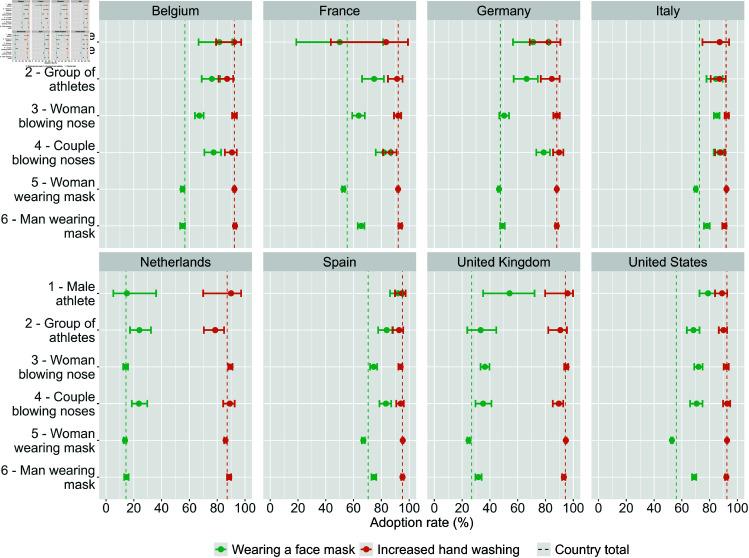
During the COVID-19 pandemic, many primary data collection efforts relied on online surveys via social media recruitment. According to the leverage-salience theory, respondents' varying interest in the survey topic can lead to differential survey responses, potentially introducing biases. In this study, we investigate the potential impact of displaying the survey topic in the survey recruitment materials on survey responses. We use data from the "COVID-19 Health Behavior Survey", a cross-national online survey that we ran between March and August 2020 in eight countries in Europe and North America (N=120,184). Respondents were recruited via targeted advertisements placed on Facebook with varying degrees of reference to the survey topic of COVID-19. The aim of our study is to assess whether stronger (or weaker) topic salience in the ad images is associated with higher (or lower) threat perceptions of COVID-19 and the adoption of preventive behaviors, including face mask use and increased hand-washing. Regression analyses show that in 20 of the 32 models, ad images had no significant effect on the survey outcomes. Factors like the month of survey participation or respondents' age were more influential. In the remaining models, where unexplained image effects persisted, the impact was minimal. While mask-wearing images were generally associated with lower threat perceptions of COVID-19 to oneself and the family, we found no consistent pattern for the adoption of protective behaviors. Overall, our findings do not provide consistent evidence that higher topic salience in our Facebook-based recruitment materials systematically influenced survey responses. However, in specific countries, certain recruitment images were linked to variations in COVID-19 threat perception and uptake of preventive behaviors. These context-specific effects highlight the importance of careful recruitment design for Facebook-based surveys during health crises.
在新冠疫情期间,许多原始数据收集工作依赖于通过社交媒体招募进行的在线调查。根据杠杆显著性理论,受访者对调查主题的不同兴趣可能导致不同的调查回复,从而可能引入偏差。在本研究中,我们调查了在调查招募材料中展示调查主题对调查回复的潜在影响。我们使用了“新冠健康行为调查”的数据,这是一项于2020年3月至8月在欧洲和北美的八个国家进行的跨国在线调查(N = 120,184)。受访者是通过在脸书上投放的有不同程度提及新冠调查主题的定向广告招募而来的。我们研究的目的是评估广告图片中更强(或更弱)的主题显著性是否与对新冠的更高(或更低)威胁认知以及预防行为的采用相关,包括戴口罩和增加洗手频率。回归分析表明,在32个模型中的20个模型中,广告图片对调查结果没有显著影响。调查参与月份或受访者年龄等因素的影响更大。在其余存在无法解释的图片效应的模型中,影响很小。虽然戴口罩的图片通常与对自己和家人的新冠威胁认知较低相关,但我们没有发现采用保护行为的一致模式。总体而言,我们的研究结果没有提供一致的证据表明我们基于脸书的招募材料中更高的主题显著性会系统性地影响调查回复。然而,在特定国家,某些招募图片与新冠威胁认知和预防行为的采用变化有关。这些特定背景下的效应凸显了在健康危机期间基于脸书的调查进行精心招募设计的重要性。



 Zotero 插件