
西部马脑炎病毒与原钙黏蛋白10受体结合的结构基础。
Structural basis for engagement of Western Equine Encephalitis Virus with the PCDH10 receptor.
作者信息
Liang Shengjian, Yang Yan, Liu Yixiao, Xu Zhili, Hou Jichao, Li Donghan, Zhao Lixin, Hu Chuyu, Liu Xiaoke, Rao Zihe, Wang Yanyi, Lou Zhiyong
机构信息
School of Basic Medical Sciences, Tsinghua University, Beijing, China.
Key Laboratory of Virology and Biosafety, Wuhan Institute of Virology, Chinese Academy of Sciences, Wuhan, Hubei, China.
出版信息
Nat Commun. 2025 Jul 8;16(1):6290. doi: 10.1038/s41467-025-61659-4.
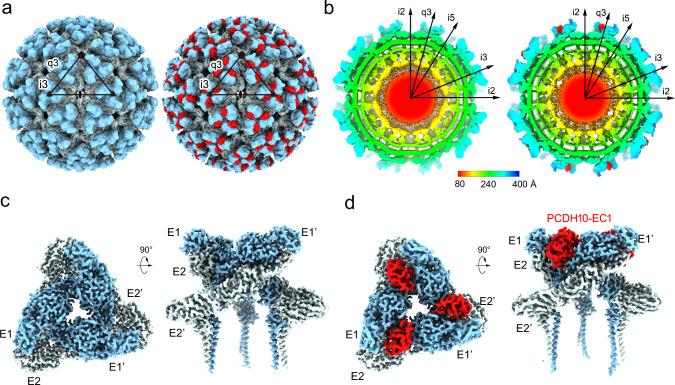
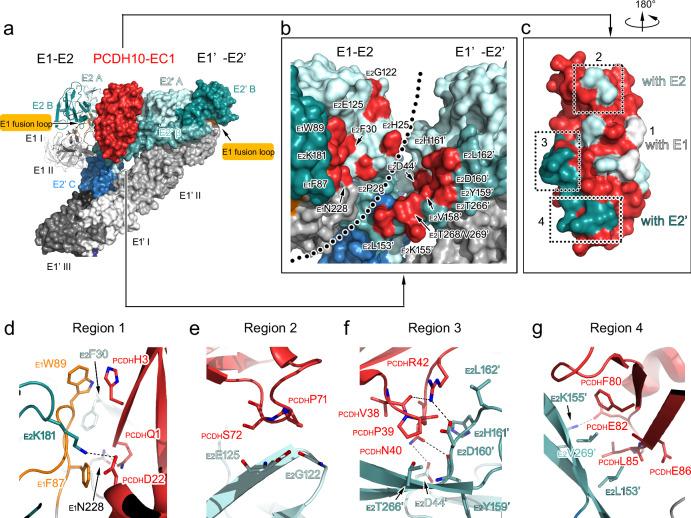
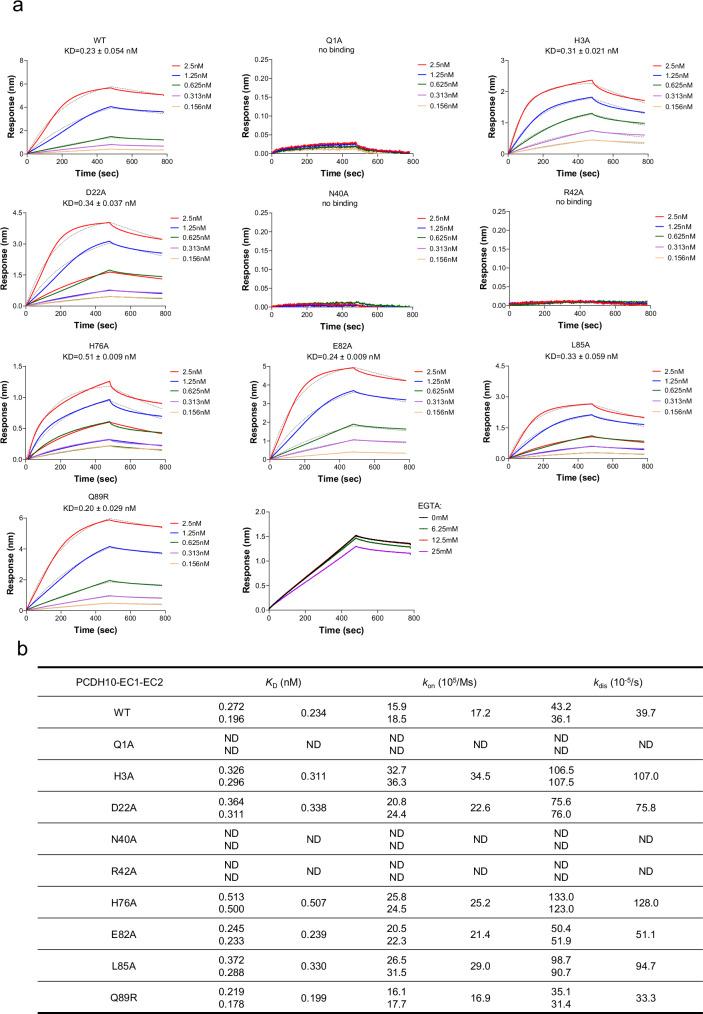
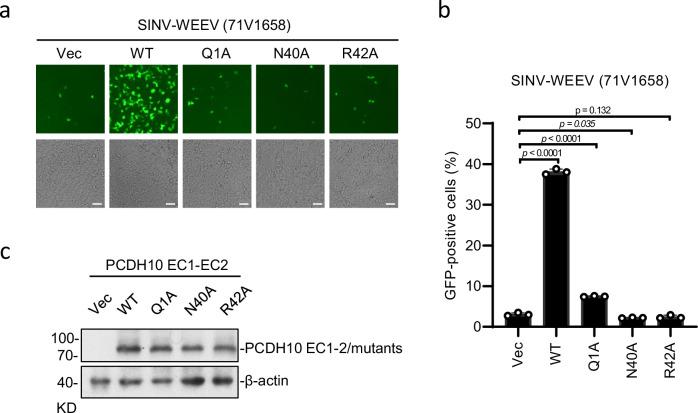
PCDH10 is a newly identified general receptor for Western equine encephalitis virus (WEEV) members, a group of encephalitic alphaviruses that cause severe diseases in humans and equids. While WEEV typically binds PCDH10 as a receptor, nonpathogenic strains have evolved to lose mammalian PCDH10 binding, retaining only avian PCDH10 affinity. Virulent strains also engage VLDLR and ApoER2 as alternative receptors. Here, we determine the structure of WEEV strain 71V1658 virus-like particles (VLPs) in complex with human PCDH10 extracellular cadherin repeats 1-2 (EC1-EC2) by cryo-electron microscopy at 2.99 Å resolution. EC1 inserts into a cleft clamped by two adjacent E2-E1 heterodimers within a single trimeric spike, whereas EC2 maintains no contact with the WEEV VLP. Mutagenesis studies elucidate the impacts of the interacting residues on PCDH10. And residue 153 of E2 is crucial for PCDH10 binding, and the Q153L mutation observes in the nonpathogenic strain Imperial-181 restores its ability to bind to PCDH10. Moreover, the arginine residue at position 89 on avian PCDH10 is essential for its interaction with strain Imperial-181. These results advance our understanding of receptor recognition by alphaviruses and the shift in receptor usage, providing insights for the development of antiviral therapies.
PCDH10是一种新发现的西方马脑炎病毒(WEEV)成员的通用受体,WEEV是一组能在人类和马科动物中引发严重疾病的脑炎α病毒。虽然WEEV通常将PCDH10作为受体结合,但非致病株已进化到失去与哺乳动物PCDH10的结合能力,仅保留对禽类PCDH10的亲和力。强毒株还会利用极低密度脂蛋白受体(VLDLR)和载脂蛋白E受体2(ApoER2)作为替代受体。在此,我们通过冷冻电子显微镜以2.99埃的分辨率确定了WEEV毒株71V1658病毒样颗粒(VLP)与人PCDH10细胞外钙黏蛋白重复序列1 - 2(EC1 - EC2)形成的复合物的结构。EC1插入到单个三聚体刺突内由两个相邻E2 - E1异二聚体夹住的裂隙中,而EC2与WEEV VLP无接触。诱变研究阐明了相互作用残基对PCDH10的影响。E2的153位残基对PCDH10结合至关重要,在非致病株Imperial - 181中观察到的Q153L突变恢复了其与PCDH10结合的能力。此外,禽类PCDH10上89位的精氨酸残基对其与Imperial - 181株的相互作用至关重要。这些结果推进了我们对α病毒受体识别以及受体使用转变的理解,为抗病毒疗法的开发提供了见解。

 Zotero 插件