
童年期虐待与抑郁青少年的公开攻击行为之间的关联:述情障碍和失眠的中介作用。
Associations between childhood maltreatment and overt aggression in depressed adolescents: the mediating effect of alexithymia and insomnia.
作者信息
Wang Jiawei, Liu Lewei, Zhou Sanhua, Zhao Lili, Wu Qianqian, Sun Tiantian, Zhang Nali, Wei Xuemei, Xia Lei, Zhao Feng
机构信息
Department of Psychiatry, Bozhou People's Hospital, Bozhou, Anhui, China.
Department of Psychiatry, The Fourth Affiliated Hospital of Anhui Medical University, Hefei, Anhui, China.
出版信息
Front Psychiatry. 2025 Jun 24;16:1619353. doi: 10.3389/fpsyt.2025.1619353. eCollection 2025.
BACKGROUND
Overt aggression may be associated with childhood maltreatment (CM), insomnia, and alexithymia, but the underlying mechanisms of these associations have not been fully explored in adolescents with major depressive disorder (MDD). Therefore, the present study aimed to deeply analyze the relationships between overt aggression and CM, insomnia, and alexithymia in adolescents with MDD, to reveal the mediating mechanisms, and to provide a theoretical basis for clinical interventions.
METHODS
From December 2024 to December 2025, this study included 251 adolescents with MDD. The Modified Overt Aggression Scale (MOAS), the 17-item Hamilton Depression Rating Scale (HAMD-17), the Childhood Trauma Questionnaire (CTQ), the Insomnia Severity Index Scale (ISI), and the Toronto Alexithymia Scale (TAS-20) were used to assess the adolescents' overt aggression, depression, CM, insomnia, and alexithymia. Additionally, we employed the PROCESS macro program to examine the mediating role of insomnia and alexithymia between CM and overt aggression.
RESULTS
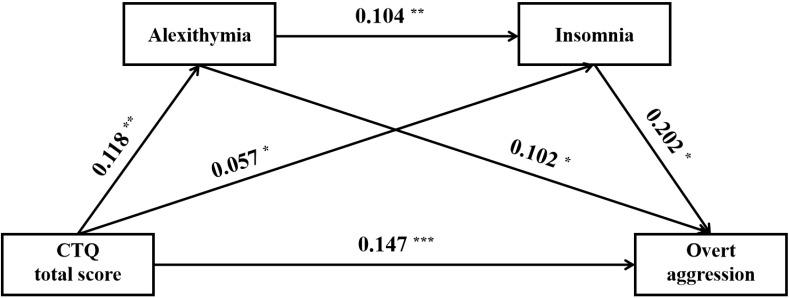
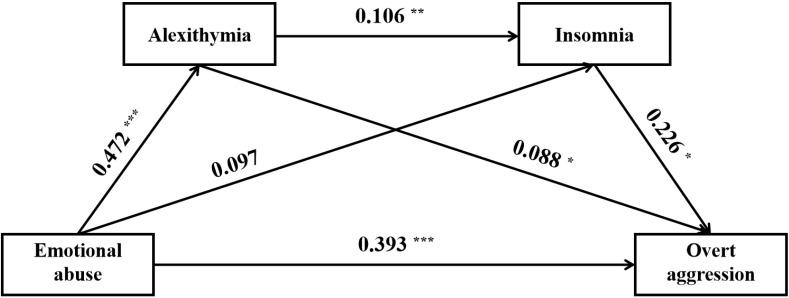
The prevalence of overt aggression in adolescents with MDD was 66.1%. The regression analyses showed that age (Beta = -0.761, t = -2.967, = 0.003), depression (Beta = 0.183, t = 2.676, = 0.008), CM (Beta = 0.132, t = 4.048, < 0.001), and alexithymia (Beta = 0.092, t = 1.990, = 0.048) were independent correlates of overt aggression. When CTQ subscale scores involved in the regression model, age (Beta = -0.829, t = -3.257, = 0.001), depression (Beta = 0.184, t = 2.618, = 0.009), emotional abuse (Beta = 0.372, t = 4.081, < 0.001), and insomnia (Beta = 0.170, t = 2.054, = 0.041) were independent correlates. Moreover, alexithymia and insomnia played a chain mediating role between CM and overt aggression.
CONCLUSION
The risk of overt aggression is significantly higher in depressed adolescents and is significantly associated with CM, insomnia, and alexithymia. Additionally, insomnia and alexithymia may play a mediating role between CM and overt aggression. Given these findings, comprehensive interventions for depressed adolescents with adverse childhood experiences, insomnia, and alexithymia, should be emphasized in clinical practice to effectively reduce their risk of overt aggression.
背景
公开攻击行为可能与童年期虐待(CM)、失眠和述情障碍有关,但在患有重度抑郁症(MDD)的青少年中,这些关联的潜在机制尚未得到充分探讨。因此,本研究旨在深入分析患有MDD的青少年中公开攻击行为与CM、失眠和述情障碍之间的关系,揭示其中的中介机制,并为临床干预提供理论依据。
方法
从2024年12月至2025年12月,本研究纳入了251名患有MDD的青少年。使用改良的公开攻击行为量表(MOAS)、17项汉密尔顿抑郁量表(HAMD - 17)、儿童创伤问卷(CTQ)、失眠严重程度指数量表(ISI)和多伦多述情障碍量表(TAS - 20)来评估青少年的公开攻击行为、抑郁、CM、失眠和述情障碍。此外,我们采用PROCESS宏程序来检验失眠和述情障碍在CM与公开攻击行为之间的中介作用。
结果
患有MDD的青少年中公开攻击行为的患病率为66.1%。回归分析表明,年龄(β = -0.761,t = -2.967,P = 0.003)、抑郁(β = 0.183,t = 2.676,P = 0.008)、CM(β = 0.132,t = 4.048,P < 0.001)和述情障碍(β = 0.092,t = 1.990,P = 0.048)是公开攻击行为的独立相关因素。当将CTQ子量表分数纳入回归模型时,年龄(β = -0.829,t = -3.257,P = 0.001)、抑郁(β = 0.184,t = 2.618,P = 0.009)、情感虐待(β = 0.372,t = 4.081,P < 0.001)和失眠(β = 0.170,t = 2.054,P = 0.041)是独立相关因素。此外,述情障碍和失眠在CM与公开攻击行为之间起连锁中介作用。
结论
抑郁青少年公开攻击行为的风险显著更高,且与CM、失眠和述情障碍显著相关。此外,失眠和述情障碍可能在CM与公开攻击行为之间起中介作用。鉴于这些发现,在临床实践中应强调对有不良童年经历、失眠和述情障碍的抑郁青少年进行综合干预,以有效降低他们公开攻击行为的风险。

 Zotero 插件