
在适用于工业应用的发酵罐培养物中利用自诱导方法生产重组D-阿洛酮糖3-表异构酶。
Production of recombinant D-allulose 3-epimerase utilizing an auto-induction approach in fermentor cultures suitable for industrial application.
作者信息
Lischer Kenny, Laksmi Fina Amreta, Nugraha Yudhi, Az-Zahra Fauziah, Herawan David, Juanssilfero Ario Betha, Wibowo Des Saputro, Ramadhan Kharisma Panji, Nuryana Isa, Ali Mohd Shukuri Mohamad
机构信息
Department of Chemical Engineering, University of Indonesia, Jakarta, Indonesia.
Research Center for Applied Microbiology, National Research and Innovation Agency, Bogor, West Java, Indonesia.
出版信息
PLoS One. 2025 Jul 9;20(7):e0327420. doi: 10.1371/journal.pone.0327420. eCollection 2025.
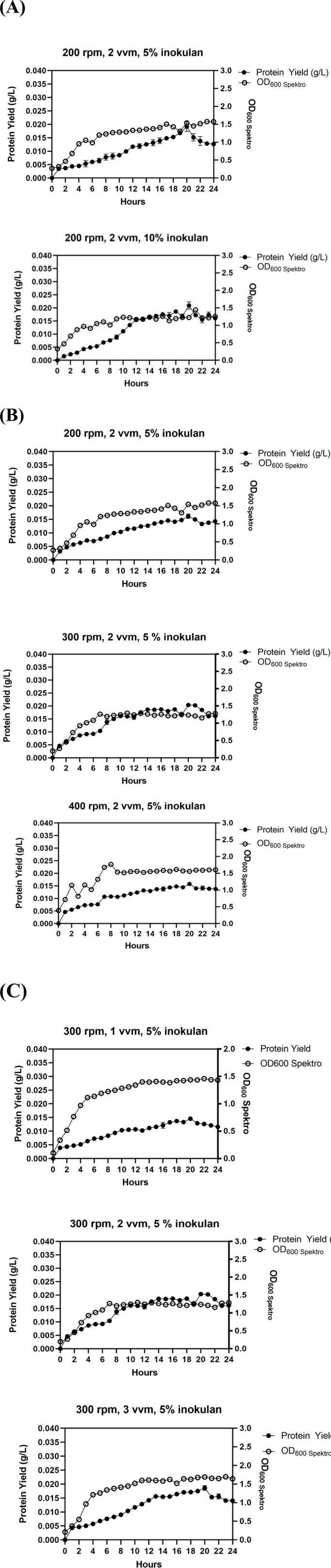
D-Allulose 3-epimerase (DAEase) is the key enzyme catalyzing D-fructose to catalyze into D-allulose, a rare sugar in foods, which has lately drawn increasing worldwide attention owing to its possible health advantages and application as a substitute sucrose. This work focused on the development of an economical, scalable production method of DAEase by using the Escherichia coli BL21 star™ (DE3) as host expression. The research work aims to optimize the production of the enzyme through an auto-induction strategy in chemically defined media by using lactose as a natural inducer, thereby overcoming various limitations of conventional IPTG induction methods. The optimal concentration of lactose, glucose, and glycerol for maximum expression of DAEase was determined to be 1.5%, 0.125%, and 1.5%, respectively. Fermentor-scale optimization yielded a maximum amount of this enzyme with 5% inoculant, 300 rpm agitation, and 2 vvm aeration. Purification by affinity and anion exchange chromatography resulted in a sevenfold increase in specific activity with an overall yield of 12% and 43 mg of pure recombinant DAEase per liter of culture. Enzyme assays confirmed that DAEase had catalytic activity in the conversion of D-fructose to D-allulose, which was further confirmed by HPLC analysis. This optimized auto-induction-based strategy demonstrated its potential for large-scale production of DAEase in a cost-effective manner with enhanced reproducibility to meet industrial demands for synthesizing D-allulose.
D-阿洛酮糖3-表异构酶(DAEase)是催化D-果糖转化为D-阿洛酮糖的关键酶,D-阿洛酮糖是一种在食品中罕见的糖,由于其潜在的健康益处以及作为蔗糖替代品的应用,近来在全球范围内受到越来越多的关注。这项工作聚焦于开发一种经济、可扩展的生产DAEase的方法,以大肠杆菌BL21 star™ (DE3)作为宿主进行表达。该研究旨在通过在化学成分确定的培养基中使用乳糖作为天然诱导剂的自诱导策略来优化该酶的生产,从而克服传统IPTG诱导方法的各种局限性。确定使DAEase表达量最大时乳糖、葡萄糖和甘油的最佳浓度分别为1.5%、0.125%和1.5%。发酵罐规模的优化得到了该酶的最大产量,接种量为5%,搅拌速度为300 rpm,通气量为2 vvm。通过亲和色谱和阴离子交换色谱进行纯化,比活性提高了7倍,总产率为12%,每升培养物可获得43 mg纯重组DAEase。酶活性测定证实DAEase具有将D-果糖转化为D-阿洛酮糖的催化活性,这通过高效液相色谱分析得到进一步证实。这种基于优化自诱导的策略展示了其以具有成本效益的方式大规模生产DAEase的潜力,具有更高的可重复性,以满足合成D-阿洛酮糖的工业需求。




 Zotero 插件