
基因预测的血清25-羟基维生素D浓度与2型糖尿病的关系:一项孟德尔随机化研究
Genetically Predicted Serum 25-Hydroxyvitamin D Concentrations in Related to Type 2 Diabetes Mellitus: A Mendelian Randomization Study.
作者信息
Yang Jin
机构信息
Department of Laboratory Medicine, Obstetrics and Gynecology Hospital of Fudan University, Shanghai Key Lab of Reproduction and Development, Shanghai Key Lab of Female Reproductive Endocrine Related Diseases, Shanghai, China.
出版信息
Endocrinol Diabetes Metab. 2025 Jul;8(4):e70050. doi: 10.1002/edm2.70050.
BACKGROUND
In several observational studies, vitamins B6, B9, B12, C and 25-hydroxyvitamin D[25(OH)D] concentrations were associated with type 2 diabetes mellitus (T2DM). Although vitamins play a role in the development of type 2 diabetes mellitus (T2DM), their associations remain unclear.
OBJECTIVE
This study employed Mendelian randomisation (MR) to explore the causal relationships between circulating concentrations of vitamins B6, B9, B12, C, 25-hydroxyvitamin D and T2DM.
METHODS
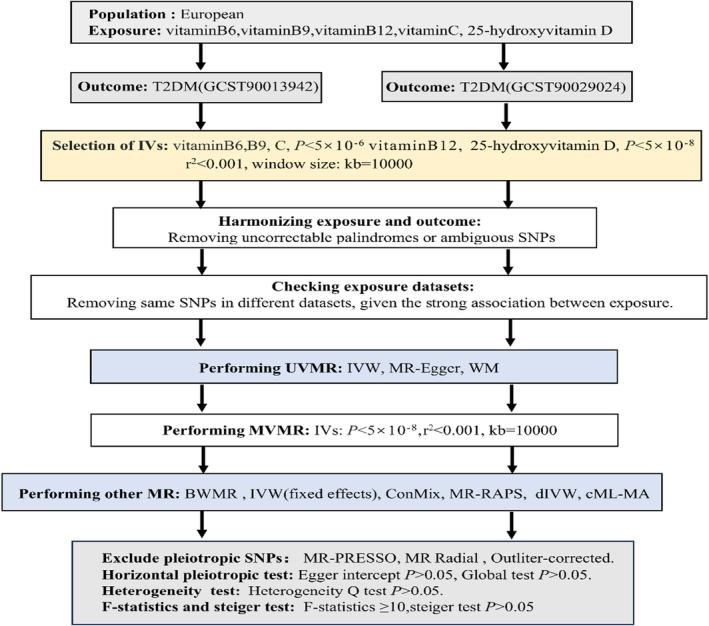
Single-nucleotide polymorphisms (SNPs) linked to vitamin B6, vitamin B9, vitamin B12, vitamin C and 25(OH)D levels were used as instrumental variables (IVs) in this study. We have two outcomes related to T2DM derived from two genome-wide association studies (GWAS). The first study, referenced by PMID: 3417140, encompasses a cohort of 406,831 individuals of European descent. The second study, identified by PMID: 29892013, includes a sample size of 468,298 Europeans.
RESULTS
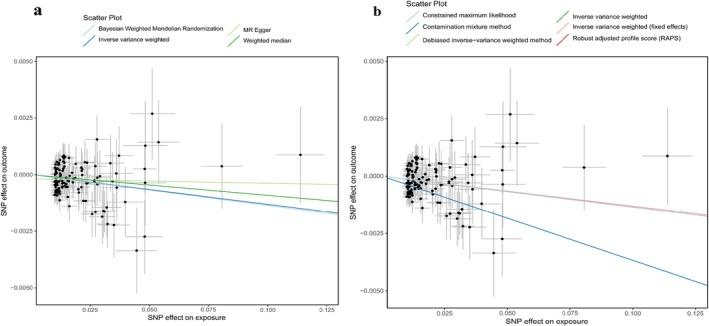
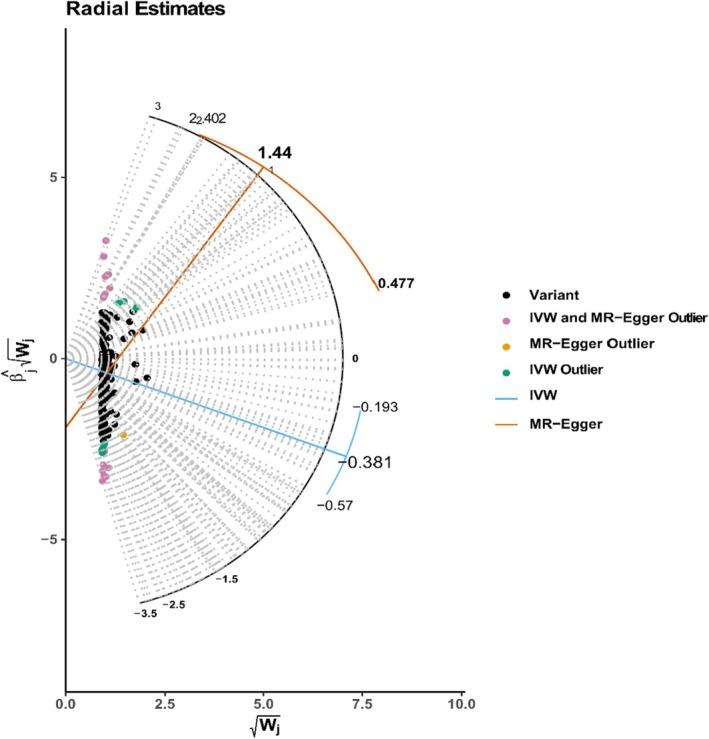
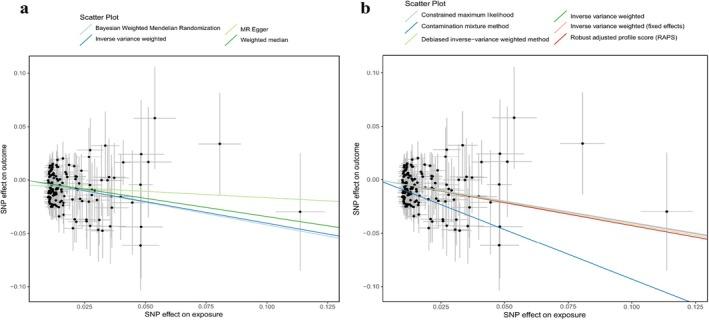
Both univariable Mendelian randomization (UVMR) and multivariable Mendelian randomization (MVMR) analyses demonstrate that genetically predicted elevated levels of serum 25(OH)D are consistently associated with a reduced risk of T2DM. In the UVMR analyses, A 1-SD increase in genetically predicted serum 25(OH)D levels, the inverse-variance weighted (IVW) p = 3.8 × 10, p = 7.6 × 10, the odds ratio(OR) of T2DM (GCST90013942) was 0.67, 95% confidence interval (CI): 0.57-0.78. Furthermore, a 1-SD increase in genetically predicted serum 25(OH)D levels was associated with an OR of 0.987 for T2DM (GCST90029024), the IVW p = 1.1 × 10, p = 1.1 × 10 with a 95% CI of 0.981-0.994. In the MVMR analyses, genetically predicted higher serum 25(OH)D levels were associated with a decreased risk of T2DM by the IVW p = 1.2 × 10, p = 5.9 × 10 in GCST90013942 and IVW p = 4.9 × 10, p = 2.5 × 10 in GCST90029024. In contrast, levels of vitamins B6, B9, B12, and C did not domenstrate a significant association with T2DM.
CONCLUSION
Our research reveals that higher circulating serum 25(OH)D levels reduce the possibility of T2DM.
背景
在多项观察性研究中,维生素B6、B9、B12、C和25-羟基维生素D[25(OH)D]的浓度与2型糖尿病(T2DM)相关。尽管维生素在2型糖尿病(T2DM)的发生发展中起作用,但其关联仍不明确。
目的
本研究采用孟德尔随机化(MR)方法探讨循环中维生素B6、B9、B12、C、25-羟基维生素D浓度与T2DM之间的因果关系。
方法
与维生素B6、维生素B9、维生素B12、维生素C和25(OH)D水平相关的单核苷酸多态性(SNP)在本研究中用作工具变量(IV)。我们有两个与T2DM相关的结果,来自两项全基因组关联研究(GWAS)。第一项研究, PMID为3417140,涵盖了406,831名欧洲血统个体的队列。第二项研究,由PMID:29892013确定,包括468,298名欧洲人的样本量。
结果
单变量孟德尔随机化(UVMR)和多变量孟德尔随机化(MVMR)分析均表明,遗传预测的血清25(OH)D水平升高与T2DM风险降低一致相关。在UVMR分析中,遗传预测的血清25(OH)D水平每增加1个标准差,T2DM(GCST90013942)的逆方差加权(IVW)p = 3.8×10,p = 7.6×10,比值比(OR)为0.67,95%置信区间(CI):0.57 - 0.78。此外,遗传预测的血清25(OH)D水平每增加1个标准差,T2DM(GCST90029024)的OR为0.987,IVW p = 1.1×10,p = 1.1×10,95%CI为0.981 - 0.994。在MVMR分析中,遗传预测的较高血清25(OH)D水平与T2DM风险降低相关,GCST90013942中IVW p = 1.2×10,p = 5.9×10,GCST90029024中IVW p = 4.9×10,p = 2.5×10。相比之下,维生素B6、B9、B_{12}和C的水平与T2DM无显著关联。
结论
我们的研究表明,循环血清中较高水平的25(OH)D可降低患T2DM的可能性。
 Zotero 插件