
维莫非尼在BRAF突变的A375黑色素瘤细胞中诱导衰老表型并增加黏附性,但在野生型BRAF的SK-MEL-2黑色素瘤细胞中则不然。
Vemurafenib Induces Senescent Phenotype with Increased Adhesion in BRAF Mutant A375 but not in Wild Type BRAF SK-MEL-2 Melanoma Cells.
作者信息
Esimbekova Aleksandra Rashidovna, Belenyuk Vasiliy Dmitrievich, Savchenko Andrey Anatolievich, Ruksha Tatiana Gennadievna
机构信息
Department of Pathophysiology, Krasnoyarsk State Medical University, Krasnoyarsk, 660022, Russia.
Laboratory of Cell Molecular Physiology and Pathology, Federal Research Center, Krasnoyarsk Science Center of the Siberian Branch of the Russian Academy of Sciences, Krasnoyarsk, 660022, Russia.
出版信息
Adv Pharm Bull. 2025 Feb 12;15(1):176-185. doi: 10.34172/apb.42808. eCollection 2025 Apr.
PURPOSE
The present study aimed to determine the selective effects of BRAF V600E inhibitor on focal adhesion in melanoma cells with respect to their phenotypic reprogramming.
METHODS
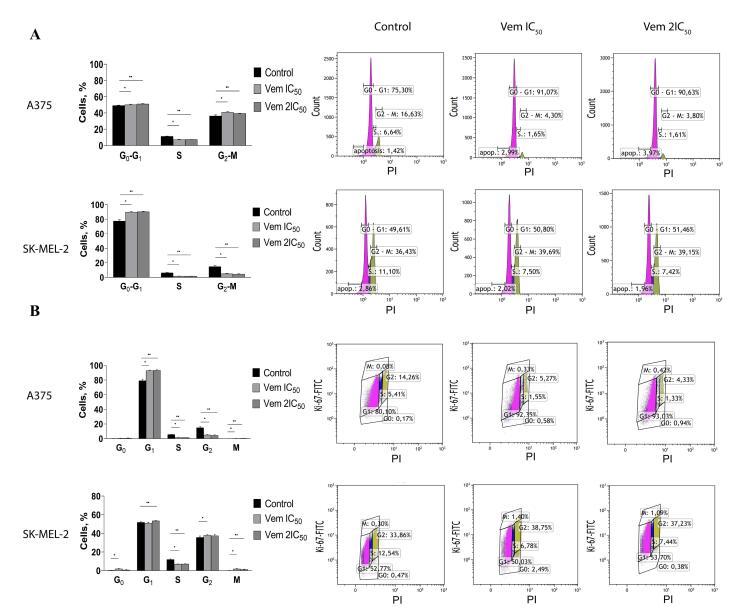
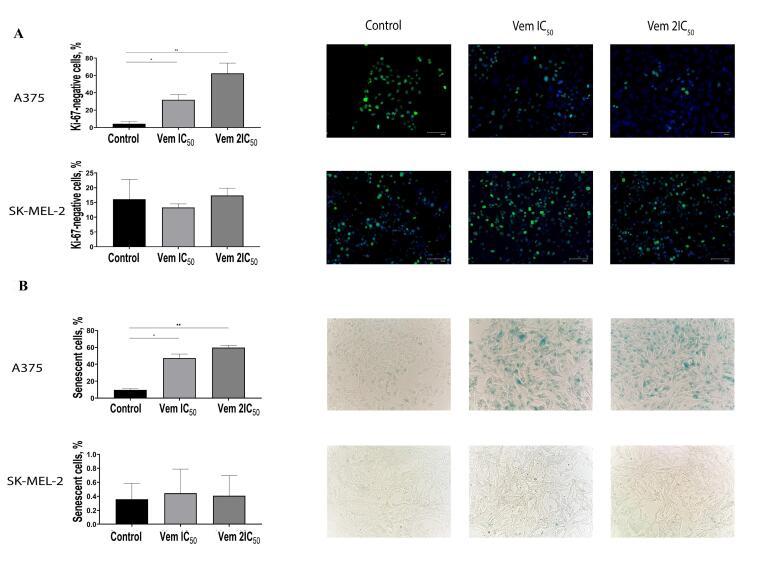
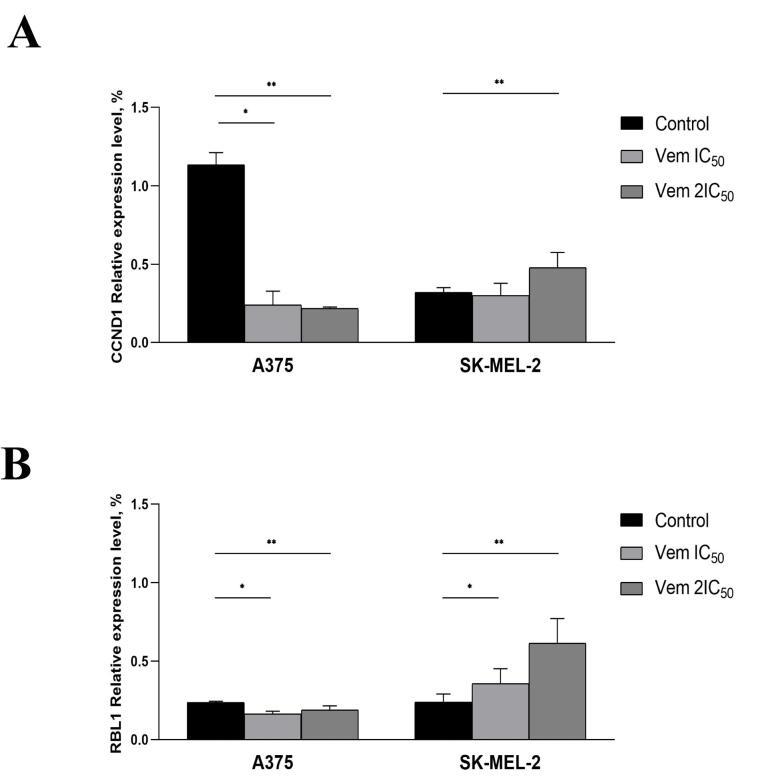
Flow cytometry was used to analyse the distribution of BRAFV600E and BRAFWT melanoma cells throughout the cell cycle post-vemurafenib treatment. Senescent cells were identified based on b-galactosidase activity and the mRNA expression of cell cycle proteins, CCND1 and RBL1. Centrifugal cell adhesion assay was used to determine the adhesive capacities of resting and proliferative BRAF mutant and BRAF wild-type melanoma cells under vemurafenib treatment. Fibronectin binding was evaluated by spectrophotometry and quantitative real-time PCR to measure the mRNA levels of integrins: ITGAV, ITGA5, ITGB1 and ITGB3.
RESULTS
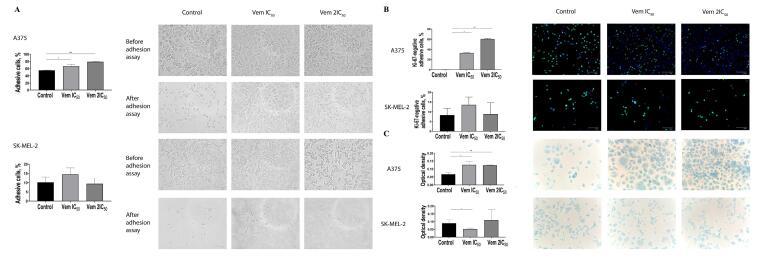
Vemurafenib increases the proportion of melanoma BRAFV600E-positive cells in the G0 phase of a cell cycle. Melanoma cells entering the G0 phase after vemurafenib treatment indicated an upregulation of senescence-associated markers. Non-proliferating melanoma cell number was elevated among vemurafenib-treated BRAFV600E cells with enhanced attachment. BRAFV600E-positive but not BRAFV600E-negative cells were characterised by upregulated ITGAV.
CONCLUSION
The current results demonstrated that vemurafenib induces the phenotypic switch in melanoma cells depending on their mutational status. It also strengthens the adhesive features of senescent cells, increasing their binding to fibronectin via ITGAV, which may be a part of the phenotypic mode of drug resistance or slow interaction of proliferating cancer cells with the extracellular matrix (ECM). Thus, targeting senescent cells by focal adhesion modulators may be a promising approach to control drug-resistant melanoma cells.
目的
本研究旨在确定BRAF V600E抑制剂对黑色素瘤细胞粘着斑的选择性作用及其表型重编程。
方法
采用流式细胞术分析维莫非尼治疗后BRAFV600E和BRAF野生型黑色素瘤细胞在整个细胞周期中的分布。根据β-半乳糖苷酶活性以及细胞周期蛋白CCND1和RBL1的mRNA表达来鉴定衰老细胞。采用离心细胞粘附试验测定维莫非尼治疗下静止和增殖的BRAF突变型及BRAF野生型黑色素瘤细胞的粘附能力。通过分光光度法和定量实时PCR评估纤连蛋白结合情况,以测量整合素ITGAV、ITGA5、ITGB1和ITGB3的mRNA水平。
结果
维莫非尼增加了黑色素瘤BRAFV600E阳性细胞在细胞周期G0期的比例。维莫非尼治疗后进入G0期的黑色素瘤细胞显示衰老相关标志物上调。在维莫非尼处理的BRAFV600E细胞中,非增殖性黑色素瘤细胞数量增加且粘附增强。BRAFV600E阳性而非BRAFV600E阴性细胞的特征是ITGAV上调。
结论
目前的结果表明,维莫非尼根据黑色素瘤细胞的突变状态诱导其表型转换。它还增强了衰老细胞的粘附特性,通过ITGAV增加其与纤连蛋白的结合,这可能是耐药表型模式的一部分或增殖癌细胞与细胞外基质(ECM)缓慢相互作用的一部分。因此,通过粘着斑调节剂靶向衰老细胞可能是控制耐药黑色素瘤细胞的一种有前景的方法。


 Zotero 插件