
利用免疫肿瘤学登记数据增强非小细胞肺癌治疗预测。
Utilizing Immuno-Oncology registry data for enhanced non-small cell lung cancer treatment predictions.
作者信息
Zhang Yili, Lev-Ari Shaked, Zaemes Jacob, Della Pia Alexandra, DeAgresta Bianca, Gupta Samir, Marki Alex, Zemel Rachel, Ip Andrew, Alaoui Adil, Charalampous Charalampos, Rahman Iris, Wilkins Olivia, Madhavan Subha, McGarvey Peter, Pascual Lauren, Atkins Michael B, Shah Neil J
机构信息
Innovation Center for Biomedical Informatics, Georgetown University, Washington, DC, 20007, United States.
Ella Lemelbaum Institute for Immuno-Oncology, Sheba Medical Center at Tel Hashomer, Ramat Gan, 526260, Israel.
出版信息
JAMIA Open. 2025 Jul 9;8(4):ooaf069. doi: 10.1093/jamiaopen/ooaf069. eCollection 2025 Aug.
OBJECTIVES
We aim to leverage more comprehensive phenotypic and genotypic clinical data to enhance the treatment response predictions.
MATERIALS AND METHODS
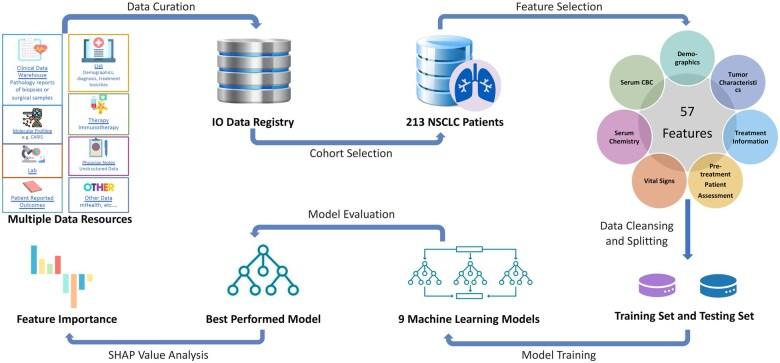
The study cohort includes 213 NSCLC patients who underwent ICI therapy. Patients were categorized based on treatment outcomes: those with complete or partial responses were considered responders, while those exhibiting stable or progressive disease were deemed non-responders. Comprehensive phenotypic and genomic features were selected for prediction. We developed 9 machine learning models. The model demonstrating the highest area under the receiver operating characteristic curve (AUROC) performance was further analyzed using Shapley additive explanation values to interpret the predictive factors.
RESULTS
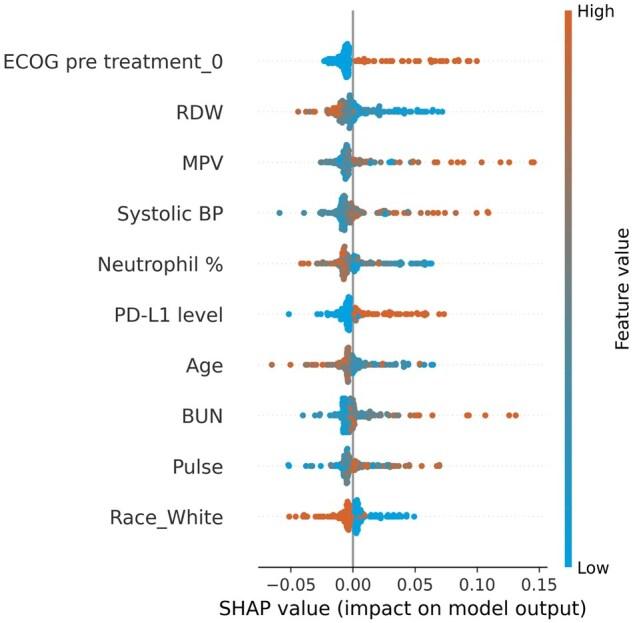
There were 72 patients who responded to the treatment, while 141 patients were considered non-responders. In total, 57 features were included, encompassing demographics, tumor status, treatment information, pre-treatment information, serum CBC, serum chemistry, and vital signs. The KNN model excelled among the models, achieving an AUROC score of 0.862 and outperforming the conventional PD-L1 biomarker's AUROC of 0.619. The top features influencing ICI treatment response include the ECOG performance status of 0, lower red cell distribution width, higher mean platelet volume, etc.
DISCUSSION
The significance of functional status, inflammatory biomarkers, and PD-L1 expression are revealed. This research underscores the potential of using a more nuanced combination of biochemical markers and clinical data to enhance the precision of immunotherapy efficacy predictions, compared with single prognostic biomarkers such as PD-L1.
CONCLUSION
Our findings emphasize the complex interplay among various risk factors that influence the effectiveness of ICI.
目的
我们旨在利用更全面的表型和基因型临床数据来增强治疗反应预测。
材料与方法
研究队列包括213例接受免疫检查点抑制剂(ICI)治疗的非小细胞肺癌(NSCLC)患者。根据治疗结果对患者进行分类:完全或部分缓解的患者被视为反应者,而疾病稳定或进展的患者被视为无反应者。选择综合表型和基因组特征进行预测。我们开发了9种机器学习模型。使用夏普利加性解释值进一步分析表现出最高受试者工作特征曲线下面积(AUROC)性能的模型,以解释预测因素。
结果
有72例患者对治疗有反应,而141例患者被视为无反应者。总共纳入了57个特征,包括人口统计学、肿瘤状态、治疗信息、治疗前信息、血清全血细胞计数、血清生化指标和生命体征。KNN模型在这些模型中表现出色,AUROC评分为0.862,优于传统PD-L1生物标志物的AUROC(0.619)。影响ICI治疗反应的主要特征包括ECOG体能状态为0、较低的红细胞分布宽度、较高的平均血小板体积等。
讨论
揭示了功能状态、炎症生物标志物和PD-L1表达的重要性。与单一预后生物标志物如PD-L1相比,本研究强调了使用更细微的生化标志物和临床数据组合来提高免疫治疗疗效预测准确性的潜力。
结论
我们的研究结果强调了影响ICI有效性的各种风险因素之间的复杂相互作用。

 Zotero 插件