
乳腺癌患者的压力负荷与全因死亡率的关联。
Association of Allostatic Load With All-Cause Mortality in Patients With Breast Cancer.
机构信息
Division of Surgical Oncology, Department of Surgery, The Ohio State University, Columbus.
Department of Biomedical Informatics, College of Medicine, The Ohio State University, Columbus.
出版信息
JAMA Netw Open. 2023 May 1;6(5):e2313989. doi: 10.1001/jamanetworkopen.2023.13989.
IMPORTANCE
Elevated allostatic load (AL) has been associated with adverse socioenvironmental stressors and tumor characteristics that convey poor prognosis in patients with breast cancer. Currently, the association between AL and all-cause mortality in patients with breast cancer is unknown.
OBJECTIVE
To examine the association between AL and all-cause mortality in patients with breast cancer.
DESIGN, SETTING, AND PARTICIPANTS: This cohort study used data from an institutional electronic medical record and cancer registry at the National Cancer Institute Comprehensive Cancer Center. Participants were patients with breast cancer diagnoses (stage I-III) between January 1, 2012, through December 31, 2020. Data were analyzed from April 2022 through November 2022.
EXPOSURE
AL was expressed as a summary score calculated by assigning 1 point for biomarkers in the worst sample quartile. High AL was defined as AL greater than the median.
MAIN OUTCOMES AND MEASURES
The main outcome was all-cause mortality. A Cox proportional hazard models with robust variance tested the association between AL and all-cause mortality.
RESULTS
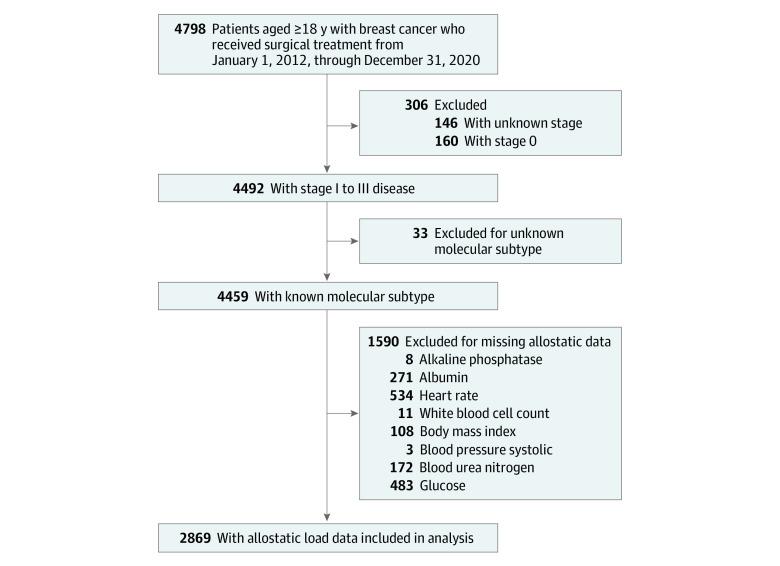
There were 4459 patients (median [IQR] age, 59 [49-67] years) with an ethnoracial distribution of 3 Hispanic Black patients (0.1%), 381 non-Hispanic Black patients (8.5%), 23 Hispanic White patients (0.5%), 3861 non-Hispanic White patients (86.6%), 27 Hispanic patients with other race (0.6%), and 164 non-Hispanic patients with other race (3.7%). The mean (SD) AL was 2.6 (1.7). Black patients (adjusted relative ratio [aRR], those with 1.11; 95% CI, 1.04-1.18), single marital status (aRR, 1.06; 95% CI, 1.00-1.12), and those with government-supplied insured (Medicaid aRR, 1.14; 95% CI, 1.07-1.21; Medicare aRR, 1.11; 95% CI, 1.03-1.19) had a higher adjusted mean AL than those who were White, married/living as married, or privately insured, respectively. Adjusting for sociodemographic, clinical, and treatment factors, high AL was associated with a 46% increase in mortality risk (hazard ratio [HR], 1.46; 95% CI, 1.11-1.93) over low AL. Similarly, compared with patients in the first AL quartile, those in the third quartile (HR, 1.53; 95% CI, 1.07-2.18) and the fourth quartile (HR, 1.79; 95% CI, 1.16-2.75) had significantly increased risks of mortality. There was a significant dose-dependent association between increased AL and a higher risk of all-cause mortality. Furthermore, AL remained significantly associated with higher all-cause mortality after adjusting for the Charlson Comorbidity Index.
CONCLUSIONS AND RELEVANCE
These findings suggest increased AL is reflective of socioeconomic marginalization and associated with all-cause mortality in patients with breast cancer.
重要性
已发现,全身适应综合征(AL)负荷增加与乳腺癌患者的不良社会环境压力源和预示预后不良的肿瘤特征相关。目前,AL 与乳腺癌患者全因死亡率之间的关系尚不清楚。
目的
研究 AL 与乳腺癌患者全因死亡率之间的关系。
设计、设置和参与者: 这项队列研究使用了美国国立癌症研究所综合癌症中心机构电子病历和癌症登记处的数据。参与者为 2012 年 1 月 1 日至 2020 年 12 月 31 日期间确诊为乳腺癌(I 期-III 期)的患者。数据分析于 2022 年 4 月至 2022 年 11 月进行。
暴露因素
AL 通过将生物标志物中最差样本四分位数的分值加总来表示,其评分 1 分。高 AL 定义为 AL 大于中位数。
主要结局和测量指标
主要结局为全因死亡率。使用具有稳健方差的 Cox 比例风险模型检验 AL 与全因死亡率之间的关系。
结果
共有 4459 例患者(中位[IQR]年龄为 59[49-67]岁),种族分布为 3 例西班牙裔黑人(0.1%)、381 例非西班牙裔黑人(8.5%)、23 例西班牙裔白人(0.5%)、3861 例非西班牙裔白人(86.6%)、27 例其他种族的西班牙裔患者(0.6%)和 164 例其他种族的非西班牙裔患者(3.7%)。平均(SD)AL 为 2.6(1.7)。黑人患者(调整后的相对比值[aRR]为 1.11;95%CI,1.04-1.18)、单身婚姻状况(aRR,1.06;95%CI,1.00-1.12)和政府保险(医疗补助[aRR,1.14;95%CI,1.07-1.21];医疗保险[aRR,1.11;95%CI,1.03-1.19])的 AL 平均值高于白人、已婚/以已婚身份生活或私人保险的患者。在校正了社会人口统计学、临床和治疗因素后,高 AL 与低 AL 相比,死亡风险增加了 46%(风险比[HR],1.46;95%CI,1.11-1.93)。同样,与 AL 处于第一四分位的患者相比,处于第三四分位(HR,1.53;95%CI,1.07-2.18)和第四四分位(HR,1.79;95%CI,1.16-2.75)的患者的死亡风险显著增加。AL 增加与全因死亡率升高之间存在显著的剂量依赖性关联。此外,在调整 Charlson 合并症指数后,AL 仍然与较高的全因死亡率显著相关。
结论和相关性
这些发现表明,AL 升高反映了社会经济边缘化,与乳腺癌患者的全因死亡率相关。
 Zotero 插件