
小脑内由D-犬尿氨酸合成犬尿喹啉酸:D-氨基酸氧化酶的独特作用
Kynurenic Acid Synthesis from D-Kynurenine in the Cerebellum: A Distinct Role of D-Amino Acid Oxidase.
作者信息
Pérez de la Cruz Verónica, Sathyasaikumar Korrapati V, Wang Xiao-Dan, Blanco Ayala Tonali, Beggiato Sarah, González Esquivel Dinora F, Pineda Benjamin, Schwarcz Robert
机构信息
Neurobiochemistry and Behavior Laboratory, National Institute of Neurology and Neurosurgery "Manuel Velasco Suárez", Mexico City 14269, Mexico.
Maryland Psychiatric Research Center, Department of Psychiatry, University of Maryland School of Medicine, Baltimore, MD 21228, USA.
出版信息
Cells. 2025 Jul 5;14(13):1030. doi: 10.3390/cells14131030.
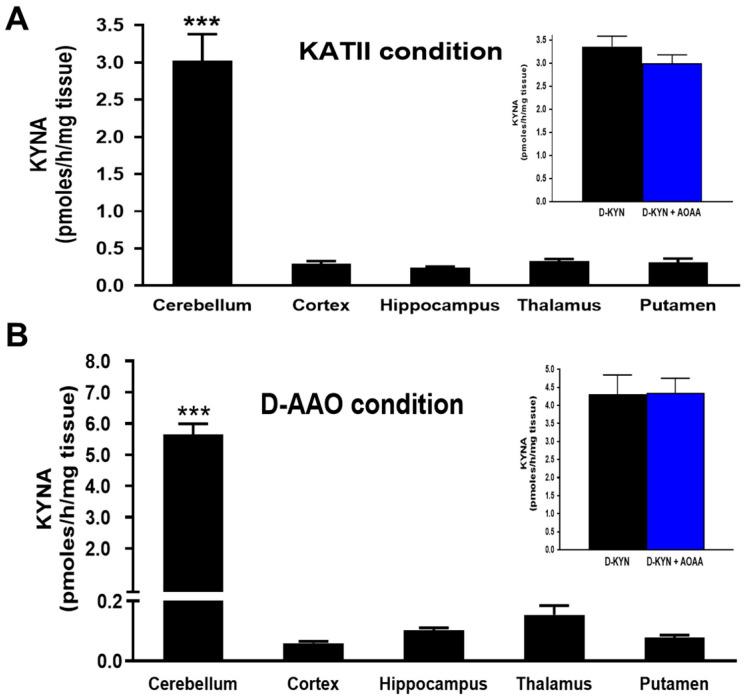
The enzymatic formation of kynurenic acid (KYNA), a neuromodulator metabolite of the kynurenine pathway (KP) of tryptophan metabolism, in the mammalian brain is widely attributed to kynurenine aminotransferase II (KATII). However, an alternative biosynthetic route, involving the conversion of D-kynurenine (D-KYN) to KYNA by D-amino acid oxidase (D-AAO), may play a role as well. In the present study, we first confirmed that purified D-AAO efficiently converted D-KYN-but not L-KYN-to KYNA. We then examined KYNA formation from D-KYN (100 µM) in vitro, using tissue homogenates from several human brain regions. KYNA was generated in all areas, with D-AAO-specific production being most effective by far in the cerebellum. Next tested in homogenates from rat cerebellum, KYNA neosynthesis was significantly reduced by D-AAO inhibition, whereas KATII inhibition had no effect. Finally, KYNA production was assessed by in vivo microdialysis in rat cerebellum. Local D-KYN perfusion, alone and in combination with inhibitors of D-AAO (kojic acid) or aminotransferases (AOAA), caused a substantive increase in extracellular KYNA levels. This effect was attenuated dose-dependently by micromolar concentrations of kojic acid, whereas co-perfusion of AOAA (1 mM) was ineffective. Together, our findings indicate that D-AAO should be considered a major contributor to KYNA production in the cerebellum, highlighting region-specific qualitative differences in cerebral KYNA metabolism.
犬尿喹啉酸(KYNA)是色氨酸代谢的犬尿氨酸途径(KP)的一种神经调节代谢产物,在哺乳动物大脑中,其酶促形成广泛归因于犬尿氨酸转氨酶II(KATII)。然而,另一条生物合成途径,即由D-氨基酸氧化酶(D-AAO)将D-犬尿氨酸(D-KYN)转化为KYNA,可能也发挥作用。在本研究中,我们首先证实纯化的D-AAO能有效地将D-KYN(而非L-KYN)转化为KYNA。然后,我们使用来自几个人脑区域的组织匀浆,在体外检测了由D-KYN(100µM)生成KYNA的情况。在所有区域均生成了KYNA,其中D-AAO特异性生成在小脑最为有效。接下来在大鼠小脑匀浆中进行测试,D-AAO抑制可显著降低KYNA的新合成,而KATII抑制则无作用。最后,通过大鼠小脑的体内微透析评估KYNA的生成。局部灌注D-KYN,单独或与D-AAO抑制剂(曲酸)或转氨酶抑制剂(氨基氧乙酸)联合使用,均可使细胞外KYNA水平大幅升高。曲酸的微摩尔浓度可剂量依赖性地减弱这种效应,而共灌注氨基氧乙酸(1 mM)则无效。总之,我们的研究结果表明,D-AAO应被视为小脑KYNA生成的主要贡献者,突出了大脑KYNA代谢的区域特异性质量差异。



 Zotero 插件