
用于人类癌症和造血干细胞植入的Il2rg和Prkdc近乎完全缺失的NOD SCID小鼠的生成。
Generation of NOD SCID mice with near-complete deletions of Il2rg and Prkdc for human cancer and HSC engraftment.
作者信息
Kim You-Min, Na Hee Ju, Kwon Do Hee, Lee Jae Hoon, Park Bo Min, Lee Subin, Nam Tae Wook, Park Mi Yeon, Park Sun Ha, Kim Sung Joo, Choi Bongkum, Lee Han-Woong
机构信息
Department of Biochemistry, College of Life Science and Biotechnology, Yonsei University, Seoul, 03722, Republic of Korea.
Transplantation Research Center, Research Institute for Future Medicine, Samsung Medical Center, Gangnam-gu, Seoul, 06351, Republic of Korea.
出版信息
Transgenic Res. 2025 Jul 11;34(1):35. doi: 10.1007/s11248-025-00454-9.
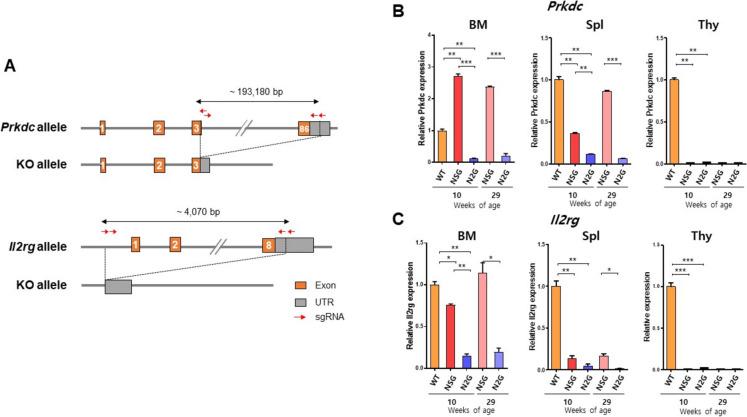
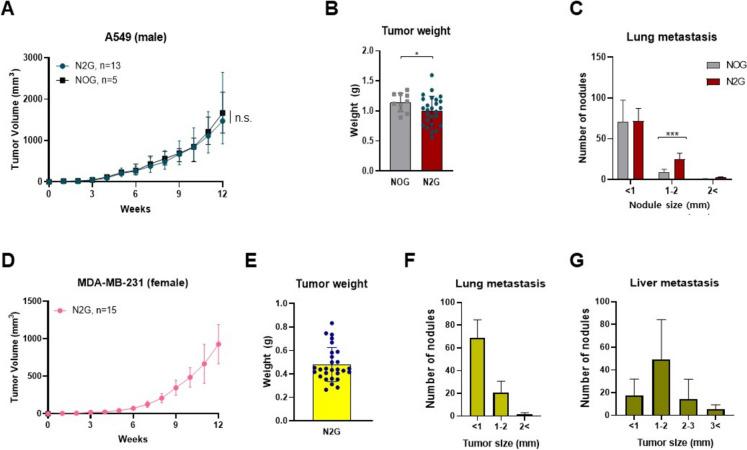
Immunodeficient mouse models are invaluable tools for preclinical research, particularly for cancer therapies and studies of the human immune system. Notably, strains with combined Prkdc (scid) and Il2rg (null) mutations-such as NOG and NSG mice- are widely used due to their profound immunodeficiency, allowing efficient engraftment of various human cells. However, these models were generated by disrupting the Il2rg gene through replacement with a neomycin resistance (Neo) cassette in embryonic stem cells. Incomplete excision of this cassette can inadvertently alter the expression of neighboring genes, thereby introducing potential confounding variables. In addition, they may still express mutant mRNAs that escape nonsense-mediated decay (NMD) and/or produce truncated proteins with residual activity, potentially compromising the interpretation of experimental outcomes. To address this, we developed the N2G mouse strain (NOD-2-Genes KO) where almost all genomic loci of both Prkdc and Il2rg genes are deleted via CRISPR/Cas9 genome editing. N2G mice exhibited tumor growth comparable to NOG mice following the transplantation with several human cancer cell lines. Moreover, human CD34 cord blood (CB) cells engrafted into N2G mice showed robust reconstitution of human immune cells, especially T cells in peripheral blood, spleen and bone marrow, compared to NSG mice. These results suggest that N2G mice, lacking residual mutant mRNA and the exogenous Neo resistant gene, offer an advanced model for preclinical studies.
免疫缺陷小鼠模型是临床前研究的宝贵工具,特别是在癌症治疗和人类免疫系统研究方面。值得注意的是,具有Prkdc(scid)和Il2rg(null)联合突变的品系——如NOG和NSG小鼠——因其严重的免疫缺陷而被广泛使用,这使得各种人类细胞能够有效植入。然而,这些模型是通过在胚胎干细胞中用新霉素抗性(Neo)盒替换来破坏Il2rg基因而产生的。该盒的不完全切除可能会无意中改变邻近基因的表达,从而引入潜在的混杂变量。此外,它们可能仍会表达逃避无义介导衰变(NMD)的突变mRNA和/或产生具有残余活性的截短蛋白,这可能会影响实验结果的解释。为了解决这个问题,我们开发了N2G小鼠品系(NOD-2-基因敲除),其中Prkdc和Il2rg基因的几乎所有基因组位点都通过CRISPR/Cas9基因组编辑被删除。在用几种人类癌细胞系移植后,N2G小鼠的肿瘤生长情况与NOG小鼠相当。此外,与NSG小鼠相比,植入N2G小鼠的人类CD34脐带血(CB)细胞显示出人类免疫细胞的强劲重建,尤其是外周血、脾脏和骨髓中的T细胞。这些结果表明,缺乏残余突变mRNA和外源性Neo抗性基因的N2G小鼠为临床前研究提供了一个先进的模型。



 Zotero 插件