
默贝科病毒刺突蛋白的结构与受体结合活性揭示了人类二肽基肽酶4适应性的关键特征。
Structures and receptor binding activities of merbecovirus spike proteins reveal key signatures for human DPP4 adaptation.
作者信息
Yuan Hang, Wang Jingjing, Ma Yong, Li Zimu, Gao Xijie, Habib Gul, Liu Banghui, Chen Jing, He Jun, Zhou Peng, Shi Zheng-Li, Chen Xinwen, Xiong Xiaoli
机构信息
State Key Laboratory of Respiratory Disease, Guangdong Provincial Key Laboratory of Stem Cell and Regenerative Medicine, Guangdong-Hong Kong Joint Laboratory for Stem Cell and Regenerative Medicine, Guangzhou Institutes of Biomedicine and Health, Chinese Academy of Sciences, Guangzhou 510530, China.
University of Chinese Academy of Sciences, Beijing 100864, China.
出版信息
Sci Adv. 2025 Jul 11;11(28):eadv7296. doi: 10.1126/sciadv.adv7296.
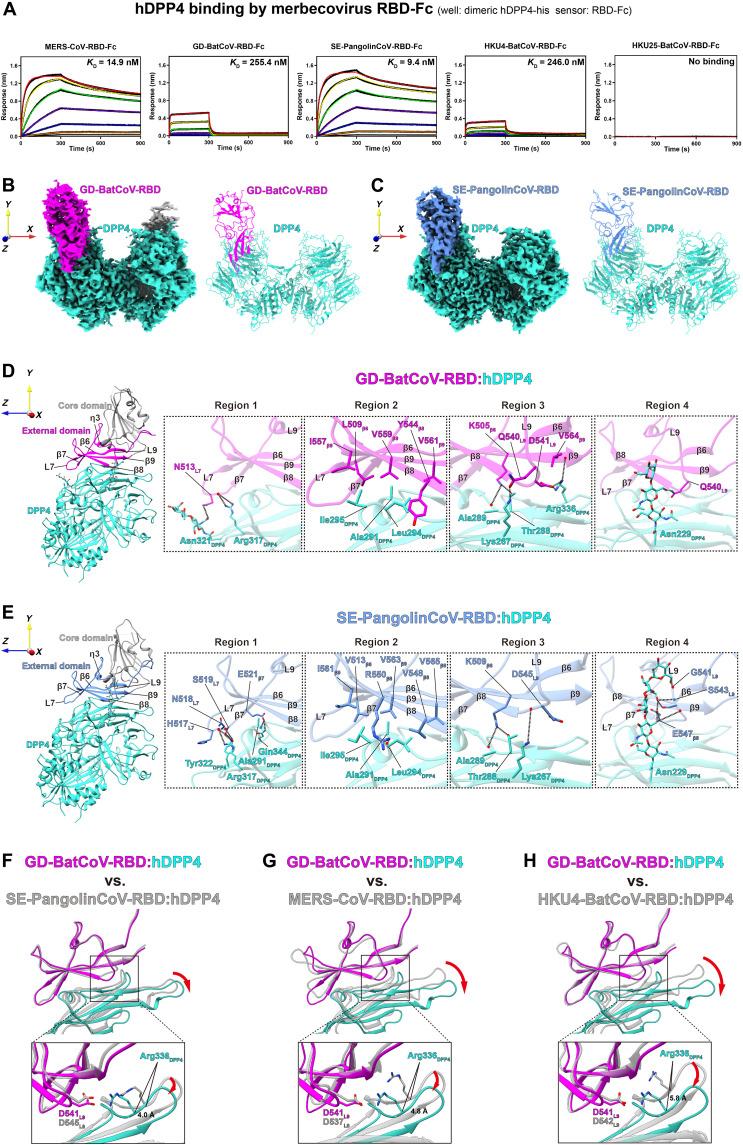
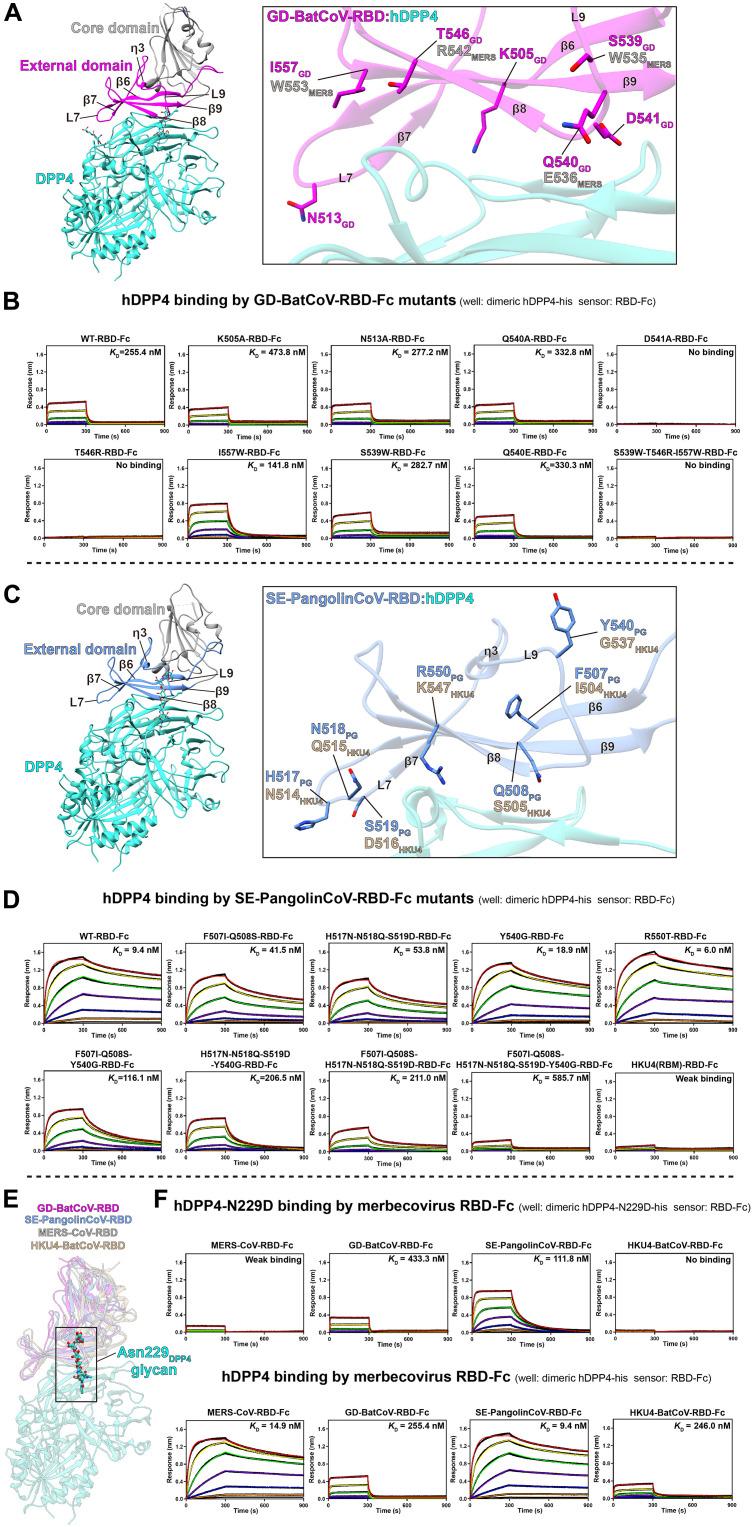
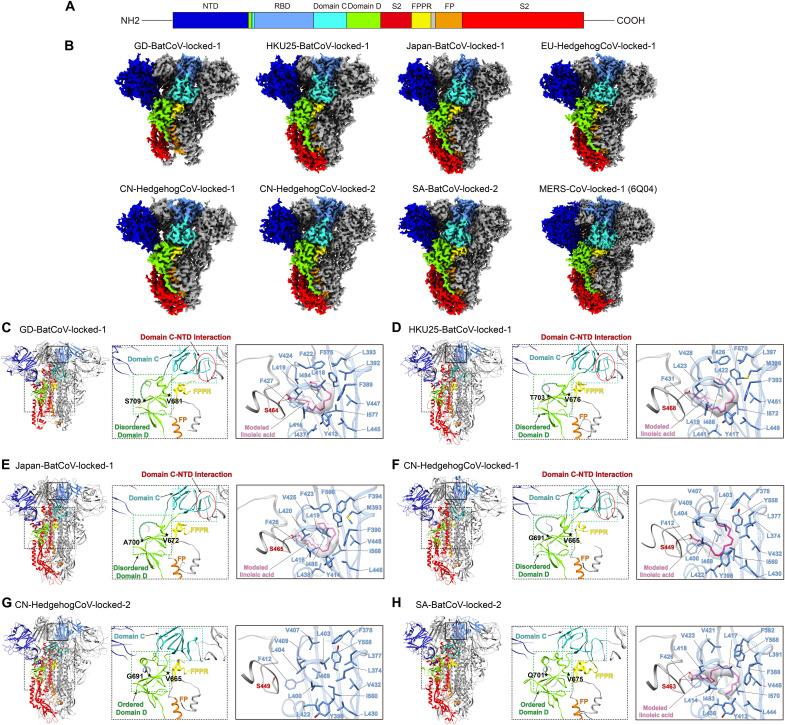
Merbecoviruses from bats, pangolins, and hedgehogs pose significant zoonotic threats, with a limited understanding of receptor binding by their spike (S) proteins. Here, we report cryo-EM structures of GD-BatCoV (BtCoV-422) and SE-PangolinCoV (MjHKU4r-CoV-1) RBDs in complex with human DPP4 (hDPP4). These structures exhibit a substantial offset in their hDPP4 interaction interfaces, revealing a conserved hydrophobic cluster as a convergent signature of DPP4 binding within the MERS-HKU4 clade of merbecoviruses. Structure-guided mutagenesis demonstrates that favorable interactions are distributed across multiple receptor binding motif (RBM) regions, working synergistically to confer high-affinity hDPP4 binding. Swapping of the merbecovirus RBM regions indicate limited plasticity and interchangeability among these regions. In addition, we report cryo-EM structures of six merbecovirus S-trimers. Structure-based phylogenetics suggests that hDPP4-binding merbecoviruses undergo convergent evolution, while ACE2-binding merbecoviruses exhibit diversification in their binding mechanisms. These findings offer critical insights into merbecovirus receptor utilization, providing a structural understanding for future surveillance.
来自蝙蝠、穿山甲和刺猬的中东呼吸综合征冠状病毒属病毒构成了重大的人畜共患病威胁,人们对其刺突(S)蛋白的受体结合了解有限。在此,我们报告了与人类二肽基肽酶4(hDPP4)结合的GD-BatCoV(BtCoV-422)和SE-PangolinCoV(MjHKU4r-CoV-1)受体结合域(RBD)的冷冻电镜结构。这些结构在其hDPP4相互作用界面上呈现出显著的偏移,揭示了一个保守的疏水簇,作为中东呼吸综合征冠状病毒属病毒中MERS-HKU4进化枝内DPP4结合的趋同特征。基于结构的诱变表明,有利的相互作用分布在多个受体结合基序(RBM)区域,协同作用以赋予高亲和力的hDPP4结合。中东呼吸综合征冠状病毒属病毒RBM区域的交换表明这些区域的可塑性和互换性有限。此外,我们报告了六种中东呼吸综合征冠状病毒属病毒S三聚体的冷冻电镜结构。基于结构的系统发育分析表明,与hDPP4结合的中东呼吸综合征冠状病毒属病毒经历了趋同进化,而与血管紧张素转换酶2(ACE2)结合的中东呼吸综合征冠状病毒属病毒在其结合机制上表现出多样化。这些发现为中东呼吸综合征冠状病毒属病毒的受体利用提供了关键见解,为未来的监测提供了结构上的理解。



 Zotero 插件