
解析反苯环丙胺的靶点格局以用于新药研发。
Unravelling the target landscape of tranylcypromines for new drug discovery.
作者信息
Song Yihui, Chang Junbiao, Yu Bin
机构信息
School of Pharmaceutical Sciences, Zhengzhou University, Zhengzhou 450001, China.
Key Laboratory of Gastrointestinal Cancer (Fujian Medical University), Ministry of Education, Fujian Medical University, Fuzhou 350122, China.
出版信息
Acta Pharm Sin B. 2025 Jun;15(6):2985-3007. doi: 10.1016/j.apsb.2025.04.012. Epub 2025 Apr 14.
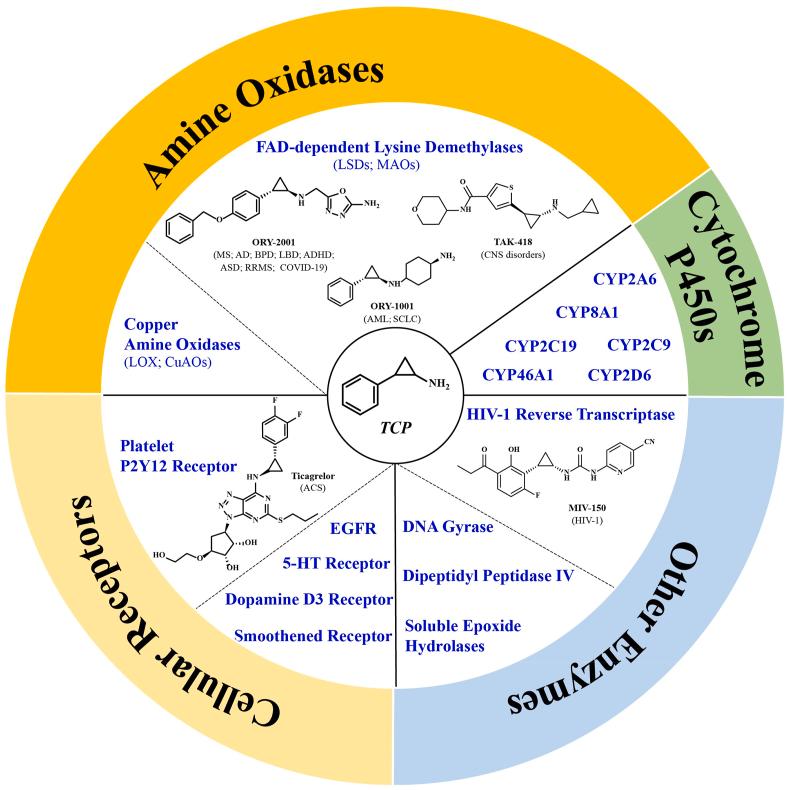
Molecular editing around privileged scaffolds, also known as periphery editing, is a commonly used strategy in contemporary drug discovery and development. Tranylcypromine (TCP) is a widely acknowledged scaffold with diverse pharmacological activities. TCP-derived compounds target different enzymes and cellular receptors such as amine oxidase, platelet P2Y receptor, and cytochrome P450 superfamily. These compounds have demonstrated various effects including antidepressant, anticancer, antiviral properties, involvement in prostaglandin synthesis, and mediation of drug metabolism. Notably, the first reversible oral P2Y receptor antagonist, ticagrelor, is currently used to prevent future myocardial infarction, stroke, and cardiovascular death. Several TCP-based lysine demethylase 1 (LSD1) inhibitors are currently undergoing clinical assessment. MIV-150, a third-generation non-nucleoside reverse transcriptase inhibitor, has progressed to the clinical stage for treating human immunodeficiency virus type 1 (HIV-1) seronegative patients suffering from acute coronary syndrome. This review aims to explore the target landscape of TCPs, highlight key structure-activity relationships (SARs), and emphasize the therapeutic potential of TCPs for treating various diseases. Finally, the lessons learned from our medicinal chemistry practice, challenges and future directions of TCP-based drug discovery are briefly discussed.
围绕特权骨架的分子编辑,也称为周边编辑,是当代药物发现与开发中常用的策略。反苯环丙胺(TCP)是一种具有多种药理活性的公认骨架。TCP衍生化合物靶向不同的酶和细胞受体,如胺氧化酶、血小板P2Y受体和细胞色素P450超家族。这些化合物已显示出多种作用,包括抗抑郁、抗癌、抗病毒特性、参与前列腺素合成以及介导药物代谢。值得注意的是,首个可逆性口服P2Y受体拮抗剂替格瑞洛目前用于预防未来心肌梗死、中风和心血管死亡。几种基于TCP的赖氨酸去甲基化酶1(LSD1)抑制剂目前正在进行临床评估。MIV-150是一种第三代非核苷逆转录酶抑制剂,已进入临床阶段,用于治疗患有急性冠状动脉综合征的1型人类免疫缺陷病毒(HIV-1)血清阴性患者。本综述旨在探索TCP的靶点格局,突出关键的构效关系(SAR),并强调TCP在治疗各种疾病方面的治疗潜力。最后,简要讨论了我们药物化学实践中的经验教训、基于TCP的药物发现面临的挑战和未来方向。








 Zotero 插件