
中性粒细胞会加重坏死性小肠结肠炎患者肠道类器官中的炎性病变。
Neutrophils aggravate inflammatory lesions in intestinal organoids from necrotizing enterocolitis.
作者信息
Heuer Kim M, Boettcher Michael, Raluy Laia Pagerols, Hagens Johanna, Kolman Jan P, Bunders Madeleine J, Wesche Jasmin, Knopf Jasmin, Herrmann Martin, Reinshagen Konrad, Vincent Deirdre
机构信息
Department of Pediatric Surgery, University Medical Center Hamburg-Eppendorf, Hamburg, Germany.
Department of Pediatric Surgery, University Medical Center Mannheim, Heidelberg University, Mannheim, Germany.
出版信息
Front Immunol. 2025 Jun 27;16:1582526. doi: 10.3389/fimmu.2025.1582526. eCollection 2025.
INTRODUCTION
Necrotizing enterocolitis (NEC) is a leading cause of neonatal death and long-term morbidity, involving complex pathophysiology including prematurity, abnormal bacterial colonization, and ischemia-reperfusion injury, partially mediated by neutrophils. However, the limitations of current animal models hinder the development of targeted therapies for NEC. Thus, this study aimed to develop a human intestinal organoid model for NEC to investigate its pathophysiology, understand neutrophil involvement, and bridge animal and human research.
METHODS
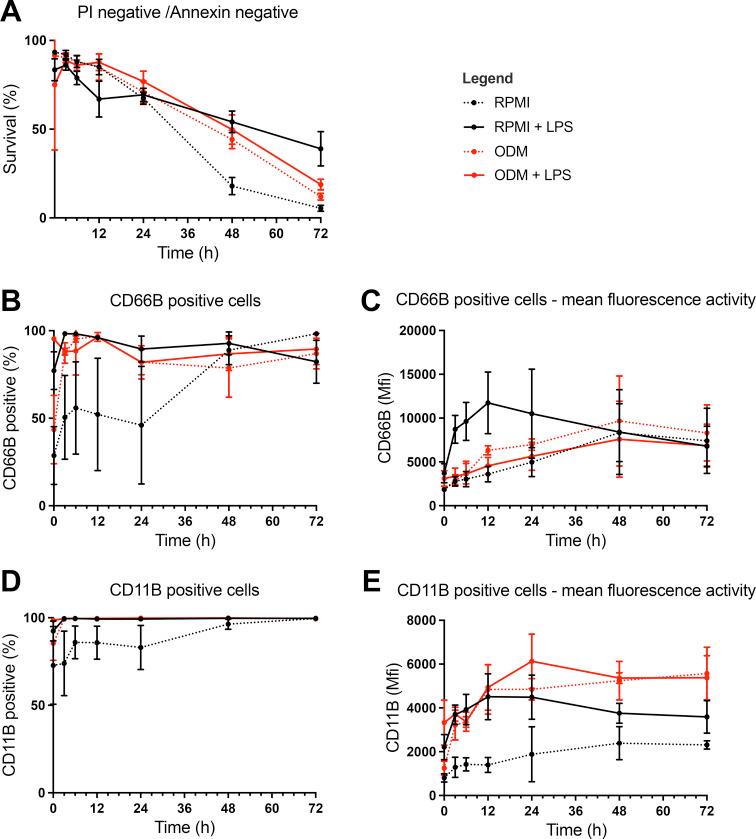
Organoid cultures were established from human neonatal intestinal samples with NEC (n=7) and without gut inflammation (controls, n=7), treated with lipopolysaccharides (LPS), and/or cocultured with neutrophils. Flow cytometry quantified neutrophil survival (propidium iodide/Annexin-V), activation (CD11b/CD66b), and TLR-4 expression, as well as organoid TLR-4 expression and apoptosis markers. NEC status and neutrophil recruitment were analyzed using immunofluorescence.
RESULTS
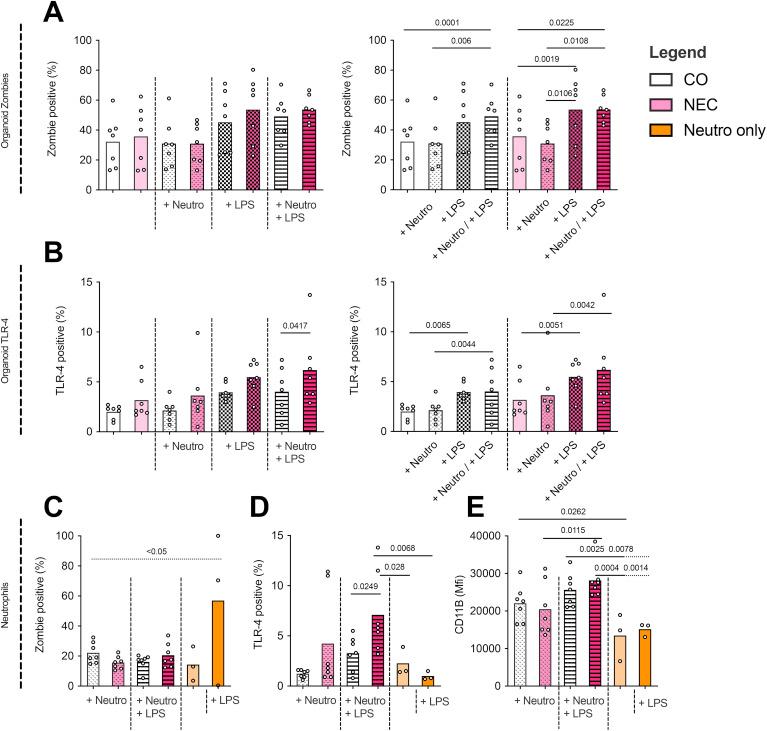
After LPS administration, NEC organoids showed significantly increased TLR-4 expression, intestinal apoptosis markers, and NEC scores compared to controls, with more pronounced differences after neutrophil addition. Neutrophil activation markers were elevated when cocultured with both NEC and control organoids, but TLR-4 expression increased only with NEC organoids.
DISCUSSION
The findings suggest that epithelial cells from NEC patients have a heightened innate TLR-4 expression upon LPS stimulation, potentially contributing to NEC development. LPS stimulation resulted in more pronounced NEC-like lesions in NEC organoids, which were exacerbated by neutrophils. This model demonstrates that neutrophils might contribute to NEC manifestation and maintenance and that NEC organoids can reflect disease aspects, potentially aiding in the development of targeted therapies.
引言
坏死性小肠结肠炎(NEC)是新生儿死亡和长期发病的主要原因,其病理生理过程复杂,包括早产、异常细菌定植和缺血再灌注损伤,部分由中性粒细胞介导。然而,当前动物模型的局限性阻碍了NEC靶向治疗的发展。因此,本研究旨在建立一种用于NEC的人肠道类器官模型,以研究其病理生理学,了解中性粒细胞的参与情况,并弥合动物和人类研究之间的差距。
方法
从患有NEC的人类新生儿肠道样本(n = 7)和无肠道炎症的样本(对照组,n = 7)中建立类器官培养物,用脂多糖(LPS)处理,和/或与中性粒细胞共培养。流式细胞术定量中性粒细胞存活(碘化丙啶/膜联蛋白-V)、活化(CD11b/CD66b)和TLR-4表达,以及类器官TLR-4表达和凋亡标志物。使用免疫荧光分析NEC状态和中性粒细胞募集情况。
结果
给予LPS后,与对照组相比,NEC类器官的TLR-4表达、肠道凋亡标志物和NEC评分显著增加,添加中性粒细胞后差异更明显。与NEC和对照类器官共培养时,中性粒细胞活化标志物升高,但TLR-4表达仅在NEC类器官中增加。
讨论
研究结果表明,NEC患者的上皮细胞在LPS刺激下先天性TLR-4表达升高,可能促成NEC的发展。LPS刺激在NEC类器官中导致更明显的NEC样病变,中性粒细胞使其加剧。该模型表明中性粒细胞可能促成NEC的表现和维持,且NEC类器官可反映疾病情况,可能有助于靶向治疗的开发。


 Zotero 插件