
用于荚膜多糖(CPS)与KpACE相互作用的表面等离子体共振
Surface Plasmon Resonance for the Interaction of Capsular Polysaccharide (CPS) With KpACE.
作者信息
Wang Zhe, Wang Lijun, Zhang Xiaomin, Zhang Jing-Ren, Cai Chao
机构信息
Key Laboratory of Marine Drugs of Ministry of Education, School of Medicine and Pharmacy, Ocean University of China, Qingdao, China.
Shandong Key Laboratory of Glycoscience and Glycotherapeutics, School of Medicine and Pharmacy, Ocean University of China, Qingdao, China.
出版信息
Bio Protoc. 2025 Jun 20;15(12):e5346. doi: 10.21769/BioProtoc.5346.
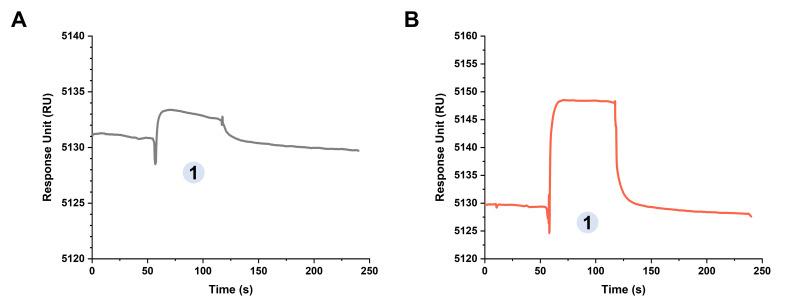
The study of carbohydrate-protein interactions is crucial for clarifying biological processes and identifying potential drug candidates. However, due to the complex structure of carbohydrates, such as high molecular weight, dynamic flexibility, and high solution viscosity, it is challenging to study their interactions with diverse proteins. Conventional analytical techniques like isothermal titration calorimetry (ITC), X-ray crystallography, molecular dynamics (MD) simulations, and nuclear magnetic resonance (NMR) spectroscopy have limitations in revealing these molecular interactions. Surface plasmon resonance (SPR), an advanced optical biosensor technique, overcomes these limitations. It enables real-time, label-free monitoring of the interaction dynamics between carbohydrates and proteins through a continuous flow over a chip surface. In this study, we utilized SPR-based techniques to explore the interaction of capsular polysaccharides (CPS) of and the enzyme KpACE ( acetylated capsule esterase). Our SPR-based analytical platform has several advantages, including shorter experimental time, a simulated physiological state, and minimal sample requirements for investigating carbohydrate-protein interactions. This approach expands the applicability scope of SPR technology and provides a valuable tool for a wide range of research. By using SPR, we successfully verified that KpACE acts on the acetyl groups of CPS, demonstrating its enzymatic activity, which is crucial for understanding the pathogenic mechanism of and developing potential antibacterial drugs. Key features • Conduct rapid screening of carbohydrate-protein interactions to determine binding affinity (KD). • Perform a comprehensive binding assay to assess the interactions between capsular polysaccharides (CPS) and mutant enzymes, thereby validating their catalytic sites. • Apply the methodology to achieve a highly sensitive, label-free, simulated physiological environment for substrate-enzyme interaction studies.
碳水化合物 - 蛋白质相互作用的研究对于阐明生物过程和识别潜在的候选药物至关重要。然而,由于碳水化合物的结构复杂,如高分子量、动态灵活性和高溶液粘度,研究它们与多种蛋白质的相互作用具有挑战性。传统的分析技术,如实等温滴定量热法(ITC)、X射线晶体学、分子动力学(MD)模拟和核磁共振(NMR)光谱,在揭示这些分子相互作用方面存在局限性。表面等离子体共振(SPR)作为一种先进的光学生物传感器技术,克服了这些局限性。它能够通过在芯片表面连续流动,对碳水化合物和蛋白质之间的相互作用动力学进行实时、无标记监测。在本研究中,我们利用基于SPR的技术来探索[具体细菌名称]的荚膜多糖(CPS)与酶KpACE(乙酰化荚膜酯酶)的相互作用。我们基于SPR的分析平台具有几个优点,包括更短的实验时间、模拟生理状态以及研究碳水化合物 - 蛋白质相互作用所需的样品量最少。这种方法扩展了SPR技术的适用范围,并为广泛的研究提供了有价值的工具。通过使用SPR,我们成功验证了KpACE作用于CPS的乙酰基团,证明了其酶活性,这对于理解[具体细菌名称]的致病机制和开发潜在的抗菌药物至关重要。关键特性 • 对碳水化合物 - 蛋白质相互作用进行快速筛选以确定结合亲和力(KD)。 • 进行全面的结合测定以评估荚膜多糖(CPS)与突变酶之间的相互作用,从而验证它们的催化位点。 • 应用该方法实现用于底物 - 酶相互作用研究的高灵敏度、无标记、模拟生理环境。
需注意,原文中部分细菌名称缺失,翻译时用[具体细菌名称]表示。


 Zotero 插件