
新型冠状病毒肺炎大流行对一家三级医院艰难梭菌感染率的影响:一项回顾性比较研究
Impact of the COVID-19 Pandemic on Clostridioides difficile Infection Rates in a Tertiary Hospital: A Retrospective Comparative Study.
作者信息
Shabana Haitham, Abdelwahed Hesham
机构信息
Department of Critical Care Medicine, Westmead Hospital, Sydney, AUS.
Department of Critical Care Medicine, Maitland Hospital, Newcastle, AUS.
出版信息
Cureus. 2025 Jun 15;17(6):e86045. doi: 10.7759/cureus.86045. eCollection 2025 Jun.
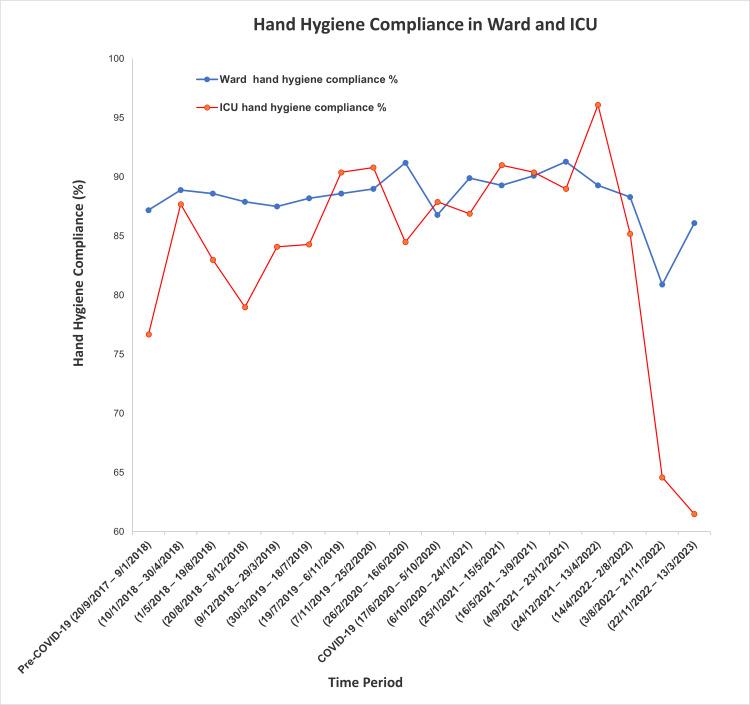
Introduction The impact of the COVID-19 pandemic on the incidence of infection (CDI) remains uncertain, with conflicting findings reported in the literature. While some studies have shown an increase in CDI cases, others have found no significant change. This study aimed to compare healthcare-associated CDI incidence rates (including community-onset and hospital-onset cases) between the pre-COVID-19 and COVID-19 periods at our institution, with secondary analyses of ICU and hospital length of stay, mortality, severity, and recurrence rates. Methods This single-center retrospective study at Wollongong Hospital compared CDI rates before and during the COVID-19 pandemic. Adult patients with diarrhea and confirmed CDI were included. Data on demographics, comorbidities, antibiotic use, hospital and ICU length of stay, mortality, and infection control metrics were analyzed. CDI incidence was calculated per 1,000 patient-days and per 1,000 admissions. Results Among 544 CDI cases (215 pre-COVID-19 and 329 during COVID-19), 291 (53.5%) were community-onset and 253 (46.5%) hospital-onset. There were no significant differences between the two periods in CDI type (p = 0.599), time to acquisition (p = 0.388), severity (17.2% vs. 19.5%), ICU admission (18.1% vs. 20.4%), ICU (p = 0.415) or hospital length of stay (p = 0.788), or mortality (9.3% vs. 8.8%). However, CDI recurrence was significantly higher during the COVID-19 period (10.9% vs. 5.6%, p < 0.05), as were incidence rates per 1,000 patient admissions (2.2 vs. 1.47, p < 0.001) and per 1,000 patient-days (0.64 vs. 0.45, p < 0.001). Hand hygiene compliance in general wards declined slightly but significantly (from 88.5% to 87.9%, p = 0.003), while ICU compliance remained stable. Conclusion The incidence of CDI was significantly higher during the COVID-19 period compared to the pre-COVID-19 period at our institution. These findings underscore the importance of strengthened antimicrobial stewardship and preventive measures during healthcare crises.
引言
2019年冠状病毒病(COVID-19)大流行对艰难梭菌感染(CDI)发病率的影响仍不确定,文献报道的结果相互矛盾。虽然一些研究显示CDI病例有所增加,但其他研究则未发现显著变化。本研究旨在比较我院在COVID-19之前和COVID-19期间医疗相关CDI发病率(包括社区发病和医院发病病例),并对重症监护病房(ICU)和住院时间、死亡率、严重程度及复发率进行二次分析。
方法
这项在卧龙岗医院进行的单中心回顾性研究比较了COVID-19大流行之前和期间的CDI发病率。纳入有腹泻且确诊为CDI的成年患者。分析了人口统计学、合并症、抗生素使用、医院和ICU住院时间、死亡率及感染控制指标等数据。CDI发病率按每1000患者日和每1000例入院计算。
结果
在544例CDI病例中(COVID-19之前215例,COVID-19期间329例),291例(53.5%)为社区发病,253例(46.5%)为医院发病。两个时期在CDI类型(p = 0.599)、感染获得时间(p = 0.388)、严重程度(17.2%对19.5%)、ICU入院率(18.1%对20.4%)、ICU(p = 0.415)或医院住院时间(p = 0.788)以及死亡率(9.3%对8.8%)方面均无显著差异。然而,COVID-19期间CDI复发率显著更高(10.9%对5.6%,p < 0.05),每1000例患者入院发病率(2.2对1.47,p < 0.001)和每1000患者日发病率(0.64对0.45,p < 0.001)也是如此。普通病房的手卫生依从性略有下降但具有统计学意义(从88.5%降至87.9%,p = 0.003),而ICU的依从性保持稳定。
结论
在我院,COVID-19期间CDI发病率显著高于COVID-19之前。这些发现强调了在医疗危机期间加强抗菌药物管理和预防措施的重要性。
 Zotero 插件