
苦扁桃仁提取物增强了米替福新的抗利什曼原虫活性。
Prunus amygdalus var. amara seed extract enhances the antileishmanial activity of miltefosine.
作者信息
Akand Sajjadul Kadir, Rahman Areeba, Ali Rahat, Husain Mohammad, Danish Mohd, Khan Mohammad Rashid, Ali Nemat, Akram Mohd Faiz, Rub Abdur
机构信息
Department of Biotechnology, Jamia Millia Islamia (A Central University), New Delhi, 110025, India.
Department of Dermatology, University of Alabama, 1720 2nd Ave South, Birmingham, AL35294, USA.
出版信息
BMC Complement Med Ther. 2025 Jul 16;25(1):273. doi: 10.1186/s12906-025-04958-z.
BACKGROUND
Leishmaniasis, an infectious disease transmitted via sand flies is caused by the protozoan parasite of Leishmania spp. The treatment of this disease is quite challenging due to the high cost, resistance, and toxicity of conventional drugs. Various research studies have demonstrated that plant based drug possess least toxicity, anti-inflammatory and anti-oxidant properties. Here, evaluation of anti-leishmanial activity of methanolic Prunus amygdalus var. amara seed extract was conducted and found that it inhibited L. donovani proliferation and cause apoptosis. Moreover, its combinations with miltefosine enhanced antileishmanial effects. GC-MS analysis confirmed the presence of various phytochemicals in the extract that contributed pharmacological efficacy. These findings highlighted the potential of herbal products as a valuable source of new treatments for leishmaniasis.
METHODS
The antileishmanial effect was determined by promastigote and amastigote assays. Parasite load was evaluated by staining L. donovani-infected macrophages with modified Giemsa stain. Cytotoxicity of seed extract was estimated by MTT (3-(4, 5- dimethylthiazol-2-yl)-2, 5-diphenyl tetrazolium bromide) assay. In addition, Pro-apoptotic events were inferred using RT-PCR and qRT-PCR. Further characterization of phytoconstituents was evaluated by gas chromatography and mass spectrometry.
RESULTS
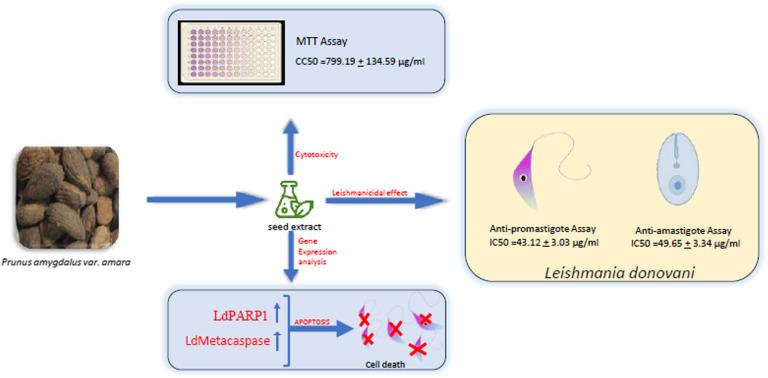
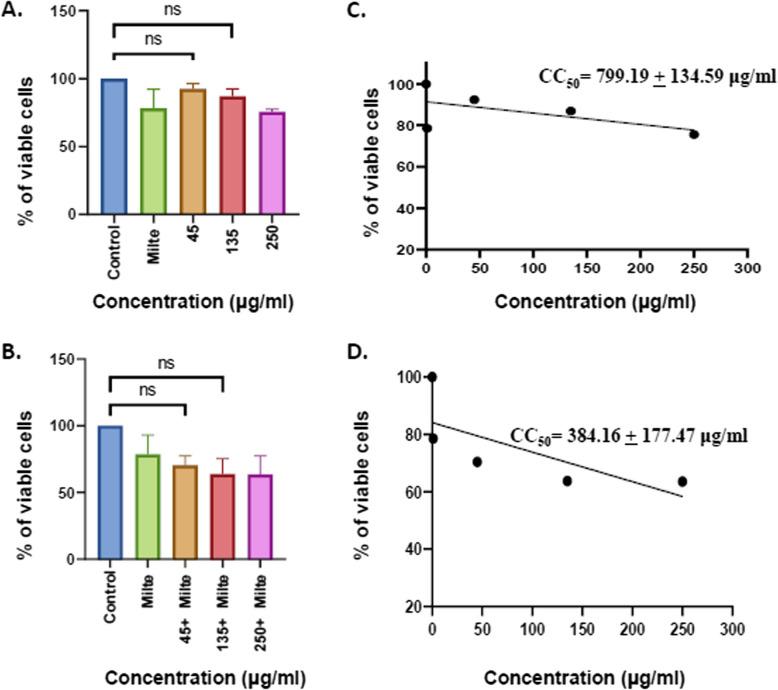
The extract promoted a dose-dependent reduction in growth of promastigotes (IC50 = 43.12 ± 3.03 μg/ml) and amastigotes (IC50 = 49.65 ± 3.34 μg/ml). Further, extract in combination with miltefosine showed enhanced antileishmanial activity against both forms of the L. donovani, promastigotes (IC50 = 4.547 ± 1.2 μg/ml) as well as amastigotes (IC50 = 19.54 ± 2.4 μg/ml). Early-stage apoptotic events were also observed in promastigote forms by determining the increased expression of LdMetacaspase and PARP1. The cytotoxic potential on THP-1 differentiated macrophages was assessed and indicated insignificant cytotoxicity of different doses of the extract (CC50 = 799.19 ± 134.59 μg/ml) and in combination with miltefosine (CC50 = 384.16 ± 177.47 μg/ml). Furthermore, the presence of phytocompounds like chaulmoogric acid and hydnocarpic acid was described, for the first time, in Prunus amygdalus var. amara seed extract.
CONCLUSION
The findings indicated that EPA plays a significant role in combating leishmaniasis and holds promise as a potential treatment for this disease. Moreover, when combined with miltefosine, EPA demonstrated increased effectiveness against leishmaniasis. Therefore, the combination of EPA and miltefosine presents a more promising outlook as a potential therapy for leishmaniasis.
背景
利什曼病是一种通过白蛉传播的传染病,由利什曼原虫属的原生动物寄生虫引起。由于传统药物成本高、耐药性和毒性大,这种疾病的治疗颇具挑战性。各种研究表明,植物性药物毒性最小,具有抗炎和抗氧化特性。在此,对苦扁桃变种甲醇提取物的抗利什曼活性进行了评估,发现它能抑制杜氏利什曼原虫的增殖并诱导细胞凋亡。此外,其与米替福新联合使用增强了抗利什曼作用。气相色谱 - 质谱联用(GC - MS)分析证实提取物中存在多种植物化学物质,这些物质有助于其药理功效。这些发现凸显了草药产品作为利什曼病新治疗方法宝贵来源的潜力。
方法
通过前鞭毛体和无鞭毛体试验确定抗利什曼作用。用改良吉姆萨染色法对感染杜氏利什曼原虫的巨噬细胞进行染色,评估寄生虫载量。通过MTT(3 -(4,5 - 二甲基噻唑 - 2 - 基)- 2,5 - 二苯基四氮唑溴盐)试验评估种子提取物的细胞毒性。此外,使用逆转录 - 聚合酶链反应(RT - PCR)和实时定量逆转录 - 聚合酶链反应(qRT - PCR)推断促凋亡事件。通过气相色谱和质谱对植物成分进行进一步表征。
结果
提取物促使前鞭毛体(IC50 = 43.12±3.03μg/ml)和无鞭毛体(IC50 = 49.65±3.34μg/ml)的生长呈剂量依赖性降低。此外,提取物与米替福新联合使用对杜氏利什曼原虫的两种形态,即前鞭毛体(IC50 = 4.547±1.2μg/ml)和无鞭毛体(IC50 = 19.54±2.4μg/ml)均显示出增强的抗利什曼活性。通过测定LdMetacaspase和PARP1表达增加,在前鞭毛体形态中也观察到早期凋亡事件。评估了对THP - 1分化巨噬细胞的细胞毒性潜力,结果表明不同剂量的提取物(CC50 = 799.19±134.59μg/ml)及其与米替福新联合使用时(CC50 = 384.16±177.47μg/ml)细胞毒性不显著。此外,首次在苦扁桃变种种子提取物中描述了乔莫酸和氢化诺卡酸等植物化合物的存在。
结论
研究结果表明提取物在对抗利什曼病中发挥重要作用,有望成为这种疾病的潜在治疗方法。此外,与米替福新联合使用时,提取物对利什曼病显示出更高的疗效。因此,提取物与米替福新联合使用作为利什曼病的潜在治疗方法具有更广阔的前景。



 Zotero 插件