
为什么老年人在接种流感疫苗时会犹豫不决?一项关于新冠疫情后时代疫苗犹豫情况的横断面研究。
Why do older adults hesitate to get the flu vaccine? A cross-sectional study on vaccine hesitancy in the post-COVID-19 era.
作者信息
Wang Xinyue, Wen Sanmei, Wu Jiaqian, Cui Ziyi, Shen Hong, Hu Shiyao, Zeng Shujun, Tang Yan
机构信息
Xuhui District Center for Disease Control and Prevention, Shanghai, China.
School of Journalism and Communication, Tsinghua University, Beijing, China.
出版信息
Front Public Health. 2025 Jul 2;13:1603091. doi: 10.3389/fpubh.2025.1603091. eCollection 2025.
OBJECTIVES
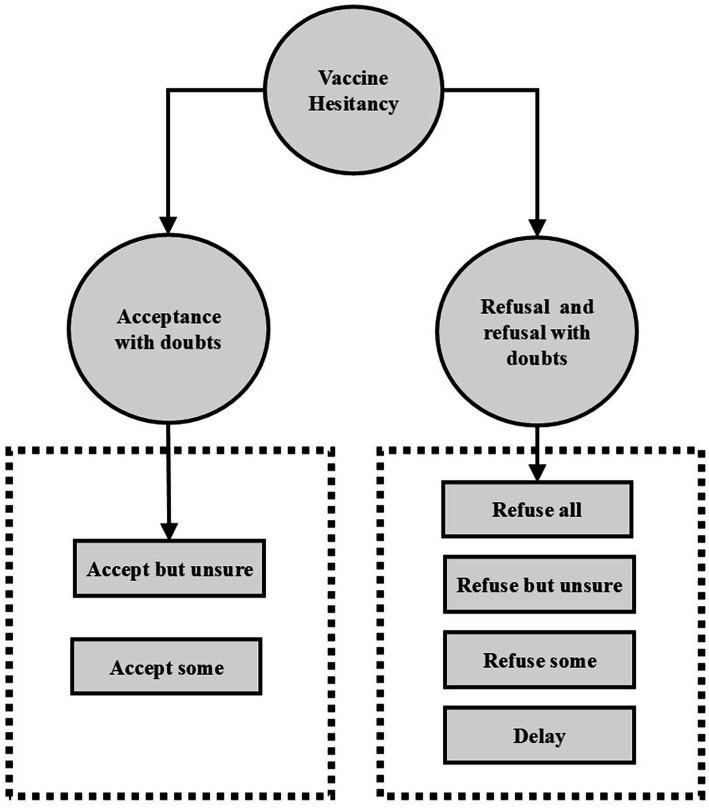
To investigate the determinants of influenza vaccine hesitancy (VH) among older adults in Shanghai, China, using the 3Cs model (confidence, complacency, and convenience) and vaccine literacy (VL) framework. This study also explored the potential effect of COVID-19 vaccine hesitancy on influenza vaccine attitudes in the post-COVID-19 era.
METHODS
We conducted a community-based cross-sectional study from January to June 2024 in Shanghai, China, involving 1,300 adults aged ≥60 years. Participants were recruited through stratified random sampling. Inclusion criteria were: community-dwelling adults aged ≥60 years in Xuhui District. Multinomial logistic regression models were used to identify predictors of vaccine hesitancy, adjusting for sociodemographic variables, self-reported health status and self-report vaccination experiences. Structural equation modeling (SEM) was employed to examine the underlying factors contributing to vaccine hesitancy and quantify their interrelationships.
RESULTS
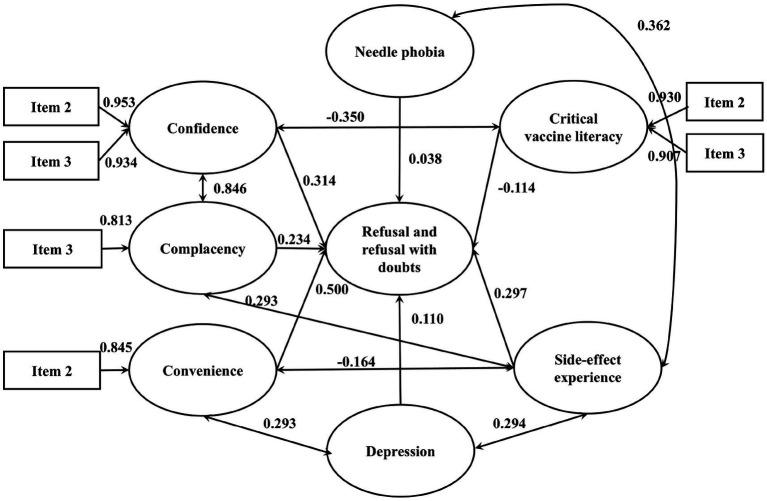
A high proportion (85.2%) of participants exhibited influenza vaccine hesitancy, with 16.2% being complete refusers. Key predictors of hesitancy included distrust in vaccine efficacy (adjusted Odds Ratio [aOR] = 2.28 for refusal), low perceived influenza severity (aOR = 5.59 for refusal), and overreliance on non-pharmaceutical interventions (NPIs) (aOR = 3.37 for refusal) and influenza-specific medication (aOR = 3.76). Limited health communication with community health workers (CHWs) and low family support significantly amplified refusal risks (aOR = 3.63). Higher vaccine knowledge reduced hesitancy (aOR = 1.85), though paradoxically, higher critical vaccine literacy correlated with refusal tendencies (aOR = 0.36). Significant standardized estimated coefficient () were observed between confidence and complacency ( = 0.846), side-effect experience and complacency ( = 0.293), side-effect experience and depression ( = 0.294), convenience and depression ( = 0.293), and side-effect experience and needle phobia ( = 0.362).
CONCLUSION
Vaccine confidence deficits and complacency regarding influenza severity are major drivers of hesitancy in older adults. This hesitancy is further exacerbated by COVID-19 vaccine skepticism and nuanced aspects of vaccine literacy. System-level interventions should integrate proactive vaccine counseling into routine care, strengthen family engagement in immunization decisions, and develop misinformation-resilient vaccine literacy programs specifically tailored for this vulnerable population.
目的
运用3C模型(信心、自满和便利性)及疫苗素养(VL)框架,调查中国上海老年人中流感疫苗犹豫(VH)的决定因素。本研究还探讨了新冠疫情后时代新冠疫苗犹豫对流感疫苗态度的潜在影响。
方法
2024年1月至6月,我们在中国上海开展了一项基于社区的横断面研究,纳入1300名年龄≥60岁的成年人。参与者通过分层随机抽样招募。纳入标准为:徐汇区年龄≥60岁的社区居住成年人。采用多项逻辑回归模型确定疫苗犹豫的预测因素,并对社会人口学变量、自我报告的健康状况和自我报告的疫苗接种经历进行调整。采用结构方程模型(SEM)来检验导致疫苗犹豫的潜在因素,并量化它们之间的相互关系。
结果
很大一部分(85.2%)参与者表现出流感疫苗犹豫,其中16.2%为完全拒绝者。犹豫的关键预测因素包括对疫苗效力的不信任(拒绝的调整优势比[aOR]=2.28)、对流感严重程度的低认知(拒绝的aOR=5.59)、对非药物干预(NPIs)的过度依赖(拒绝的aOR=3.37)以及对流感特异性药物的过度依赖(拒绝的aOR=3.76)。与社区卫生工作者(CHWs)的健康沟通有限以及家庭支持不足显著增加了拒绝风险(aOR=3.63)。较高的疫苗知识降低了犹豫程度(aOR=1.85),但矛盾的是,较高的批判性疫苗素养与拒绝倾向相关(aOR=0.36)。在信心和自满之间(=0.846)、副作用经历和自满之间(=0.293)、副作用经历和抑郁之间(=0.294)、便利性和抑郁之间(=0.293)以及副作用经历和针头恐惧之间(=0.362)观察到显著的标准化估计系数()。
结论
疫苗信心不足以及对流感严重程度的自满是老年人犹豫接种疫苗的主要驱动因素。新冠疫苗怀疑论以及疫苗素养的细微方面进一步加剧了这种犹豫。系统层面的干预措施应将积极的疫苗咨询纳入常规护理,加强家庭在免疫决策中的参与,并针对这一弱势群体制定具有抗错误信息能力的疫苗素养计划。



 Zotero 插件