
照射后细胞周期和剂量对线粒体DNA拷贝数变异的依赖性影响。
Cell cycle- and dose-dependent effects on mitochondrial DNA copy number variation following irradiation.
作者信息
Seino Ryosuke, Nishikubo Kai, Fukunaga Hisanori
机构信息
Department of Biomedical Science and Engineering, Faculty of Health Sciences, Hokkaido University, Sapporo 060-0812, Japan.
出版信息
J Cell Sci. 2025 Aug 1;138(15). doi: 10.1242/jcs.263642. Epub 2025 Aug 8.
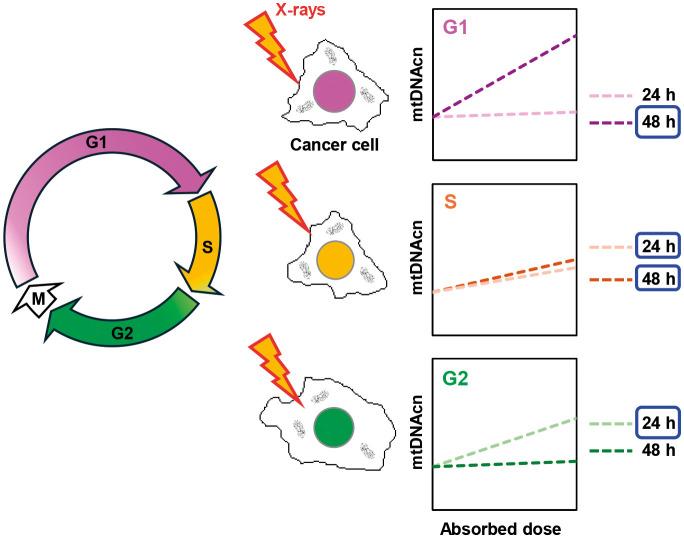
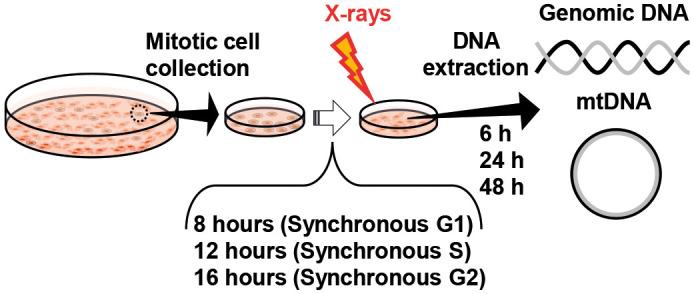
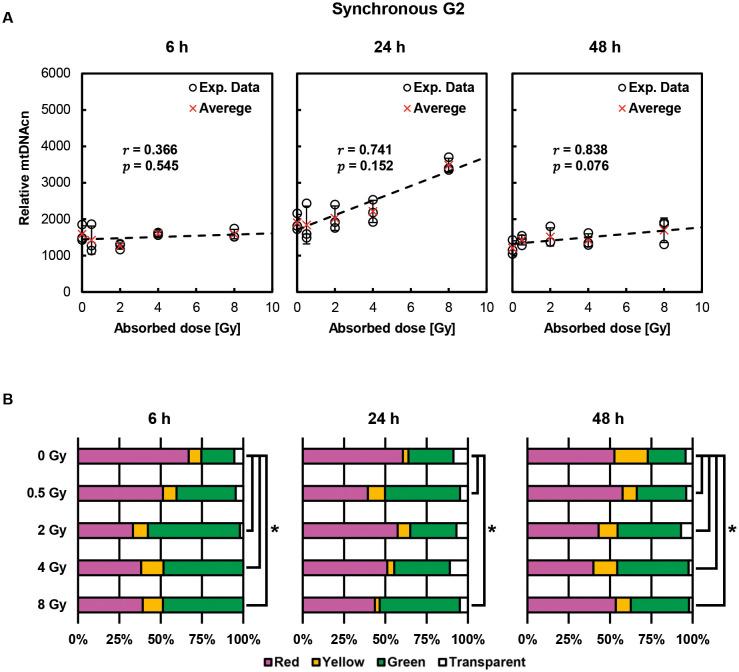
Cell survival after irradiation depends on the cell cycle at the time of exposure. This has been thought to be due to cell cycle-dependent nuclear DNA damage repair mechanisms. Here, we show the relationships between the exposed dose, the cell cycle phase at the time of exposure and changes in mitochondrial DNA copy numbers (mtDNAcn) after irradiation. We used a fluorescent ubiquitylation-based cell cycle indicator (FUCCI), which allows visualization of the cell cycle, and confirmed cell cycle synchronization in human cervical HeLa cells. In synchronous HeLa-FUCCI cells, the mtDNAcn changed with the progression of the cell cycle. Also, G1 phase-synchronized cells showed a dose-dependent increase of mtDNAcn at 48 h after X-ray exposure, whereas G2 cells showed a dose-dependent increase at 24 h. In addition, S phase-synchronized cells showed a dose-dependent increase at 24 and 48 h after irradiation. These results showed the cell cycle- and dose-dependent effects on mtDNAcn after irradiation, which might shed light on the emerging role of mitochondrial genome and in cell survival.
辐射后细胞的存活取决于照射时的细胞周期。人们一直认为这是由于细胞周期依赖性核DNA损伤修复机制所致。在此,我们展示了照射剂量、照射时的细胞周期阶段与辐射后线粒体DNA拷贝数(mtDNAcn)变化之间的关系。我们使用了一种基于荧光泛素化的细胞周期指示剂(FUCCI),它能够可视化细胞周期,并在人宫颈HeLa细胞中证实了细胞周期同步化。在同步化的HeLa-FUCCI细胞中,mtDNAcn随细胞周期的进展而变化。此外,G1期同步化细胞在X射线照射后48小时显示出mtDNAcn的剂量依赖性增加,而G2期细胞在24小时显示出剂量依赖性增加。另外,S期同步化细胞在照射后24小时和48小时显示出剂量依赖性增加。这些结果表明了辐射后细胞周期和剂量对mtDNAcn的依赖性影响,这可能有助于揭示线粒体基因组在细胞存活中的新作用。



 Zotero 插件