
多基因寿命评分与常见年龄相关疾病风险及死亡率的关联。
The association of a polygenic lifespan score with the risk of common age-related diseases and mortality.
作者信息
Tynkkynen Niko Paavo, Koivunen Kaisa, Herranen Päivi, Joensuu Laura, Törmäkangas Timo, Sillanpää Elina
机构信息
Faculty of Sport and Health Sciences, Gerontology Research Center (GEREC), University of Jyväskylä, Jyväskylä, Finland.
Wellbeing Services County of Central Finland, Jyväskylä, Finland.
出版信息
J Gerontol A Biol Sci Med Sci. 2025 Aug 23;80(9). doi: 10.1093/gerona/glaf156.
BACKGROUND
Aging increases the risk of major noncommunicable diseases. Research into the genetics of health-related traits could reveal genetic pathways for robustness against these diseases. We studied how a genetic predisposition for a long lifespan is associated with the risk of all-cause mortality and major age-related noncommunicable diseases.
METHODS
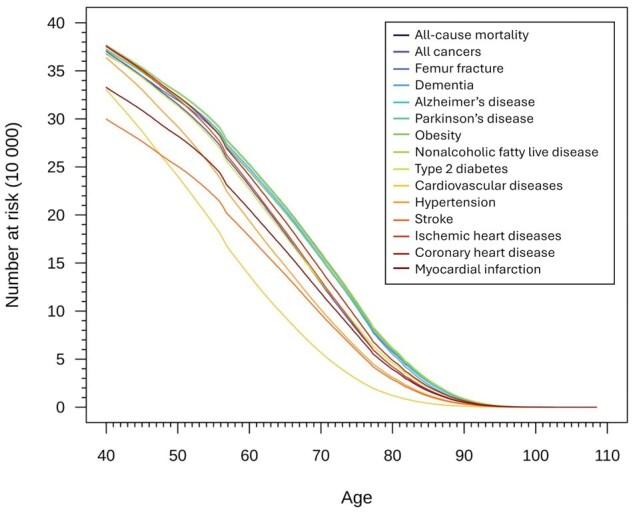
We analyzed data from 376 753 participants (mean age = 58.5 years; standard deviation = 13.9 years; 46.3% men) to examine how a polygenic lifespan score (PLS) is associated with the risk of all-cause mortality and major noncommunicable diseases. The associations between all-cause mortality, cancers, femur fracture, dementia, Alzheimer's disease, Parkinson's disease, type 2 diabetes, obesity, cardiovascular diseases, hypertension, ischemic heart diseases, coronary heart disease, stroke, and myocardial infarction were investigated using conventional and time-dependent Cox regression.
RESULTS
The PLS was associated with all the above-mentioned outcomes except for Parkinson's disease. Most of the associations were time-dependent, and the hazard ratio (HR) varied over time from protective to risk-increasing. However, the current PLS predicted noncommunicable disease risks with small effect sizes (lowest HR ≈ 0.70, highest HR ≈ 1.20, Cox-Snell pseudo-R2 > 0.01).
CONCLUSIONS
Genetic predisposition for a longer lifespan was associated with a smaller risk of common age-related noncommunicable diseases, suggesting greater robustness against these conditions. The lowest risks were found during periods when the incidences of diseases were greatest. The observed small effects highlight the need to better understand how accumulated environmental factors modify individual lifespans.
背景
衰老会增加患主要非传染性疾病的风险。对与健康相关性状的遗传学研究可能揭示抵御这些疾病的遗传途径。我们研究了长寿的遗传易感性如何与全因死亡率和主要的年龄相关非传染性疾病的风险相关联。
方法
我们分析了376753名参与者(平均年龄 = 58.5岁;标准差 = 13.9岁;46.3%为男性)的数据,以研究多基因寿命评分(PLS)如何与全因死亡率和主要非传染性疾病的风险相关联。使用传统的和时间依赖性Cox回归研究全因死亡率、癌症、股骨骨折、痴呆、阿尔茨海默病、帕金森病、2型糖尿病、肥胖、心血管疾病、高血压、缺血性心脏病、冠心病、中风和心肌梗死之间的关联。
结果
PLS与除帕金森病外的所有上述结局相关。大多数关联是时间依赖性的,危险比(HR)随时间从具有保护作用变为增加风险。然而,当前的PLS预测非传染性疾病风险的效应量较小(最低HR≈0.70,最高HR≈1.20,Cox-Snell伪R2>0.01)。
结论
更长寿命的遗传易感性与常见的年龄相关非传染性疾病的较小风险相关,表明对这些疾病具有更强的抵抗力。在疾病发病率最高的时期发现风险最低。观察到的小效应凸显了更好地理解累积环境因素如何改变个体寿命的必要性。


 Zotero 插件