
接受胸部放疗的胸内癌患者循环可溶性成纤维细胞激活蛋白(FAP)
Circulating soluble fibroblast activation protein (FAP) in patients with intra-thoracic cancer undergoing chest radiation.
作者信息
Lange Tim, Renko Alexandra, Flierl Ulrike, Ademmer Felix B, Bauersachs Johann, Christiansen Hans, Tillmanns Jochen
机构信息
Department of Radiation Oncology, Hannover Medical School, Carl-Neuberg-Str. 1, 30625, Hannover, Germany.
Department of Cardiology and Angiology, Hannover Medical School, Carl-Neuberg-Str. 1, 30625, Hannover, Germany.
出版信息
Discov Oncol. 2025 Jul 21;16(1):1381. doi: 10.1007/s12672-025-02998-y.
INTRODUCTION
Circulating soluble fibroblast activation protein (FAP) is implicated in myocardial infarction, stroke, fibrosis and various cancers. This study investigates changes in FAP concentrations in patients with intra-thoracic malignancies undergoing chest radiation therapy to assess its potential as a biomarker for radiation-induced organ injury.
METHODS
Eighteen patients with intra-thoracic cancers (lung, esophagus and metastatic) received chest radiation therapy. Blood samples were taken before and after treatment, and FAP concentrations were measured using an ELISA assay. A control group of 53 healthy volunteers was included for comparison.
RESULTS
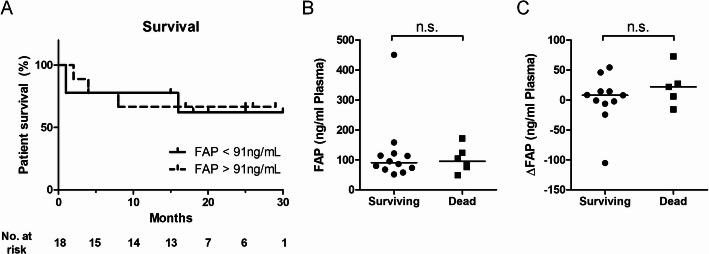
Baseline FAP concentrations were significantly lower in cancer patients (median 91 ng/mL, 25th-75th percentiles 72-123 ng/mL) compared to healthy controls (median 118 ng/mL, 25th-75th percentiles 104-140 ng/mL, P = 0.0002). No significant difference in FAP concentrations was found between baseline and post-radiation samples (median 91 vs. 108 ng/mL, P = 0.19). FAP concentrations were not influenced by cancer type, radiation dose or chemotherapy and did not predict patient survival. Time between baseline and final blood sampling was 31 days median (range 9-46 days) and median follow-up period was 20 months (range 15-30 months).
CONCLUSION
Our findings indicate that FAP concentrations do not reflect radiation-induced inflammation or fibrosis in the early period after radiation therapy. The small patient cohort and short duration between radiation therapy and FAP measurement may have limited our ability to detect changes in FAP related to long-term radiation effects. Further research with larger cohorts and longer follow-up periods is needed to better understand the role of FAP in cancer and response to radiation injury.
引言
循环可溶性成纤维细胞活化蛋白(FAP)与心肌梗死、中风、纤维化及多种癌症有关。本研究调查接受胸部放射治疗的胸内恶性肿瘤患者FAP浓度的变化,以评估其作为辐射诱导器官损伤生物标志物的潜力。
方法
18例胸内癌症(肺癌、食管癌及转移性癌)患者接受胸部放射治疗。在治疗前后采集血样,采用酶联免疫吸附测定法测量FAP浓度。纳入53名健康志愿者作为对照组进行比较。
结果
与健康对照组(中位数118 ng/mL,第25-75百分位数104-140 ng/mL,P = 0.0002)相比,癌症患者的基线FAP浓度显著较低(中位数91 ng/mL,第25-75百分位数72-123 ng/mL)。在基线样本和放疗后样本之间未发现FAP浓度有显著差异(中位数91对108 ng/mL,P = 0.19)。FAP浓度不受癌症类型、放射剂量或化疗的影响,也不能预测患者生存情况。基线与最后一次采血之间的时间中位数为31天(范围9-46天),中位随访期为20个月(范围15-30个月)。
结论
我们的研究结果表明,FAP浓度在放疗后的早期阶段不能反映辐射诱导的炎症或纤维化。患者队列较小以及放疗与FAP测量之间的时间较短,可能限制了我们检测与长期辐射效应相关的FAP变化的能力。需要进行更大队列和更长随访期的进一步研究,以更好地了解FAP在癌症及辐射损伤反应中的作用。


 Zotero 插件