
通过弥合精子成熟机制方面的知识差距来改进辅助生殖中的精子筛选策略。
Improving sperm selection strategies for assisted reproduction through closing the knowledge gap in sperm maturation mechanics.
作者信息
Hart Hanah May, Nixon Brett, Martin Jacinta Hope, Aitken Robert John, De Iuliis Geoffry Nunzio
机构信息
Centre for Reproductive Science, School of Environmental and Life Sciences, College of Engineering, Science and Environment, University of Newcastle, Callaghan, NSW, Australia.
Infertility and Reproduction Research Program, Hunter Medical Research Institute, New Lambton Heights, NSW, Australia.
出版信息
Hum Reprod Open. 2025 Jul 3;2025(3):hoaf040. doi: 10.1093/hropen/hoaf040. eCollection 2025.
BACKGROUND
Male factors contribute to ∼50% of all infertility cases globally and are a major contributor to escalating use of ART. In most instances, sub-fertile men retain the ability to produce spermatozoa, albeit with reduced quality and function. By necessity, an important feature of ART is the use of technologies that bypass the natural selection barriers that prevent poor-quality spermatozoa from participating in fertilization. This means that ART carries a significant risk of facilitating fertilization with poor-quality gametes harbouring undetected DNA damage and/or altered epigenomes. Such a scenario may account for the epidemiological links between the use of 'high intervention' technologies [e.g. ICSI] and an increased risk of adverse offspring outcomes. Such data highlight a pressing need for improved sperm selection tools that better mimic natural selection barriers, to ensure only the highest-quality spermatozoa are used for ART.
OBJECTIVE AND RATIONALE
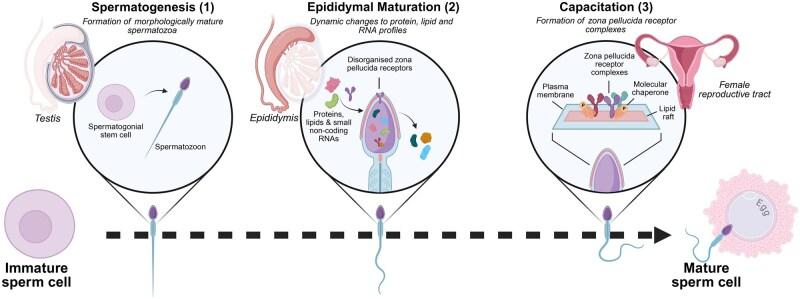
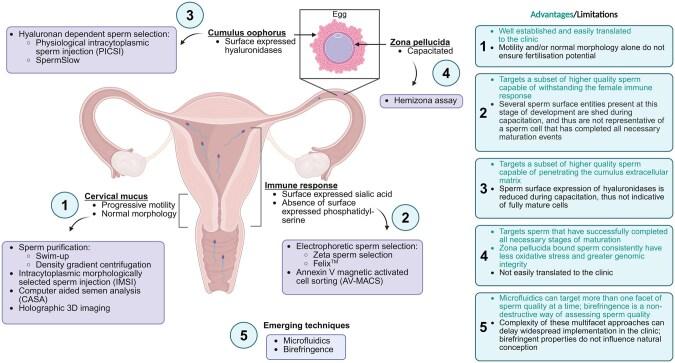
Current sperm selection techniques for ART and the processes underpinning sperm maturation have often been considered independently and therefore reviewed separately. Here we outline the requirement for connecting research paradigms towards advancing clinical outcomes. This review highlights the importance of combining our advancing knowledge of sperm maturation biology with the pursuit of rational sperm selection strategies for the clinic; specifically, this narrative review summarizes the current clinical technologies used for sperm selection with a focus on their physiological relevance and limitations. We have given consideration to the events associated with sperm maturation and the importance of zona pellucida (ZP) binding as inspiration to inform the development of the next generation of sperm selection strategies. The connections and information presented should provide utility and interest for both clinicians and reproductive biologists alike.
SEARCH METHODS
The PubMed database was queried using the keywords: sperm selection/function/DNA quality/epigenome, ART, ICSI, male infertility, capacitation, zona pellucida, sperm-zona pellucida binding, DNA damage, and biofabrication. These keywords were combined with other relevant phrases. Literature was restricted to peer-reviewed articles in English (published between 1972 and 2024) with references within these articles also searched.
OUTCOMES
During natural conception, high-quality sperm are 'selected', maximizing the chances of fertilization with healthy gametes carrying intact genomic/epigenetic cargo. This sub-population of spermatozoa possess the capacity to interact with the female reproductive tract and complete the suite of functional maturation processes required for successful fertilization and initiation of embryonic development. However, ART 'high intervention' strategies bypass these selective barriers leading to an increased risk of inadvertently transferring genomic defects to the offspring with potential downstream consequences for offspring health. This review contextualizes why current sperm selection technologies have provided only minor improvement to live birth rates following ART. We posit that capitalizing on sperm-ZP binding (the penultimate step of successful fertilization) with novel ZP mimetic technologies provides an attractive, but understudied, tool for clinical selection of fertilization-competent spermatozoa for ART improvement.
LIMITATIONS REASONS FOR CAUTION
The risk of bias in the interpretation of findings for a narrative review cannot be completely eliminated. Literature was limited to the language the authors speak: English.
WIDER IMPLICATIONS
ART has provided transformative advancement for infertile couples, however, gaps in our fundamental understanding of how the best gametes are 'selected' during natural conception, which when unaccounted for during clinical conception, present a risk of continued reliance on ART and health consequences for the next generation. The purpose of this article was to contextualize our current knowledge across both sperm maturation events and current selection strategies for these cells in the clinic. We outline the potential for improved clinical outcomes through the advancement of our understanding in gamete biology in concert with the development of novel methods for artificial gamete selection.
STUDY FUNDING/COMPETING INTERESTS: No external funding, but financial support was received from the School of Environmental and Life Sciences, University of Newcastle, Australia. R.J.A. is a scientific advisor to Memphasys Ltd, a biotechnology company with interests in reproductive health and responsible for developing the Felix™ electrophoretic sperm isolation device. R.J.A. receives salary and grant from, and has stock in, Memphasys Ltd. The other authors declare no conflicts of interest.
背景
在全球所有不孕不育病例中,男性因素约占50%,并且是辅助生殖技术(ART)使用不断增加的主要原因。在大多数情况下,生育能力低下的男性仍具备产生精子的能力,尽管精子质量和功能有所下降。ART的一个重要特征必然是使用一些技术来绕过自然选择屏障,这些屏障会阻止质量差的精子参与受精过程。这意味着ART存在很大风险,即促成与携带未检测到的DNA损伤和/或表观基因组改变的劣质配子受精。这种情况可能解释了“高干预”技术(如卵胞浆内单精子注射[ICSI])的使用与不良后代结局风险增加之间的流行病学关联。这些数据凸显了迫切需要改进精子选择工具,使其更好地模拟自然选择屏障,以确保仅使用最高质量的精子进行ART。
目的与理论依据
目前用于ART的精子选择技术以及精子成熟的基础过程常常被独立看待,因此分别进行了综述。在此,我们概述了将研究范式联系起来以推进临床结果的必要性。本综述强调了将我们对精子成熟生物学不断深入的认识与追求合理的临床精子选择策略相结合的重要性;具体而言,这篇叙述性综述总结了当前用于精子选择的临床技术,重点关注其生理相关性和局限性。我们考虑了与精子成熟相关的事件以及透明带(ZP)结合的重要性,以此为灵感来指导下一代精子选择策略的开发。所呈现的联系和信息应该对临床医生和生殖生物学家都有用且有吸引力。
检索方法
使用关键词“精子选择/功能/DNA质量/表观基因组”“ART”“ICSI”“男性不育”“获能”“透明带”“精子 - 透明带结合”“DNA损伤”和“生物制造”查询PubMed数据库。这些关键词与其他相关短语相结合。文献限于英文同行评审文章(发表于1972年至2024年之间),并对这些文章中的参考文献也进行了检索。
结果
在自然受孕过程中,高质量精子被“选择”出来,从而最大化了与携带完整基因组/表观遗传物质的健康配子受精的机会。这一精子亚群具备与女性生殖道相互作用并完成成功受精和启动胚胎发育所需的一系列功能成熟过程的能力。然而,ART的“高干预”策略绕过了这些选择屏障,导致无意中将基因组缺陷传递给后代的风险增加,对后代健康可能产生潜在的下游影响。本综述阐述了为什么当前的精子选择技术在ART后对活产率仅带来了微小的改善。我们认为,利用精子 - ZP结合(成功受精的倒数第二步)以及新型ZP模拟技术,为临床选择有受精能力的精子以改善ART提供了一种有吸引力但研究不足的工具。
局限性及注意事项
叙述性综述对研究结果解释存在偏差的风险无法完全消除。文献限于作者所使用的语言:英语。
更广泛的影响
ART为不孕夫妇带来了变革性的进展,然而,我们对自然受孕过程中如何“选择”最佳配子这一基本理解存在差距,而在临床受孕过程中未考虑到这一点,就存在继续依赖ART以及对下一代健康产生影响的风险。本文的目的是梳理我们目前在精子成熟事件以及临床中这些细胞的当前选择策略方面的知识。我们概述了通过深化对配子生物学的理解并结合开发新型人工配子选择方法来改善临床结果的潜力。
研究资金/利益冲突:无外部资金,但获得了澳大利亚纽卡斯尔大学环境与生命科学学院的资金支持。R.J.A.是Memphasys Ltd公司的科学顾问,该生物技术公司对生殖健康领域感兴趣,负责开发Felix™电泳精子分离装置。R.J.A.从Memphasys Ltd公司获得薪水、资助并持有该公司股票。其他作者声明无利益冲突。
 Zotero 插件