
基于人参的纳米疗法在癌症治疗中的应用:最新进展、应对差距及转化成果
Ginseng-Based Nanotherapeutics in Cancer Treatment: State-of-the-Art Progress, Tackling Gaps, and Translational Achievements.
作者信息
Tiwari Pragya, Park Kyeung-Il
机构信息
Department of Horticulture and Life Science, Yeungnam University, Gyeongsan 38541, Republic of Korea.
出版信息
Curr Issues Mol Biol. 2025 Apr 3;47(4):250. doi: 10.3390/cimb47040250.
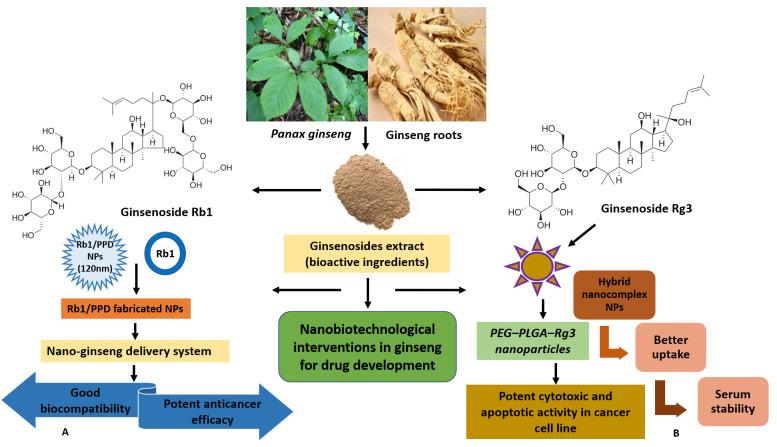
Among medicinal plants, the genus (family: ) includes plant species widely recognized for their multi-faceted pharmacological attributes. The triterpenoids, designated as ginsenosides, are increasingly recognized as drug-like molecules in cancer therapies due to their therapeutic role in restricting tumor invasion, proliferation, metastasis, apoptosis, and drug resistance reversal in tumor cells. In the nanobiotechnological era, nano-delivery systems provide feasible solutions to address bottlenecks associated with traditional drug delivery methods (low bioavailability, instability in the gastrointestinal tract, high dosage requirements, side effects, poor absorption, and incomplete drug utilization in the body). The dedicated efforts for precise and effective treatment have directed the development of ginsenoside-based nano-delivery systems to achieve potent anticancer efficacies and address the limitations in ginseng pharmacokinetics, facilitating drug development trials. Studies into ginseng pharmacokinetics showed a remarkable prolonged clearance and free drug levels of ~15% (ginsenoside RB1 nanoparticles) in mice (compared to only ~5% for ginsenosides) and better antitumor efficacies, demonstrating key success in ginseng biotechnology for drug development. Delving into the nanobiotechnological interventions in ginseng-derived therapeutics, this study summarizes current advances and achievements, particularly in cancer treatment, tackles existing gaps, focuses on feasible solutions, and examines prospects of translational success.
在药用植物中,该属(科: )包含因其多方面药理特性而被广泛认可的植物物种。被称为人参皂苷的三萜类化合物,由于其在限制肿瘤细胞侵袭、增殖、转移、凋亡以及逆转肿瘤细胞耐药性方面的治疗作用,在癌症治疗中越来越被视为类药物分子。在纳米生物技术时代,纳米递送系统为解决与传统药物递送方法相关的瓶颈(生物利用度低、胃肠道不稳定、高剂量需求、副作用、吸收差以及体内药物利用不完全)提供了可行的解决方案。为实现精确有效的治疗所做的不懈努力推动了基于人参皂苷的纳米递送系统的发展,以实现强大的抗癌功效并解决人参药代动力学方面的局限性,促进药物开发试验。对人参药代动力学的研究表明,小鼠体内的清除率显著延长,游离药物水平达到约15%(人参皂苷RB1纳米颗粒)(相比之下人参皂苷仅约为5%),且具有更好的抗肿瘤功效,证明了人参生物技术在药物开发方面取得的关键成功。本研究深入探讨人参衍生疗法中的纳米生物技术干预措施,总结当前的进展和成就,特别是在癌症治疗方面,解决现有差距,关注可行的解决方案,并审视转化成功的前景。


 Zotero 插件