
将人工智能整合到下一代测序中:进展、挑战与未来方向。
Integrating Artificial Intelligence in Next-Generation Sequencing: Advances, Challenges, and Future Directions.
作者信息
Athanasopoulou Konstantina, Michalopoulou Vasiliki-Ioanna, Scorilas Andreas, Adamopoulos Panagiotis G
机构信息
Department of Biochemistry and Molecular Biology, Faculty of Biology, National and Kapodistrian University of Athens, 15701 Athens, Greece.
出版信息
Curr Issues Mol Biol. 2025 Jun 19;47(6):470. doi: 10.3390/cimb47060470.
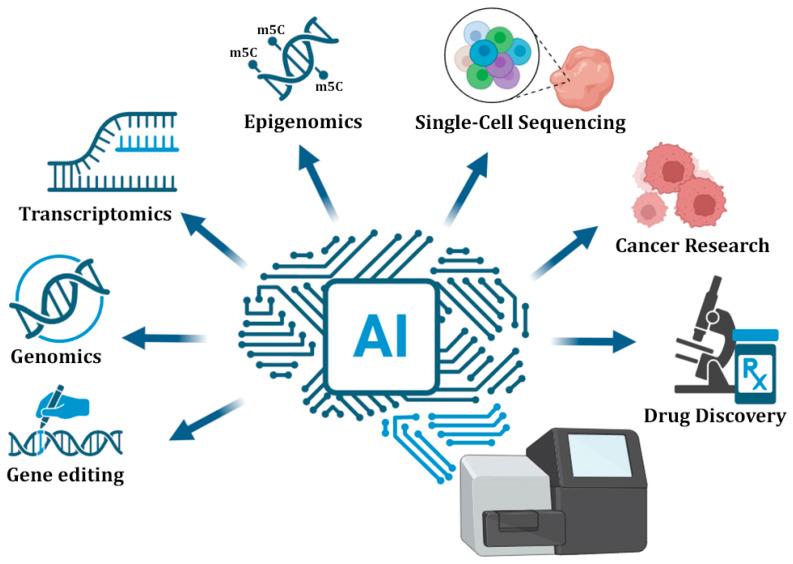
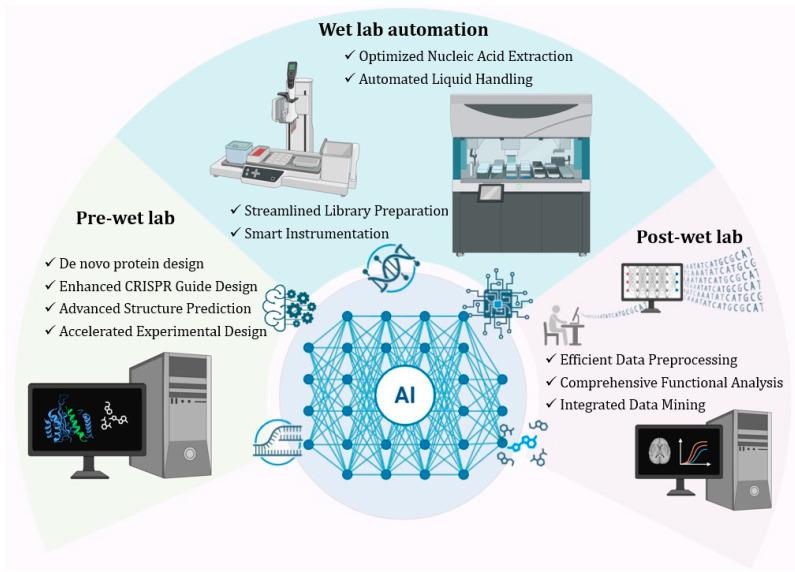
The integration of artificial intelligence (AI) into next-generation sequencing (NGS) has revolutionized genomics, offering unprecedented advancements in data analysis, accuracy, and scalability. This review explores the synergistic relationship between AI and NGS, highlighting its transformative impact across genomic research and clinical applications. AI-driven tools, including machine learning and deep learning, enhance every aspect of NGS workflows-from experimental design and wet-lab automation to bioinformatics analysis of the generated raw data. Key applications of AI integration in NGS include variant calling, epigenomic profiling, transcriptomics, and single-cell sequencing, where AI models such as CNNs, RNNs, and hybrid architectures outperform traditional methods. In cancer research, AI enables precise tumor subtyping, biomarker discovery, and personalized therapy prediction, while in drug discovery, it accelerates target identification and repurposing. Despite these advancements, challenges persist, including data heterogeneity, model interpretability, and ethical concerns. This review also discusses the emerging role of AI in third-generation sequencing (TGS), addressing long-read-specific challenges, like fast and accurate basecalling, as well as epigenetic modification detection. Future directions should focus on implementing federated learning to address data privacy, advancing interpretable AI to improve clinical trust and developing unified frameworks for seamless integration of multi-modal omics data. By fostering interdisciplinary collaboration, AI promises to unlock new frontiers in precision medicine, making genomic insights more actionable and scalable.
将人工智能(AI)整合到下一代测序(NGS)中,彻底改变了基因组学,在数据分析、准确性和可扩展性方面带来了前所未有的进步。本综述探讨了AI与NGS之间的协同关系,强调了其在基因组研究和临床应用中的变革性影响。由AI驱动的工具,包括机器学习和深度学习,提升了NGS工作流程的各个方面——从实验设计和湿实验室自动化到对生成的原始数据进行生物信息学分析。AI整合在NGS中的关键应用包括变异检测、表观基因组分析、转录组学和单细胞测序,其中卷积神经网络(CNNs)、循环神经网络(RNNs)和混合架构等AI模型优于传统方法。在癌症研究中,AI能够实现精确的肿瘤亚型分类、生物标志物发现和个性化治疗预测,而在药物发现中,它能加速靶点识别和药物重新利用。尽管取得了这些进展,但挑战依然存在,包括数据异质性、模型可解释性和伦理问题。本综述还讨论了AI在第三代测序(TGS)中的新兴作用,解决长读长测序特有的挑战,如快速准确的碱基识别以及表观遗传修饰检测。未来的方向应聚焦于实施联邦学习以解决数据隐私问题,推进可解释AI以提高临床信任度,并开发统一框架以实现多模态组学数据的无缝整合。通过促进跨学科合作,AI有望在精准医学领域开拓新的前沿,使基因组学见解更具可操作性和可扩展性。
 Zotero 插件