
尼泊尔结核病报告率的地理模式及其与社会经济因素的关联:一项空间横断面研究(2020 - 2023年)
Geographical patterns of tuberculosis notification rates and their association with socioeconomic factors in Nepal: a spatial cross-sectional study (2020-2023).
作者信息
Mahato Roshan Kumar, Htike Kyaw Min, Koro Alex Bagas, Sornlorm Kittipong, Yadav Rajesh Kumar, Kafle Alok, Sharma Vijay, Singh Dip Bahadur, Laohasiriwong Wongsa
机构信息
Department of Health Management Innovative Technology, Faculty of Public Health, Khon Kaen University, Nai Mueang, Khon Kaen, Thailand.
School of Health and Allied Sciences, Pokhara University, Pokhara, Nepal.
出版信息
BMJ Open. 2025 Jul 22;15(7):e093858. doi: 10.1136/bmjopen-2024-093858.
OBJECTIVES
To identify the patterns of tuberculosis (TB) notification rates and examine their relationship with social and economic determinants in Nepal between 2020 and 2023.
DESIGN
Cross-sectional study.
SETTING
Nepal.
PARTICIPANTS
All TB cases across all ages.
PRIMARY OUTCOME
Prevalence of TB cases.
METHODS
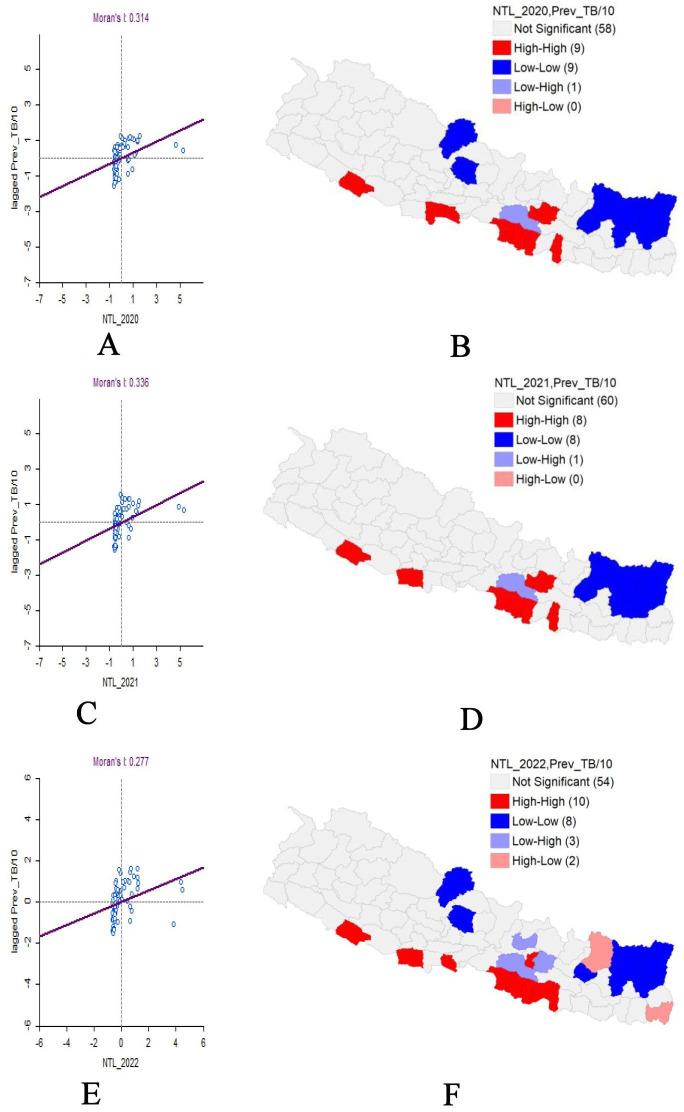
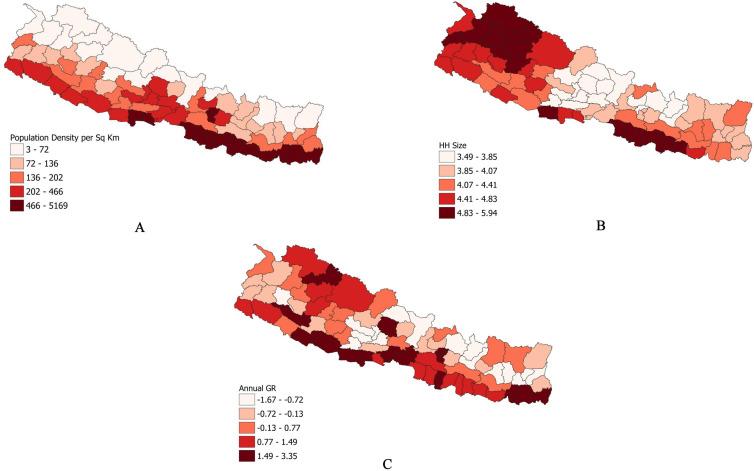
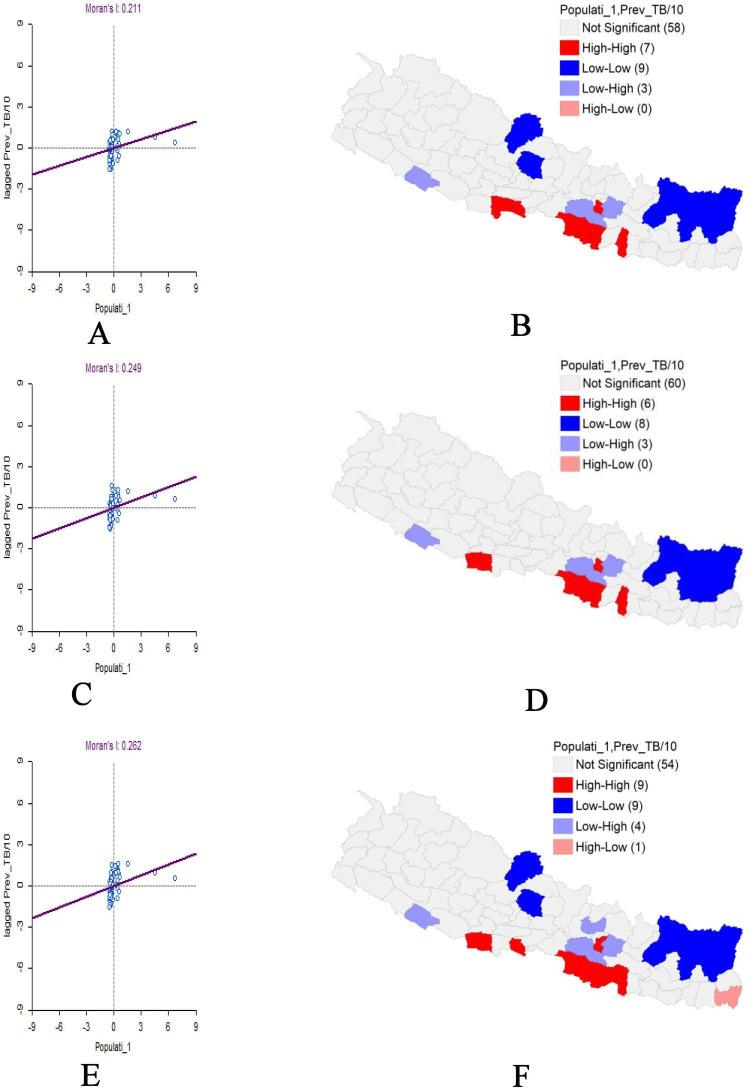
This cross-sectional spatial analysis used the data set of the National Tuberculosis Control Centre, Nepal, covering the Fiscal Year (FY) 2020-2021 to 2022-2023. Moran's I and Local Indicators of Spatial Association were employed to detect the spatial autocorrelation between the prevalence of TB and associated social and demographic factors.
RESULTS
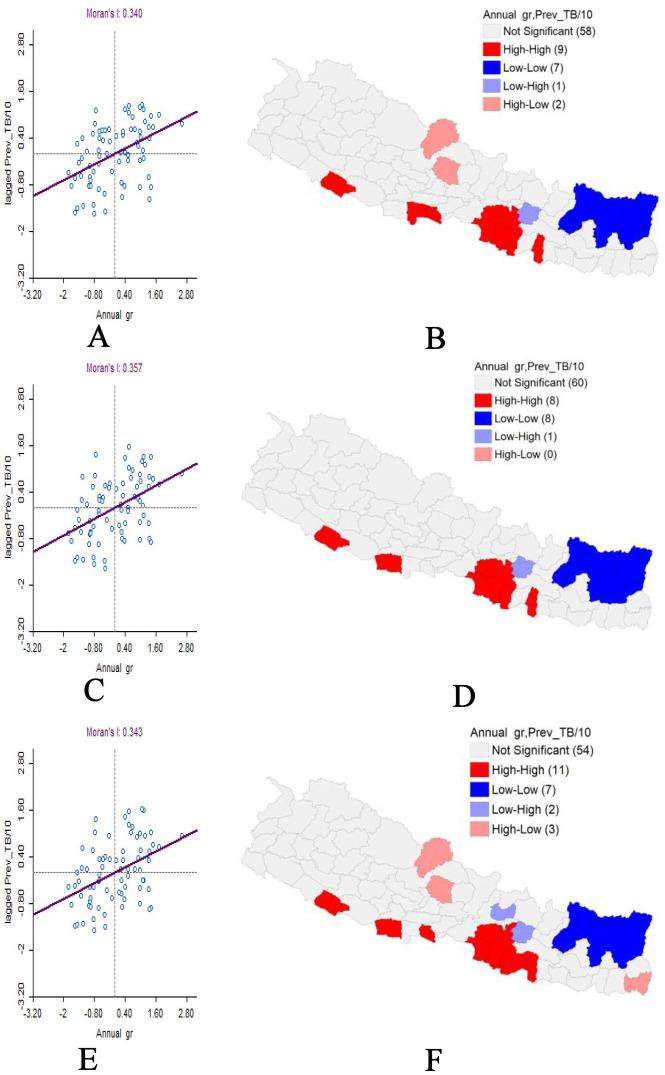
The overall prevalence rate for TB in FY 2020-2021 was 98.08 per 100 000 population. This increased to 129.82 per 100 000 population in FY 2021-2022, followed by a slight decrease to 128.39 per 100 000 population in FY 2022-2023. The highest TB prevalence was observed in Kathmandu, with 146 cases per 100 000 population in 2020-2021, and in Dang district, the rate decreased from 215-191 per 100 000 population. We investigated the spatial patterns of TB prevalence and highlighted the geographic areas in each district in Nepal from 2021 to 2023 with Moran's I of 0.558, 0.614 and 0.596, respectively. The consistent identification of High-High clusters in specific districts like Banke, Kapilbastu and Parsa across all 3 years periods highlighted persistent high-risk areas for TB transmission in Nepal.
CONCLUSIONS
This study emphasised the strong spatial associations and the complex, diverse aspects of TB transmission shaped by demographic and socioeconomic factors. Our results highlighted the need for tailored public health approaches that account for specific social determinants to address TB effectively.
目的
确定2020年至2023年尼泊尔结核病通报率模式,并研究其与社会和经济决定因素之间的关系。
设计
横断面研究。
地点
尼泊尔。
参与者
所有年龄段的所有结核病病例。
主要结果
结核病病例的患病率。
方法
这项横断面空间分析使用了尼泊尔国家结核病控制中心的数据集,涵盖2020 - 2021财政年度至2022 - 2023财政年度。采用莫兰指数(Moran's I)和局部空间自相关指标来检测结核病患病率与相关社会和人口因素之间的空间自相关性。
结果
2020 - 2021财政年度结核病的总体患病率为每10万人口98.08例。在2021 - 2022财政年度,这一数字增至每10万人口129.82例,随后在2022 - 2023财政年度略有下降,降至每10万人口128.39例。加德满都的结核病患病率最高,在2020 - 2021年每10万人口中有146例,而在当区,该比率从每10万人口215例降至191例。我们调查了结核病患病率的空间模式,并突出显示了2021年至2023年尼泊尔每个地区的地理区域,莫兰指数分别为0.558、0.614和0.596。在所有3年期间,班凯、卡皮尔巴斯图和帕尔萨等特定地区持续出现高高聚集区,突出表明尼泊尔存在结核病传播的持续高风险地区。
结论
本研究强调了结核病传播在空间上的强烈关联以及由人口和社会经济因素塑造的复杂多样的方面。我们的结果突出表明,需要采取针对具体社会决定因素的定制化公共卫生方法,以有效应对结核病。



 Zotero 插件