
自愿运动通过调节线粒体功能障碍减轻小鼠缺血性脑损伤。
Voluntary exercise alleviates ischemic brain injury in mice by modulating mitochondrial dysfunction.
作者信息
Li Beibei, Zhou Ye, Yang Guifen, Li Bo, Zhu Mingjin, Lu Dan, Dai Senge, Pan Guoyuan
机构信息
Tongde Hospital of Zhejiang Province, No. 234, Gucui Road, Hangzhou, Zhejiang, China.
The First Affiliated Hospital of Zhejiang University of Chinese Medicine, No. 54, Post and Telecommunication Road, Hangzhou, Zhejiang, China.
出版信息
Iran J Basic Med Sci. 2025;28(7):846-851. doi: 10.22038/ijbms.2025.80783.17488.
OBJECTIVES
The relationship between exercise and mitochondrial function is unclear. This study investigated the relationship between voluntary exercise and mitochondrial dynamics in ischemic stroke model mice.
MATERIALS AND METHODS
This experiment used 54 male C57BL/6 J mice to assess the therapeutic effect of voluntary exercise on ischemic stroke in a middle cerebral artery occlusion (MCAO) model. Body weight and the number of wheel turns were recorded to monitor the physiological condition of the mice. The degree of brain injury was evaluated via hematoxylin and eosin (H&E) staining and measurement of the cerebral infarction volume. Western blotting and immunofluorescence were used to measure dynein-1-like protein 1 (DRP1), mitochondrial fission protein 1 (FIS1), and optic atrophy type 1 (OPA1) levels to assess mitochondrial dynamics and analyze the degree of mitochondrial apoptosis by measuring cytochrome c (CYT-C), cleaved caspase-3, and caspase-3 expression.
RESULTS
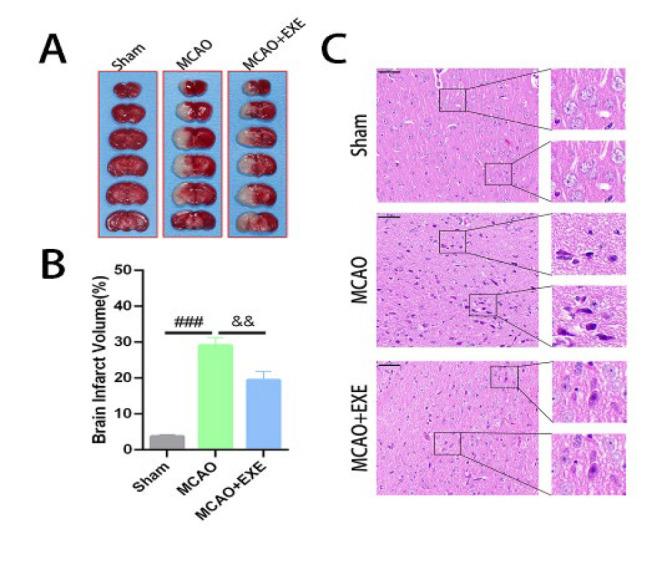
Voluntary exercise positively affected the behavioral score and infarct volume. H&E staining revealed that voluntary exercise reversed MCAO-induced cortical damage. Furthermore, voluntary exercise improved mitochondrial dynamics by inhibiting DRP1 and FIS1 expression and inducing OPA1 expression. Additionally, the mitochondrial apoptosis pathway was inhibited by down-regulating the expression of CYT-C, cleaved caspase-3, and caspase-3.
CONCLUSION
Voluntary exercise exerts a significant neuroprotective effect against MCAO-induced brain injury by regulating mitochondrial dynamics and the mitochondrial apoptotic pathway.
目的
运动与线粒体功能之间的关系尚不清楚。本研究调查了缺血性中风模型小鼠中自主运动与线粒体动力学之间的关系。
材料与方法
本实验使用54只雄性C57BL/6 J小鼠,以评估自主运动对大脑中动脉闭塞(MCAO)模型中缺血性中风的治疗效果。记录体重和轮转次数以监测小鼠的生理状况。通过苏木精和伊红(H&E)染色及测量脑梗死体积来评估脑损伤程度。采用蛋白质免疫印迹法和免疫荧光法检测动力蛋白样蛋白1(DRP1)、线粒体分裂蛋白1(FIS1)和视神经萎缩蛋白1(OPA1)水平,以评估线粒体动力学,并通过测量细胞色素c(CYT-C)、裂解的半胱天冬酶-3和半胱天冬酶-3的表达来分析线粒体凋亡程度。
结果
自主运动对行为评分和梗死体积有积极影响。H&E染色显示,自主运动可逆转MCAO诱导的皮质损伤。此外,自主运动通过抑制DRP1和FIS1表达并诱导OPA1表达来改善线粒体动力学。此外,通过下调CYT-C、裂解的半胱天冬酶-3和半胱天冬酶-3的表达,线粒体凋亡途径受到抑制。
结论
自主运动通过调节线粒体动力学和线粒体凋亡途径,对MCAO诱导的脑损伤发挥显著的神经保护作用。



 Zotero 插件