
甲状腺功能与牙周炎之间的关联:一种使用美国国家健康与营养检查调查(NHANES)的机器学习方法
Associations Between Thyroid Function and Periodontitis: A Machine Learning Approach Using NHANES.
作者信息
Wang Han, Tian Suyan, Bai Sen, Yang Chunqi, Jiang Zhengang, Li Nannan
机构信息
The First Department of Oral and Maxillofacial Surgery & Oral Plastic and Aesthetic Surgery, Hospital of Stomatology, Jilin University, Changchun, Jilin, China.
Division of Clinical Research, The First Hospital of Jilin University, Changchun, Jilin, China.
出版信息
Int Dent J. 2025 Jul 23;75(5):100921. doi: 10.1016/j.identj.2025.100921.
INTRODUCTION
Thyroid dysfunction alters bone metabolism and is associated with osteoporosis. Since periodontitis involves alveolar bone loss, and thyroid disorders may impair immune regulation as well as bone remodeling, we hypothesized that thyroid hormone (TH) levels could predict the risk and severity of periodontitis. However, this potential association remains understudied to date.
METHODS
This study utilized cross-sectional data from the 2009-2010 and 2011-2012 National Health and Nutrition Examination Survey (NHANES) cycles, comprising 2352 eligible participants: 704 without periodontitis and 1648 with periodontitis. We analyzed the data using multiple machine learning (ML) approaches, including eXtreme Gradient Boosting (XGBoost), random forest (RF), support vector machine (SVM), logistic regression (LR), and multilayer perceptron (MLP). Predictive models were developed using thyroid function parameters and clinical characteristics.
RESULTS
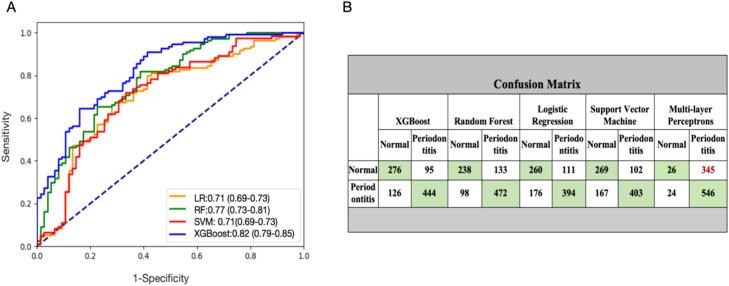
XGBoost demonstrated the highest performance for both binary and multi-class classification tasks, while MLP performed worse compared to other models. For binary classification, the XGBoost model achieved an average area under the ROC curve (AUC) of 0.854, a recall of 0.760, a precision of 0.760, and an F1-score of 0.754 across 5-fold cross-validations (CV). Thyroid-stimulating hormone (TSH) emerged as a top predictor in feature importance analysis, alongside age and body mass index (BMI). Similarly, for multi-classclassification, TSH ranked highly in both feature importance and SHAP value analyses. Models excluding thyroid function variables exhibited significantly inferior performance compared to those incorporating them.
CONCLUSIONS
Our findings suggest that thyroid parameters, particularly TSH, might predict risk for periodontitis and serve as its biomarkers, thereby enabling early intervention and personalized patient care. Further validation through larger, prospective studies is warranted to confirm these observations.
引言
甲状腺功能障碍会改变骨代谢并与骨质疏松症相关。由于牙周炎涉及牙槽骨丧失,且甲状腺疾病可能损害免疫调节以及骨重塑,我们推测甲状腺激素(TH)水平可预测牙周炎的风险和严重程度。然而,这种潜在关联迄今为止仍研究不足。
方法
本研究利用了2009 - 2010年和2011 - 2012年国家健康和营养检查调查(NHANES)周期的横断面数据,包括2352名符合条件的参与者:704名无牙周炎患者和1648名有牙周炎患者。我们使用多种机器学习(ML)方法分析数据,包括极端梯度提升(XGBoost)、随机森林(RF)、支持向量机(SVM)、逻辑回归(LR)和多层感知器(MLP)。使用甲状腺功能参数和临床特征建立预测模型。
结果
对于二分类和多分类任务,XGBoost表现出最高性能,而MLP与其他模型相比表现较差。对于二分类,XGBoost模型在5折交叉验证(CV)中,ROC曲线下面积(AUC)平均为0.854,召回率为0.760,精确率为0.760,F1分数为0.754。促甲状腺激素(TSH)在特征重要性分析中与年龄和体重指数(BMI)一起成为顶级预测因子。同样,对于多分类任务,TSH在特征重要性和SHAP值分析中均排名靠前。与纳入甲状腺功能变量的模型相比,排除甲状腺功能变量的模型表现明显较差。
结论
我们的研究结果表明,甲状腺参数,尤其是TSH,可能预测牙周炎风险并作为其生物标志物,从而实现早期干预和个性化患者护理。有必要通过更大规模的前瞻性研究进行进一步验证以证实这些观察结果。



 Zotero 插件