
磁纳米阱富集技术助力对环境水样中的混合纳米塑料颗粒进行超灵敏定量分析。
MagNanoTrap enrichment empowers ultra-sensitive quantification of mixed nanoplastic particles from environmental water samples.
作者信息
Mao Maochao, Bienstein Marian, Contreras Francisca, Wang Dong, Feng Lilin, Schwaneberg Ulrich
机构信息
Lehrstuhl für Biotechnologie, RWTH Aachen University, Worringerweg 3, 52074 Aachen, Germany.
出版信息
Res Sq. 2025 Jul 14:rs.3.rs-6254645. doi: 10.21203/rs.3.rs-6254645/v1.
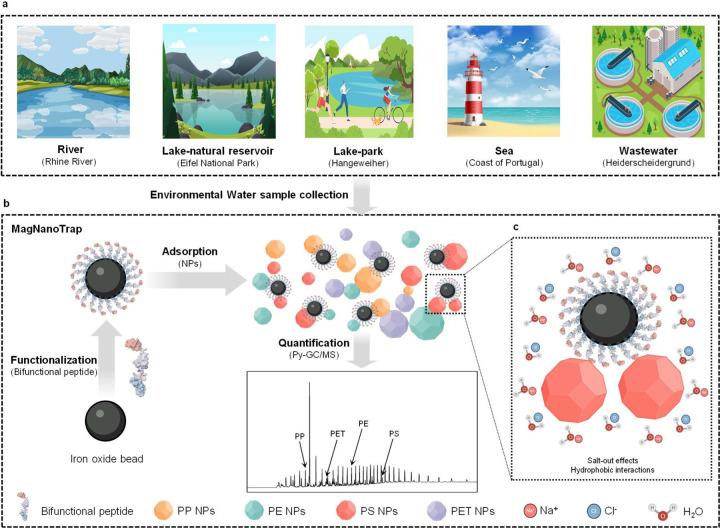
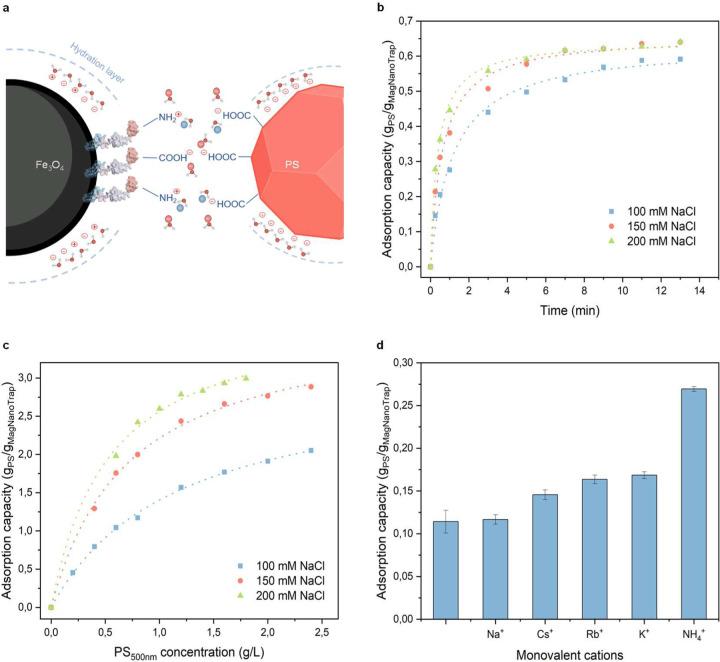
Detection and quantification of nanoplastic particles (NPs) in environmental water are important for monitoring NPs' fate and assessing health impacts, but the lack of sensitive and universal detection systems hinders regulation according to the EU Commission (Allan, J. et al., 2021). The MagNanoTrap termed enrichment platform is based on a bifunctional peptide (LCI-DZ-MBP1) combined with FeO superparamagnetic nanoparticles (SPIONs); the bifunctional peptide was designed to decorate SPIONs for NPs capture, with the LCI-peptide binding to SPIONs and the MBP1-peptide acting as a general binder for polypropylene (PP), polyethylene (PE), polystyrene (PS), and polyethylene terephthalate (PET) particles. The MagNanoTrap enrichment platform, with a maximum MagNanoTrap adsorption capacity of 3.95 ± 0.14 g/g for PS-COOH NPs, enables in combination with pyrolysis-gas chromatography/mass spectrometry (Py-GC/MS) to reliably determine the composition of mixed NPs and quantify NP amounts down to 0.061 µg for PS. The achieved sensitivity ensures that a 1 L water sample is usually sufficient to detect and quantify NPs in environmental water samples, requiring only 16 mg of LCI-DZ-MBP1 coated SPIONs. The high affinity and general applicability of MagNanoTrap against NPs are ensured through high salt ion concentration, which makes hydrophobic interactions the main binding force. Proof of concept for versatile use of the MagNanoTrap enrichment platform was successfully performed by enrichment and quantification of mixed NPs, including PP, PS, PE, PET, poly (methyl methacrylate), polycarbonate, nylon 6, and nylon 66, across seven types of environmental water samples from rivers, lake, sea, and wastewater sources.
检测和量化环境水中的纳米塑料颗粒(NPs)对于监测纳米塑料颗粒的归宿和评估健康影响至关重要,但缺乏灵敏且通用的检测系统阻碍了欧盟委员会的监管(Allan, J.等人,2021年)。MagNanoTrap富集平台基于一种双功能肽(LCI-DZ-MBP1)与FeO超顺磁性纳米颗粒(SPIONs)相结合;该双功能肽经设计用于修饰SPIONs以捕获纳米塑料颗粒,其中LCI肽与SPIONs结合,MBP1肽作为聚丙烯(PP)、聚乙烯(PE)、聚苯乙烯(PS)和聚对苯二甲酸乙二酯(PET)颗粒的通用结合剂。MagNanoTrap富集平台对PS-COOH纳米塑料颗粒的最大吸附容量为3.95±0.14 g/g,与热解气相色谱/质谱联用(Py-GC/MS)能够可靠地确定混合纳米塑料颗粒的组成,并将PS的纳米塑料颗粒含量定量至0.�61μg。所实现的灵敏度确保通常1L水样就足以检测和量化环境水样中的纳米塑料颗粒,仅需16mg涂覆有LCI-DZ-MBP1的SPIONs。通过高盐离子浓度确保了MagNanoTrap对纳米塑料颗粒的高亲和力和广泛适用性,这使得疏水相互作用成为主要结合力。通过对来自河流、湖泊、海洋和废水源的七种环境水样中的混合纳米塑料颗粒(包括PP、PS、PE、PET聚甲基丙烯酸甲酯、聚碳酸酯、尼龙6和尼龙66)进行富集和定量,成功验证了MagNanoTrap富集平台的广泛用途。




 Zotero 插件