
YouTube Shorts上关于油拔法的横断面分析。
A Cross-Sectional Analysis of Oil Pulling on YouTube Shorts.
作者信息
Yaung Jun, Park Sun Ha, Al Khalifah Shahed
机构信息
School of Dentistry, University of California, Los Angeles, Los Angeles, CA 90024, USA.
Section of Restorative Dentistry, School of Dentistry, University of California, Los Angeles, Los Angeles, CA 90024, USA.
出版信息
Dent J (Basel). 2025 Jul 21;13(7):330. doi: 10.3390/dj13070330.
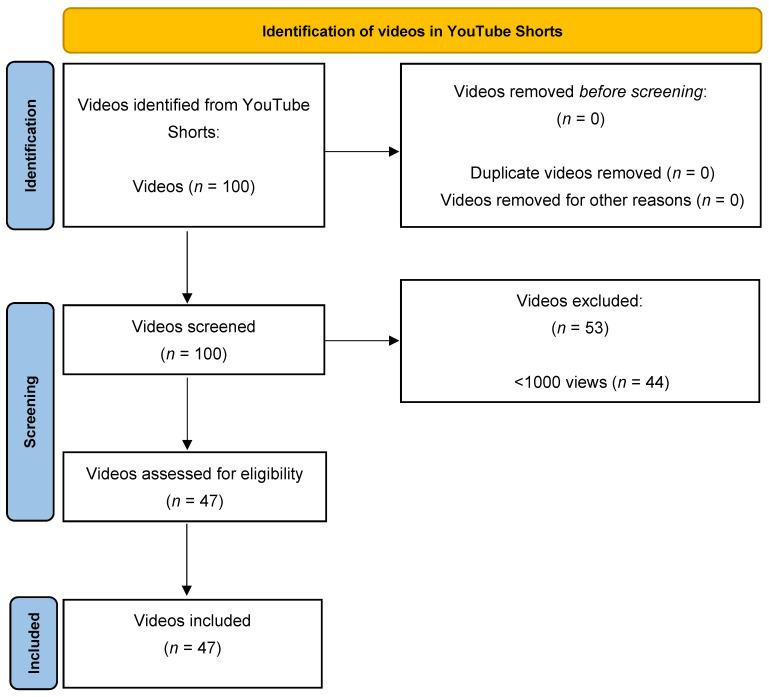
: This cross-sectional content analysis aimed to investigate how oil pulling is portrayed on YouTube Shorts, focusing on the types of speakers, claims made, and alignment with scientific evidence. The study further explored how the content may influence viewer perception, health behaviors, and the potential spread of misinformation. : On 28 January 2025, a systematic search of YouTube Shorts was performed using the term "oil pulling" in incognito mode to reduce algorithmic bias. English language videos with at least 1000 views were included through purposive sampling. A total of 47 Shorts met the inclusion criteria. Data were extracted using a structured coding framework that recorded speaker type (e.g., dentist, hygienist, influencer), engagement metrics, stated benefits, oil type and regimen, the use of disclaimers or citations, and stance toward oil pulling rated on a 5-point Likert scale. Speaker background and nationality were determined through publicly available channel descriptions or linked websites, with user identities anonymized and ethical approval deemed unnecessary due to the use of publicly available content. In total, 47 videos met the inclusion criteria. : Of the 47 YouTube Shorts that met the inclusion criteria, most were posted by influencers rather than dental professionals. These videos predominantly encouraged oil pulling, often recommending coconut oil for 10-15 min daily and citing benefits such as reduced halitosis and improved gum health. However, a smaller subset advanced more extreme claims, including reversing cavities and remineralizing enamel. Notably, US-licensed dentists and dental hygienists tended to discourage or express skepticism toward oil pulling, assigning lower Likert scores (1 or 2) to influencers and alternative health practitioners (often 4 or 5). : YouTube Shorts largely promote oil pulling through anecdotal and testimonial-driven content, often diverging from evidence-based dental recommendations. The findings reveal a disconnect between professional dental guidance and popular social media narratives. While some benefits like halitosis reduction may have limited support, exaggerated or misleading claims may result in improper oral hygiene practices. Greater engagement from dental professionals and improved health communication strategies are needed to counteract misinformation and reinforce oil pulling's role, if any, as an adjunct-not a replacement-for standard oral care. Future studies should explore viewer interpretation, behavioral influence, and cross-platform content patterns to better understand the impact of short-form health videos.
这项横断面内容分析旨在研究油拔法在YouTube Shorts上是如何呈现的,重点关注发言者类型、所宣称的内容以及与科学证据的一致性。该研究进一步探讨了这些内容可能如何影响观众认知、健康行为以及错误信息的潜在传播。:2025年1月28日,在隐身模式下使用“油拔法”一词对YouTube Shorts进行了系统搜索,以减少算法偏差。通过目的抽样纳入了至少有1000次观看量的英语视频。共有47条Shorts符合纳入标准。使用结构化编码框架提取数据,该框架记录发言者类型(如牙医、口腔保健员、有影响力的人)、参与指标、声称的益处、油的类型和疗程、是否使用免责声明或引用以及对油拔法的态度(按5级李克特量表评分)。通过公开的频道描述或链接网站确定发言者背景和国籍,由于使用的是公开可用内容,因此对用户身份进行了匿名处理且认为无需伦理批准。总共有47个视频符合纳入标准。:在符合纳入标准的47条YouTube Shorts中,大多数是由有影响力的人发布的,而不是牙科专业人员。这些视频主要鼓励油拔法,通常建议每天使用椰子油10 - 15分钟,并列举诸如减少口臭和改善牙龈健康等益处。然而,一小部分视频提出了更极端的说法,包括使龋齿逆转和使牙釉质再矿化。值得注意的是,美国有执照的牙医和口腔保健员往往不鼓励或对油拔法表示怀疑,给有影响力的人和替代健康从业者的李克特评分较低(1或2分),而后者通常为4或5分。:YouTube Shorts主要通过轶事和推荐驱动的内容来推广油拔法,这往往与基于证据的牙科建议不一致。研究结果揭示了专业牙科指导与流行的社交媒体叙述之间的脱节。虽然像减少口臭这样的一些益处可能有有限的支持,但夸大或误导性的说法可能导致不正确的口腔卫生习惯。需要牙科专业人员更多的参与以及改进健康传播策略,以对抗错误信息并强化油拔法作为标准口腔护理辅助手段(而非替代品)的作用(如果有作用的话)。未来的研究应该探索观众的解读、行为影响以及跨平台内容模式,以更好地理解短视频健康视频的影响。
 Zotero 插件