
探索美国成年人在新冠疫情期间将社交媒体用于健康和保健的预测因素:社会认知理论的应用
Exploring Predictors of Social Media Use for Health and Wellness during COVID-19 among Adults in the US: A Social Cognitive Theory Application.
作者信息
Elkefi Safa
机构信息
School of Nursing, Columbia University, New York, NY 10032, USA.
Hphactors Lab, New York, NY 10022, USA.
出版信息
Healthcare (Basel). 2023 Dec 23;12(1):39. doi: 10.3390/healthcare12010039.
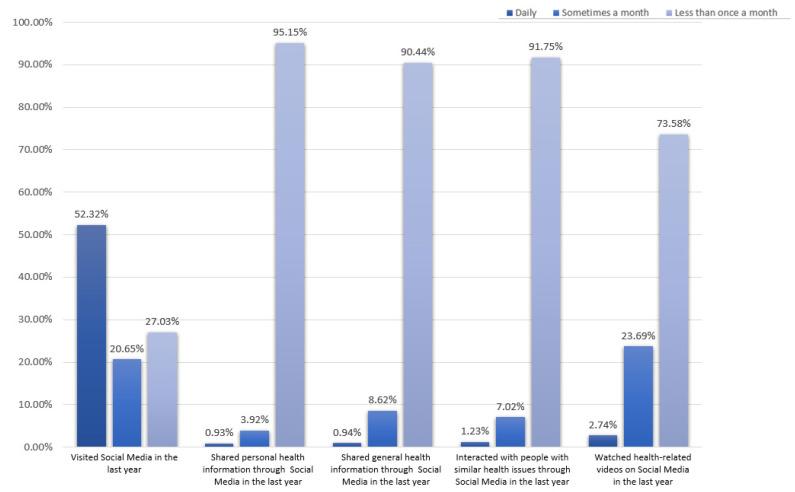
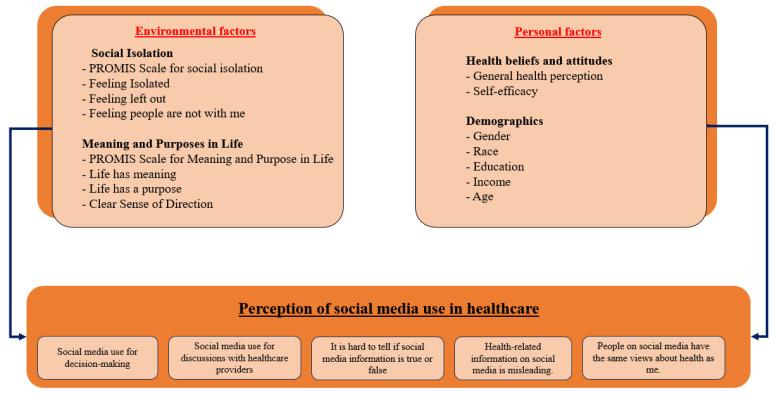
During COVID-19, SM media was relied upon for health-related information-seeking and activity support. This study uses the social cognitive theory (SCT) and a representative dataset of the population in the US to explore the factors influencing patients' perceptions of SM for health-related activities. As per SCT, consolidated factors comprised personal factors (sociodemographic, health perception, self-efficacy) and environmental factors (social isolation, purpose in life). Multivariate logistic regression analysis was conducted. Among the 6252 respondents, 95.15% rarely use SM to share personal health-related information, and 90.44% rarely use it to share general health-related information. Older individuals and Whites are less likely to consider SM for healthcare decisions. Education levels influence SM's perceived reliability. Those with positive health perceptions find SM more suitable for healthcare discussions. Socially-isolated individuals are less likely to use SM for healthcare. Those with a strong sense of purpose are less inclined to trust it for health decisions and may question its accuracy. SM-based interventions should address sociodemographic differences. Our findings contribute to the literature by SCT relevance validation in identifying the antecedents of SM use in healthcare. Our results also help to understand the challenges to its adoption. This can help enhance SM-based communication strategies and interventions.
在新冠疫情期间,患者依赖社交媒体获取健康相关信息并获得活动支持。本研究运用社会认知理论(SCT)以及美国人口的代表性数据集,探究影响患者对社交媒体用于健康相关活动认知的因素。根据社会认知理论,综合因素包括个人因素(社会人口统计学、健康认知、自我效能感)和环境因素(社会隔离、生活目的)。研究进行了多变量逻辑回归分析。在6252名受访者中,95.15%的人很少使用社交媒体分享个人健康相关信息,90.44%的人很少使用它分享一般健康相关信息。老年人和白人在医疗决策中考虑使用社交媒体的可能性较低。教育水平会影响对社交媒体可靠性的认知。健康认知积极的人认为社交媒体更适合用于医疗保健讨论。社会隔离的人不太可能将社交媒体用于医疗保健。目标感强烈的人不太倾向于在健康决策中信任它,并可能质疑其准确性。基于社交媒体的干预措施应考虑社会人口统计学差异。我们的研究结果通过验证社会认知理论在确定医疗保健中使用社交媒体的前因方面的相关性,为相关文献做出了贡献。我们的结果也有助于理解采用社交媒体面临的挑战。这有助于加强基于社交媒体的沟通策略和干预措施。
 Zotero 插件