
通过负载分泌组的3D打印生物材料促进伤口愈合。
Enhancing Wound Healing Through Secretome-Loaded 3D-Printed Biomaterials.
作者信息
Rattanachot Tithteeya, Lokanathan Yogeswaran, Fauzi Mh Busra, Maarof Manira
机构信息
Department of Tissue Engineering and Regenerative Medicine, Faculty of Medicine, Universiti Kebangsaan Malaysia, Cheras, Kuala Lumpur 56000, Malaysia.
Advance Bioactive Materials-Cells UKM Research Group, Universiti Kebangsaan Malaysia, Bangi 43600, Selangor, Malaysia.
出版信息
Gels. 2025 Jun 20;11(7):476. doi: 10.3390/gels11070476.
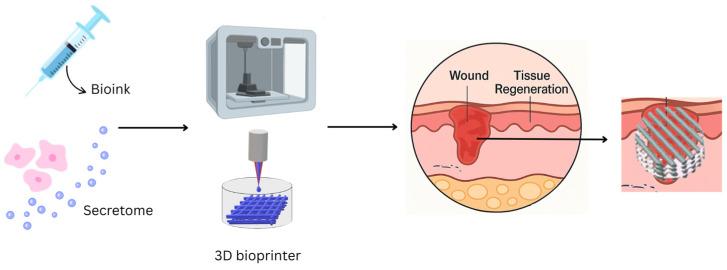
Wound healing remains a significant hurdle within the field of medical practice, especially concerning chronic and non-healing injuries. Conventional interventions, such as skin grafts, wound dressings, and biomaterials, offer structural support for the regenerated tissues but often lack the biological signaling cues essential for tissue regeneration. However, these approaches often lack the biological signals necessary to promote effective tissue repair. An emerging strategy involves incorporating cell-secreted proteins, known as the secretome, into biomaterials. The secretome contains bioactive elements such as cytokines, growth factors, and extracellular vesicles (EVs), which enhance the wound healing process. This review explores the potential of secretome-loaded biomaterials in modulating inflammation, promoting angiogenesis, and assisting in the remodeling of the extracellular matrix (ECM). Recent advancements in biomaterial engineering technology, such as 3-dimensional (3D) bioprinting, have improved the controlled delivery and bioactivity of secretome at the wound site. These gel-based biomaterials enhance wound healing by providing sustained bioactive molecule release, improving cell growth, and tissue repair. Despite these promising outcomes, limitations including variations in secretome composition and difficulties in large-scale production. Hence, secretome-loaded biomaterials offer a promising solution for wound healing, but further research is needed to optimize formulations, ensure stability, and validate clinical applications.
伤口愈合仍然是医学实践领域中的一个重大障碍,尤其是对于慢性和不愈合伤口而言。传统的干预措施,如皮肤移植、伤口敷料和生物材料,为再生组织提供结构支持,但往往缺乏组织再生所必需的生物信号线索。然而,这些方法通常缺乏促进有效组织修复所需的生物信号。一种新兴策略是将细胞分泌蛋白(即分泌组)整合到生物材料中。分泌组包含细胞因子、生长因子和细胞外囊泡(EVs)等生物活性成分,可增强伤口愈合过程。本综述探讨了负载分泌组的生物材料在调节炎症、促进血管生成以及协助细胞外基质(ECM)重塑方面的潜力。生物材料工程技术的最新进展,如三维(3D)生物打印,改善了分泌组在伤口部位的可控递送和生物活性。这些基于凝胶的生物材料通过提供生物活性分子的持续释放、促进细胞生长和组织修复来增强伤口愈合。尽管取得了这些令人鼓舞的成果,但仍存在局限性,包括分泌组组成的差异以及大规模生产的困难。因此,负载分泌组的生物材料为伤口愈合提供了一个有前景的解决方案,但需要进一步研究来优化配方、确保稳定性并验证临床应用。



 Zotero 插件