
年龄对房颤患者1年再入院率的影响:来自一个冲突频发国家的趋势与见解
The Effect of Age on 1-Year Readmissions in Atrial Fibrillation Patients: Trends and Insights From a Conflict-Stricken Country.
作者信息
Antoun Ibrahim, Alkhayer Alkassem, Eldin Aref Jalal, Alkhayer Alamer, Somani Riyaz, Ng G André, Zakkar Mustafa
机构信息
Department of Cardiovascular Sciences, University of Leicester, Leicester, UK.
Faculty of Medicine, University of Aleppo, Aleppo, Syria.
出版信息
Clin Cardiol. 2025 Jul;48(7):e70186. doi: 10.1002/clc.70186.
BACKGROUND
Atrial fibrillation (AF) is a leading cause of cardiovascular morbidity and hospitalization worldwide. However, limited data exist on AF readmissions in low-resource and conflict-affected settings. This study investigates the impact of age on 1-year readmission rates among AF patients in a Syrian tertiary hospital.
METHODS
This retrospective observational cohort study was conducted at a tertiary Syrian center between June/2021-November/2023. Patients admitted with primary AF were included, while those with secondary AF or missing demographic data were excluded. Patients were stratified into three age groups: 18-50 years (Group 1), 51-70 years (Group 2), and > 70 years (Group 3). The primary outcome was all-cause and cardiovascular-related 1-year readmissions, with secondary outcomes including readmission frequencies.
RESULTS
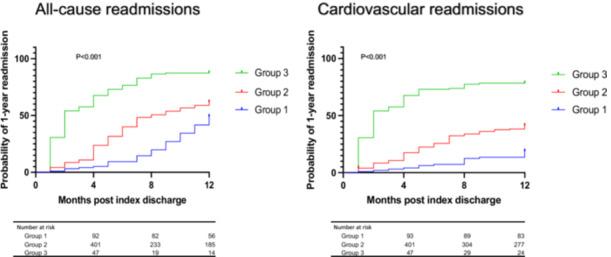
A total of 657 AF patients were included, with a median age of 60 320 (52%) were males. One-year readmission occurred in 64% of patients, with AF being the most common cause (75%). Group 1 had the highest smoking rates (70%). Group 3 had the highest rates of ischemic heart disease (47%), congestive cardiac failure (CCF) (35%), chronic kidney disease (15%, p < 0.001) and chronic liver disease (20). Older age was significantly associated with increased readmissions (87% in Group 3 vs. 62% in Group 2 and 49% in Group 1, p < 0.001). Frequent readmissions were more prevalent in Group 3 (≥ 3 admissions: 46%).
CONCLUSION
Older AF patients in a conflict-affected setting experience significantly higher readmission rates. Addressing healthcare resource limitations and optimizing AF management strategies are crucial to improving outcomes in resource-limited settings.
背景
心房颤动(AF)是全球心血管疾病发病和住院的主要原因。然而,在资源匮乏和受冲突影响的地区,关于房颤再入院的数据有限。本研究调查了年龄对叙利亚一家三级医院房颤患者1年再入院率的影响。
方法
这项回顾性观察性队列研究于2021年6月至2023年11月在叙利亚一家三级中心进行。纳入原发性房颤患者,排除继发性房颤或人口统计学数据缺失的患者。患者被分为三个年龄组:18 - 50岁(第1组)、51 - 70岁(第2组)和>70岁(第3组)。主要结局是全因和心血管相关的1年再入院情况,次要结局包括再入院频率。
结果
共纳入657例房颤患者,中位年龄为60岁,320例(52%)为男性。64%的患者发生了1年再入院,房颤是最常见原因(75%)。第1组吸烟率最高(70%)。第3组缺血性心脏病(47%)、充血性心力衰竭(CCF)(35%)、慢性肾病(15%,p < 0.001)和慢性肝病(20%)的发生率最高。年龄较大与再入院率增加显著相关(第3组为87%,第2组为62%,第1组为49%,p < 0.001)。频繁再入院在第3组更为普遍(≥3次入院:46%)。
结论
在受冲突影响地区,老年房颤患者的再入院率显著更高。解决医疗资源限制并优化房颤管理策略对于改善资源有限地区的治疗效果至关重要。

 Zotero 插件