
米诺环素通过调节PARP-1和HDAC3信号通路抑制脂多糖诱导的急性肺损伤中的炎症反应和氧化应激
Minocycline Regulates PARP-1 and HDAC3 Pathways to Inhibit Inflammation and Oxidative Stress in LPS-Induced Acute Lung Injury.
作者信息
Luo Chao, Zhu Xixi, Liang Jiefei, Zhu Chunyan, Shen Guohua, Wu Weibin
机构信息
Department of Medicine and Health, Shaoxing Key Laboratory of Targeted Drug Delivery and Targeted Materials, Shaoxing University Yuanpei College, Shaoxing, China.
School of Basic Medicine, Zhaoqing Medical University, Zhaoqing, China.
出版信息
Iran J Pharm Res. 2025 Jun 29;24(1):e161381. doi: 10.5812/ijpr-161381. eCollection 2025 Jan-Dec.
BACKGROUND
Acute lung injury (ALI) is characterized by excessive lung inflammation and apoptosis of alveolar epithelial cells, resulting in acute hypoxemic respiratory failure. Minocycline, a tetracycline antibiotic, is known to have excellent anti-inflammatory activity.
OBJECTIVES
The present study aims to reveal the protective effect and potential mechanism of the anti-inflammatory effects of minocycline on lipopolysaccharide (LPS)-induced ALI in mice and A549 cells.
METHODS
We investigated the role of minocycline in ALI mice and inflammation-induced damage to alveolar epithelial cells using various experimental approaches, including histological staining, enzyme-linked immunosorbent assay (ELISA), quantitative real-time PCR, flow cytometry, western blot analysis, and other relevant assays.
RESULTS
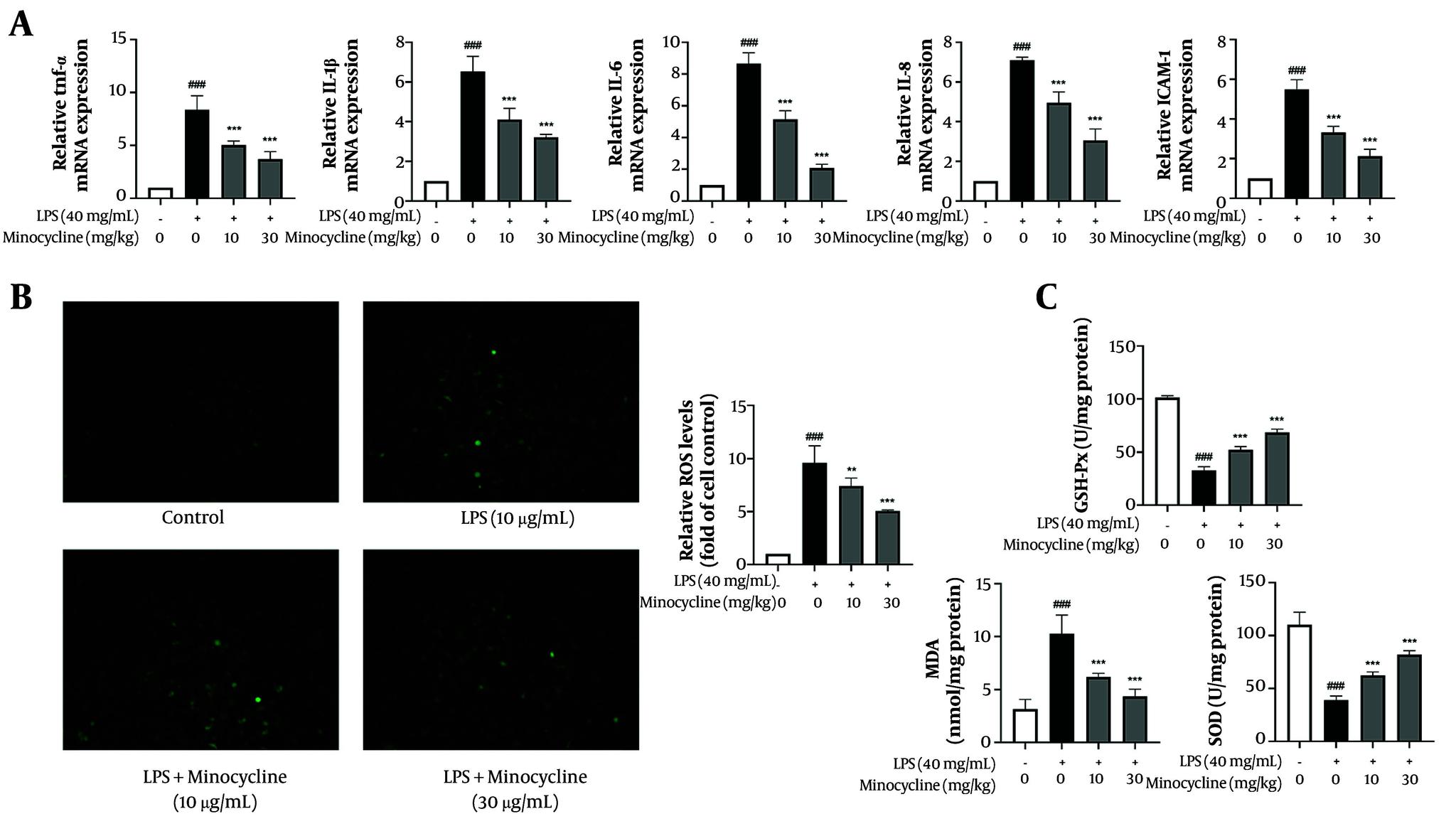
Pre-treatment with minocycline effectively attenuated LPS-induced ALI in vivo by inhibiting inflammation and oxidative damage, improving pathological changes in the lungs, alleviating pulmonary edema and protein exudation, and suppressing neutrophil aggregation. In vitro, minocycline suppressed the inflammatory response of human alveolar epithelial A549 cells, as evidenced by the inhibition of inflammatory cytokine and oxidative damage biomarker expression, reduction in intracellular reactive oxygen species (ROS) production, alleviation of mitochondrial damage, and inhibition of cell apoptosis. Subsequent mechanistic studies revealed that the protective effects of minocycline against ALI may be attributed to its suppression of poly (ADP-ribose) polymerase-1 (PARP-1) and histone deacetylase 3 (HDAC3) expression.
CONCLUSIONS
In conclusion, our study presents minocycline as a potential candidate for ALI therapy and provides an experimental foundation for investigating its anti-inflammatory mechanisms in the treatment of ALI. Further therapeutic value awaits verification in clinical and preclinical studies.
背景
急性肺损伤(ALI)的特征是肺部炎症过度和肺泡上皮细胞凋亡,导致急性低氧性呼吸衰竭。米诺环素是一种四环素类抗生素,已知具有出色的抗炎活性。
目的
本研究旨在揭示米诺环素对脂多糖(LPS)诱导的小鼠和A549细胞ALI的抗炎作用的保护效果及潜在机制。
方法
我们使用了各种实验方法,包括组织学染色、酶联免疫吸附测定(ELISA)、定量实时PCR、流式细胞术、蛋白质印迹分析及其他相关测定,来研究米诺环素在ALI小鼠及炎症诱导的肺泡上皮细胞损伤中的作用。
结果
米诺环素预处理通过抑制炎症和氧化损伤、改善肺部病理变化、减轻肺水肿和蛋白质渗出以及抑制中性粒细胞聚集,有效减轻了体内LPS诱导的ALI。在体外,米诺环素抑制了人肺泡上皮A549细胞的炎症反应,这表现为炎症细胞因子和氧化损伤生物标志物表达的抑制、细胞内活性氧(ROS)生成的减少、线粒体损伤的减轻以及细胞凋亡的抑制。随后的机制研究表明,米诺环素对ALI的保护作用可能归因于其对聚(ADP - 核糖)聚合酶 - 1(PARP - 1)和组蛋白脱乙酰酶3(HDAC3)表达的抑制。
结论
总之,我们的研究表明米诺环素是ALI治疗的潜在候选药物,并为研究其在ALI治疗中的抗炎机制提供了实验基础。其进一步的治疗价值有待临床和临床前研究验证。



 Zotero 插件