
一种基于影像组学的可解释模型,整合延迟期CT和临床特征以预测腹膜假黏液瘤的病理分级。
A radiomics-based interpretable model integrating delayed-phase CT and clinical features for predicting the pathological grade of appendiceal pseudomyxoma peritonei.
作者信息
Bai Dong, Shi Guanjun, Liang Yuanzi, Li Fang, Zheng Zhuozhao, Wang Zhiqun
机构信息
Department of Radiology, Aerospace Center Hospital, Beijing, China.
Department of Radiology, Beijing Tsinghua Changgung Hospital, School of Clinical Medicine, Tsinghua Medicine, Tsinghua University, Beijing, China.
出版信息
BMC Med Imaging. 2025 Jul 28;25(1):300. doi: 10.1186/s12880-025-01843-6.
OBJECTIVE
This study aimed to develop an interpretable machine learning model integrating delayed-phase contrast-enhanced CT radiomics with clinical features for noninvasive prediction of pathological grading in appendiceal pseudomyxoma peritonei (PMP), using Shapley Additive Explanations (SHAP) for model interpretation.
MATERIALS AND METHODS
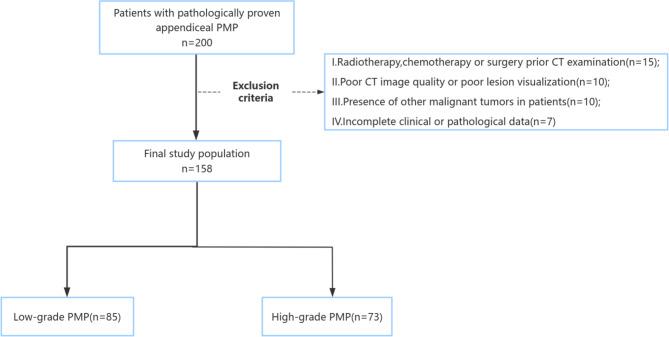
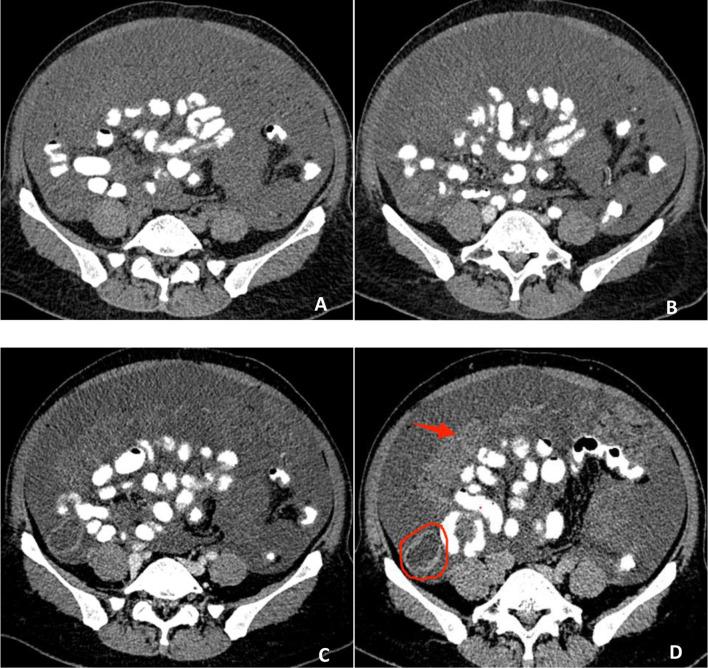
This retrospective study analyzed 158 pathologically confirmed PMP cases (85 low-grade, 73 high-grade) from January 4, 2015 to April 30, 2024. Comprehensive clinical data including demographic characteristics, serum tumor markers (CEA, CA19-9, CA125, D-dimer, CA-724, CA-242), and CT-peritoneal cancer index (CT-PCI) were collected. Radiomics features were extracted from preoperative contrast-enhanced CT scans using standardized protocols. After rigorous feature selection and five-fold cross-validation, we developed three predictive models: clinical-only, radiomics-only, and a combined clinical-radiomics model using logistic regression. Model performance was evaluated through ROC analysis (AUC), Delong test, decision curve analysis (DCA), and Brier score, with SHAP values providing interpretability.
RESULTS
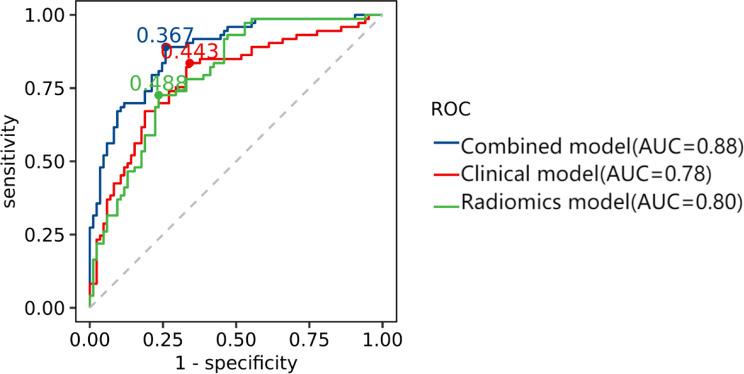
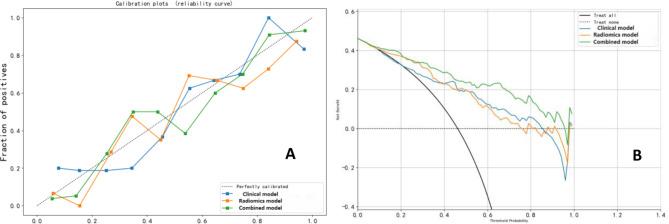
The combined model demonstrated superior performance, achieving AUCs of 0.91 (95%CI:0.86-0.95) and 0.88 (95%CI:0.82-0.93) in training and testing sets respectively, significantly outperforming standalone models (P < 0.05). DCA confirmed greater clinical utility across most threshold probabilities, with favorable Brier scores (training:0.124; testing:0.142) indicating excellent calibration. SHAP analysis identified the top predictive features: wavelet-LHH_glcm_InverseVariance (radiomics), original_shape_Elongation (radiomics), and CA-199 (clinical).
CONCLUSION
Our SHAP-interpretable combined model provides an accurate, noninvasive tool for PMP grading, facilitating personalized treatment decisions. The integration of radiomics and clinical data demonstrates superior predictive performance compared to conventional approaches, with potential to improve patient outcomes.
目的
本研究旨在开发一种可解释的机器学习模型,将延迟期对比增强CT放射组学与临床特征相结合,用于非侵入性预测腹膜假黏液瘤(PMP)的病理分级,并使用Shapley值法(SHAP)进行模型解释。
材料与方法
这项回顾性研究分析了2015年1月4日至2024年4月30日期间158例经病理证实的PMP病例(85例低级别,73例高级别)。收集了包括人口统计学特征、血清肿瘤标志物(癌胚抗原、糖类抗原19-9、糖类抗原125、D-二聚体、糖类抗原724、糖类抗原242)和CT腹膜癌指数(CT-PCI)在内的综合临床数据。使用标准化方案从术前对比增强CT扫描中提取放射组学特征。经过严格的特征选择和五折交叉验证,我们开发了三个预测模型:仅临床模型、仅放射组学模型和使用逻辑回归的临床-放射组学联合模型。通过ROC分析(AUC)、德龙检验、决策曲线分析(DCA)和布里尔评分评估模型性能,SHAP值提供可解释性。
结果
联合模型表现出卓越的性能,在训练集和测试集中的AUC分别达到0.91(95%CI:0.86-0.95)和0.88(95%CI:0.82-0.93),显著优于单独的模型(P<0.05)。DCA证实在大多数阈值概率下具有更大的临床实用性,良好的布里尔评分(训练集:0.124;测试集:0.142)表明校准良好。SHAP分析确定了最重要的预测特征:小波-LHH_glcm_逆方差(放射组学)、原始形状_伸长率(放射组学)和糖类抗原199(临床)。
结论
我们的SHAP可解释联合模型为PMP分级提供了一种准确的非侵入性工具,有助于做出个性化治疗决策。与传统方法相比,放射组学和临床数据的整合显示出卓越的预测性能,有可能改善患者预后。



 Zotero 插件