
用于基于MRI的稳健脑肿瘤分类的深度卷积神经网络多数投票集成方法
Majority Voting Ensemble of Deep CNNs for Robust MRI-Based Brain Tumor Classification.
作者信息
Liu Kuo-Ying, Lu Nan-Han, Huang Yung-Hui, Matsushima Akari, Kimura Koharu, Okamoto Takahide, Chen Tai-Been
机构信息
Department of Radiology, E-DA Cancer Hospital, I-Shou University, No. 21, Yida Road, Jiao-Su Village, Yan-Chao District, Kaohsiung 82445, Taiwan.
School of Medicine, College of Medicine, I-Shou University, No. 8, Yida Road, Jiao-Su Village, Yan-Chao District, Kaohsiung 82445, Taiwan.
出版信息
Diagnostics (Basel). 2025 Jul 15;15(14):1782. doi: 10.3390/diagnostics15141782.
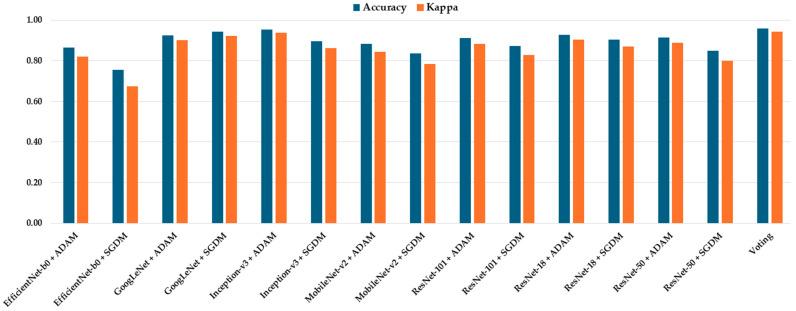
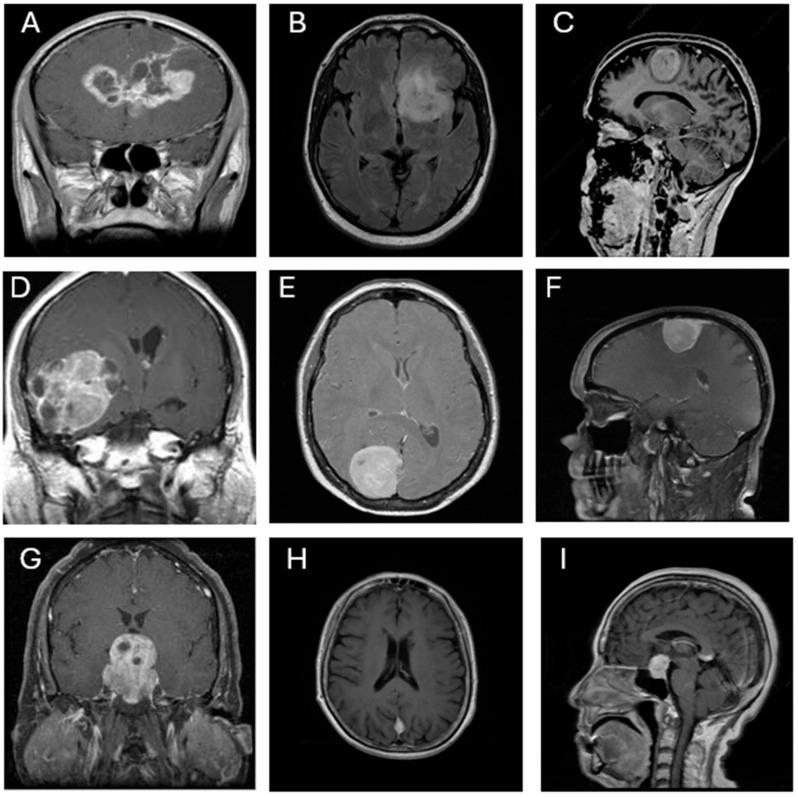
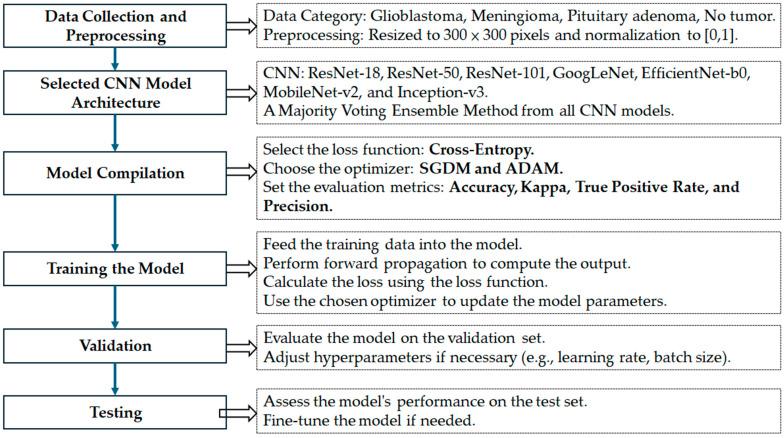
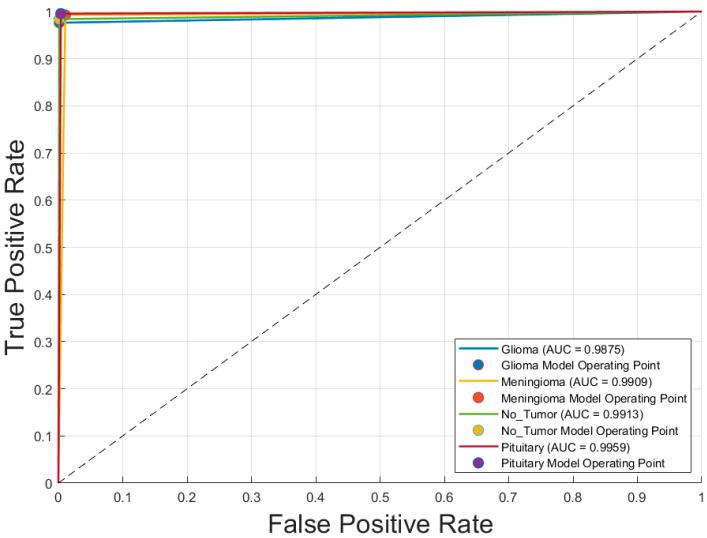
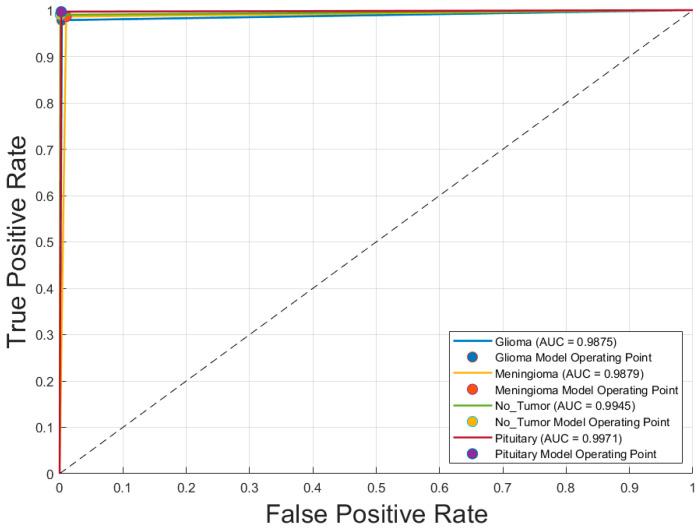
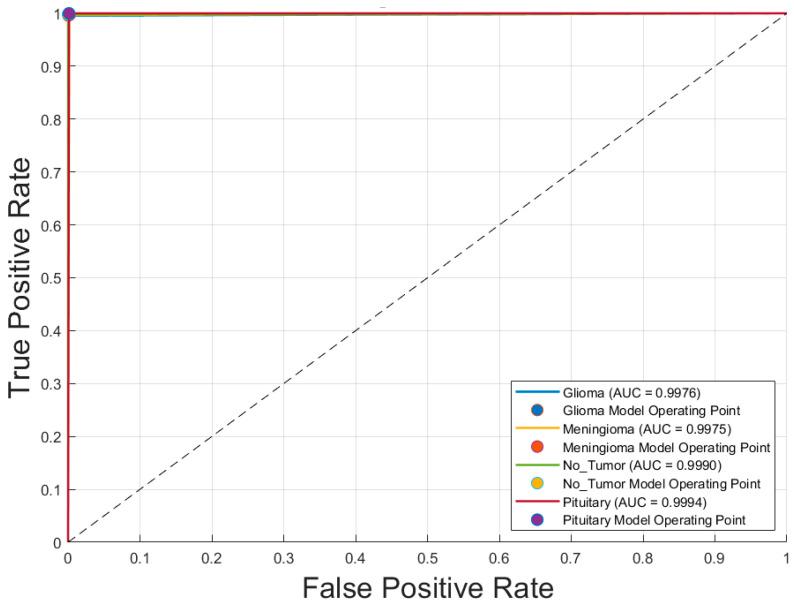
: Accurate classification of brain tumors is critical for treatment planning and prognosis. While deep convolutional neural networks (CNNs) have shown promise in medical imaging, few studies have systematically compared multiple architectures or integrated ensemble strategies to improve diagnostic performance. This study aimed to evaluate various CNN models and optimize classification performance using a majority voting ensemble approach on T1-weighted MRI brain images. : Seven pretrained CNN architectures were fine-tuned to classify four categories: glioblastoma, meningioma, pituitary adenoma, and no tumor. Each model was trained using two optimizers (SGDM and ADAM) and evaluated on a public dataset split into training (70%), validation (10%), and testing (20%) subsets, and further validated on an independent external dataset to assess generalizability. A majority voting ensemble was constructed by aggregating predictions from all 14 trained models. Performance was assessed using accuracy, Kappa coefficient, true positive rate, precision, confusion matrix, and ROC curves. : Among individual models, GoogLeNet and Inception-v3 with ADAM achieved the highest classification accuracy (0.987). However, the ensemble approach outperformed all standalone models, achieving an accuracy of 0.998, a Kappa coefficient of 0.997, and AUC values above 0.997 for all tumor classes. The ensemble demonstrated improved sensitivity, precision, and overall robustness. : The majority voting ensemble of diverse CNN architectures significantly enhanced the performance of MRI-based brain tumor classification, surpassing that of any single model. These findings underscore the value of model diversity and ensemble learning in building reliable AI-driven diagnostic tools for neuro-oncology.
脑肿瘤的准确分类对于治疗规划和预后至关重要。虽然深度卷积神经网络(CNN)在医学成像中已显示出前景,但很少有研究系统地比较多种架构或集成集成策略以提高诊断性能。本研究旨在评估各种CNN模型,并使用多数投票集成方法对T1加权MRI脑图像优化分类性能。
七个预训练的CNN架构被微调以对四类进行分类:胶质母细胞瘤、脑膜瘤、垂体腺瘤和无肿瘤。每个模型使用两种优化器(SGDM和ADAM)进行训练,并在一个公共数据集上进行评估,该数据集被分为训练集(70%)、验证集(10%)和测试集(20%)子集,并在一个独立的外部数据集上进一步验证以评估泛化能力。通过汇总所有14个训练模型的预测构建多数投票集成。使用准确率、Kappa系数、真阳性率、精确率、混淆矩阵和ROC曲线评估性能。
在单个模型中,使用ADAM的GoogLeNet和Inception-v3实现了最高的分类准确率(0.987)。然而,集成方法优于所有独立模型,实现了0.998的准确率、0.997的Kappa系数以及所有肿瘤类别的AUC值高于0.997。该集成显示出提高的敏感性、精确率和整体稳健性。
不同CNN架构的多数投票集成显著提高了基于MRI的脑肿瘤分类性能,超过了任何单个模型。这些发现强调了模型多样性和集成学习在构建可靠的人工智能驱动的神经肿瘤诊断工具中的价值。

 Zotero 插件