
突破极限:MYC介导肿瘤免疫逃逸。
Beyond the Limit: MYC Mediates Tumor Immune Escape.
作者信息
Hong Zhongyang, Ming Sitong, Luan Xin, Sun Zhe, Zhang Weidong
机构信息
School of Pharmaceutical Science, Changchun University of Chinese Medicine, Changchun 130117, China.
Institute of Interdisciplinary Integrative Medicine Research, Shanghai University of Traditional Chinese Medicine, Shanghai 200120, China.
出版信息
Pharmaceuticals (Basel). 2025 Jun 29;18(7):978. doi: 10.3390/ph18070978.
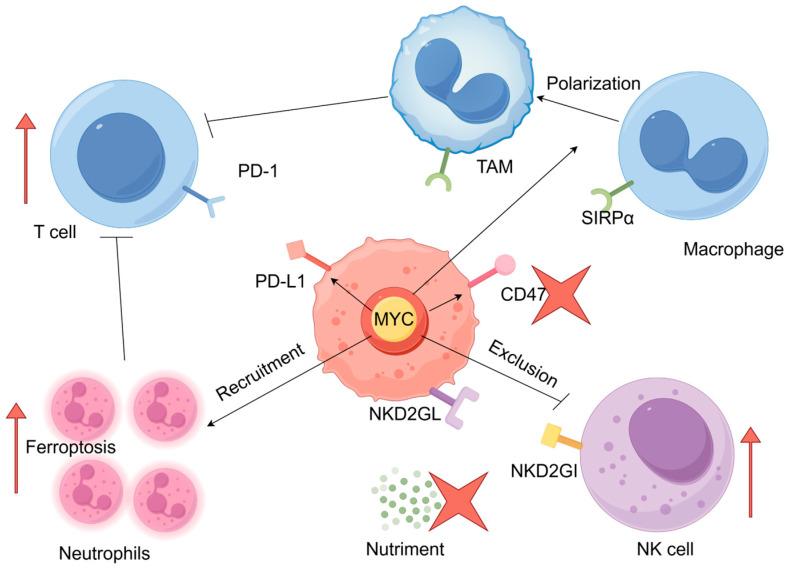
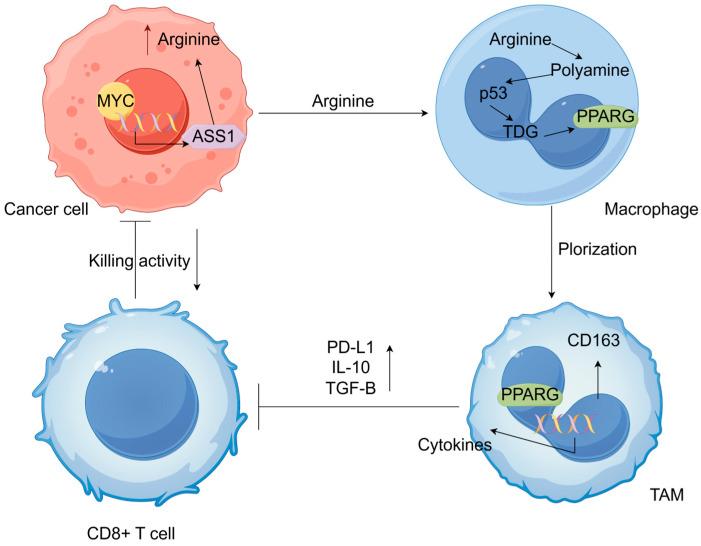
MYC is an aberrantly regulated transcription factor implicated in approximately 70% of human tumors, where it extensively modulates signaling pathways associated with cancer progression. Inactivating MYC has been shown to inhibit tumor growth and even induce sustained tumor regression across various cancer types, a phenomenon referred to as oncogene addiction. However, in vitro studies reveal that the knockout or knockdown of MYC in numerous tumor cell lines does not necessarily result in cell death, despite these tumors exhibiting MYC addiction in vivo. This discrepancy suggests that the unique tumor microenvironment in vivo may play a critical role in facilitating MYC addiction in cancer cells. MYC is also widely acknowledged for its role in mediating the immune evasion of tumor cells. Nevertheless, due to the extensive regulation of cellular gene expression by MYC and the incomplete understanding of the mechanisms underlying tumor immune escape, the precise pathways through which MYC influences tumor immune evasion remain inadequately elucidated. Recent years have seen the identification of novel tumor immune escape mechanisms, some of which have been demonstrated to be directly or indirectly regulated by MYC. For instance, MYC may contribute to immune evasion by modulating the expression of argininosuccinate synthetase 1 (ASS1), a key enzyme involved in arginine biosynthesis. Herein, in this study, we explore some novel potential mechanisms through which MYC facilitates the immune evasion of tumor cells, alongside a combined therapeutic approach targeting MYC and employing immunotherapy based on this mechanism. Furthermore, we suggest that targeting proteins interacting with MYC to modulate its expression and function may serve as an alternative strategy to direct MYC targeting, thereby expediting the clinical translation of combination therapies.
MYC是一种转录因子,其调控异常,与约70%的人类肿瘤相关,在肿瘤中它广泛调节与癌症进展相关的信号通路。已证明使MYC失活可抑制肿瘤生长,甚至在各种癌症类型中诱导肿瘤持续消退,这种现象称为癌基因成瘾。然而,体外研究表明,在许多肿瘤细胞系中敲除或敲低MYC并不一定会导致细胞死亡,尽管这些肿瘤在体内表现出MYC成瘾。这种差异表明,体内独特的肿瘤微环境可能在促进癌细胞的MYC成瘾中起关键作用。MYC在介导肿瘤细胞免疫逃逸中的作用也得到广泛认可。然而,由于MYC对细胞基因表达的广泛调控以及对肿瘤免疫逃逸潜在机制的不完全理解,MYC影响肿瘤免疫逃逸的精确途径仍未得到充分阐明。近年来发现了新的肿瘤免疫逃逸机制,其中一些已被证明直接或间接受MYC调控。例如,MYC可能通过调节精氨酸琥珀酸合成酶1(ASS1)的表达来促进免疫逃逸,ASS1是精氨酸生物合成中的关键酶。在本研究中,我们探索了MYC促进肿瘤细胞免疫逃逸的一些新的潜在机制,以及一种基于此机制的联合治疗方法,该方法靶向MYC并采用免疫疗法。此外,我们认为靶向与MYC相互作用的蛋白质以调节其表达和功能可能是直接靶向MYC的替代策略,从而加速联合疗法的临床转化。

 Zotero 插件