
评估下肢反压过程中的骨骼肌泵:心血管调节中的滞后与因果关系
Assessing the Skeletal Muscle Pump During Lower Limb Counterpressure: Lags and Causality in Cardiovascular Regulation.
作者信息
Knight Silvin P, Duggan Eoin, Xue Feng, Romero-Ortuno Roman
机构信息
FRAILMatics Research Group, Discipline of Medical Gerontology, School of Medicine, Trinity College Dublin, Dublin, Ireland.
Falls and Syncope Unit (FASU), Mercer's Institute for Successful Ageing (MISA), St James's Hospital, Dublin, Ireland.
出版信息
J Cachexia Sarcopenia Muscle. 2025 Aug;16(4):e70019. doi: 10.1002/jcsm.70019.
BACKGROUND
Orthostatic hypotension (OH) is a prevalent condition among older adults, characterised by a sudden drop in blood pressure upon standing, often leading to dizziness and increased risk of falls, morbidity and mortality. The skeletal muscle pump is thought to be important in maintaining venous return and stabilising blood pressure during postural changes, especially during the performance of physical counterpressure manoeuvres (PCMs). This study investigated the temporal relationships between thigh muscle activation, thigh haemoglobin concentration and cardiovascular parameters (heart rate [HR], stroke volume [SV] and total peripheral resistance [TPR]) to understand the muscle pump's role in haemodynamic regulation while performing supine and standing PCMs.
METHODS
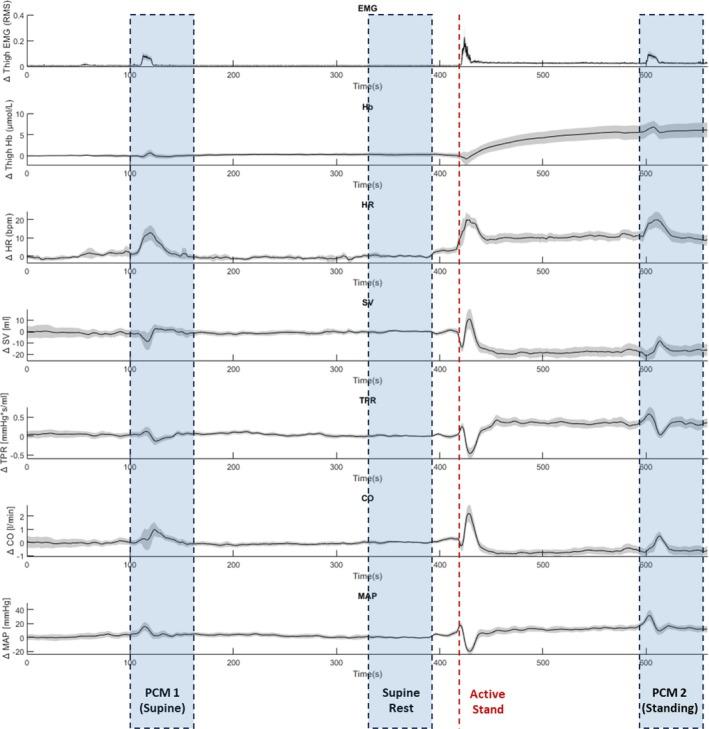
Twenty-two participants (mean age 70.4 ± 5.2 years) were assessed at the Falls and Syncope Unit at St. James's Hospital, Dublin, Ireland. Each underwent an active stand test, around which participants were asked to squeeze their thigh muscles as hard as possible for 10 s, firstly while in the supine position, and secondly after standing. Surface electromyography (EMG), near-infrared spectroscopy (NIRS) and non-invasive digital artery photoplethysmography were used to continuously monitor thigh muscle activation, muscle haemoglobin concentration and cardiovascular function, respectively. Cross-correlation and Granger causality analyses were conducted to determine the temporal and causal relationships between the signals.
RESULTS
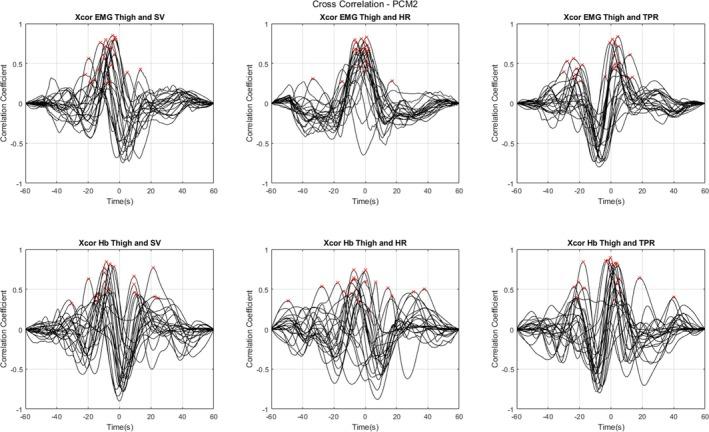
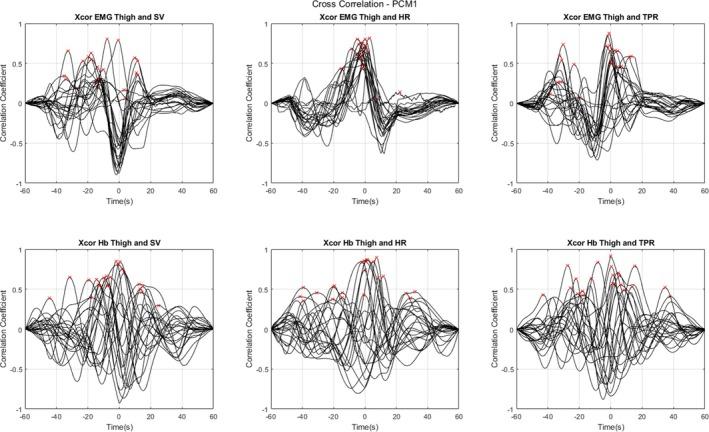
Cross-correlation analysis revealed significant temporal relationships between muscle activation and cardiovascular parameters during PCMs. Specifically, HR, TPR and SV lagged EMG by approximately 1-3, 6-9 and 8-10 s, respectively. Mean peak cross-correlation coefficients during the standing PCM were 0.609 for EMG to HR, 0.516 for EMG to TPR and 0.564 for EMG to SV. Granger causality tests indicated that muscle activation significantly predicted changes in SV, HR and TPR, with causality proportions increasing during PCMs (e.g., SV to EMG: 9.1% during supine rest; EMG to SV: 63.6% during standing PCM). Notably, inter-individual variability was observed, with peak CCs for EMG to SV ranging from 0.251 to 0.849, and lag times from -21.9 to 13.4 s during standing PCM.
CONCLUSIONS
These findings underscore the role of the skeletal muscle pump in modulating venous return and cardiac output during PCMs. The study provides a novel methodological framework for assessing skeletal muscle pump function and its impact on cardiovascular dynamics. By understanding the temporal interplay between muscle activation and cardiovascular responses, we can develop effective strategies to improve cardiovascular stability and potentially prevent OH. Future research should validate these findings in larger, more diverse cohorts and explore long-term adaptations to targeted interventions.
背景
体位性低血压(OH)在老年人中很常见,其特征是站立时血压突然下降,常导致头晕以及跌倒、发病和死亡风险增加。骨骼肌泵被认为在维持静脉回流和体位改变期间稳定血压方面很重要,尤其是在进行物理反压动作(PCM)时。本研究调查了大腿肌肉激活、大腿血红蛋白浓度与心血管参数(心率[HR]、心输出量[SV]和总外周阻力[TPR])之间的时间关系,以了解在进行仰卧位和站立位PCM时肌肉泵在血液动力学调节中的作用。
方法
22名参与者(平均年龄70.4±5.2岁)在爱尔兰都柏林圣詹姆斯医院的跌倒与晕厥科接受评估。每位参与者都进行了主动站立测试,在此过程中,要求参与者首先在仰卧位时,然后在站立后尽可能用力挤压大腿肌肉10秒。表面肌电图(EMG)、近红外光谱(NIRS)和无创数字动脉光电容积描记法分别用于连续监测大腿肌肉激活、肌肉血红蛋白浓度和心血管功能。进行了交叉相关性和格兰杰因果关系分析,以确定信号之间的时间和因果关系。
结果
交叉相关性分析揭示了PCM期间肌肉激活与心血管参数之间存在显著的时间关系。具体而言,HR、TPR和SV分别比EMG滞后约1 - 3秒、6 - 9秒和8 - 10秒。站立位PCM期间的平均峰值交叉相关系数为:EMG与HR为0.609,EMG与TPR为0.516,EMG与SV为0.564。格兰杰因果关系测试表明,肌肉激活显著预测了SV、HR和TPR的变化,在PCM期间因果比例增加(例如,SV对EMG:仰卧休息时为9.1%;EMG对SV:站立位PCM时为63.6%)。值得注意的是,观察到个体间存在差异,站立位PCM期间EMG与SV的峰值相关系数范围为0.251至0.849,滞后时间为 - 21.9至13.4秒。
结论
这些发现强调了骨骼肌泵在PCM期间调节静脉回流和心输出量中的作用。该研究为评估骨骼肌泵功能及其对心血管动力学的影响提供了一个新的方法框架。通过了解肌肉激活与心血管反应之间的时间相互作用,我们可以制定有效的策略来改善心血管稳定性并潜在预防OH。未来的研究应在更大、更多样化的队列中验证这些发现,并探索对有针对性干预的长期适应性。



 Zotero 插件