
利用人类呼吸道的原代和传代培养物评估4型(G4)猪流感病毒的大流行潜力。
Evaluation of pandemic potential of the genotype 4 (G4) swine influenza virus using and cultures of the human respiratory tract.
作者信息
Chan Jenny C M, Ching Rachel H H, Kock Hermione H M, Long Teng, Nicholls John M, Peiris J S Malik, Hui Kenrie P Y, Chan Michael C W
机构信息
School of Public Health, LKS Faculty of Medicine, The University of Hong Kong, Hong Kong SAR, PR China.
Centre for Immunology and Infection (C2i), Hong Kong Science Park, Hong Kong SAR, PR China.
出版信息
J Gen Virol. 2025 Jul;106(7). doi: 10.1099/jgv.0.002133.
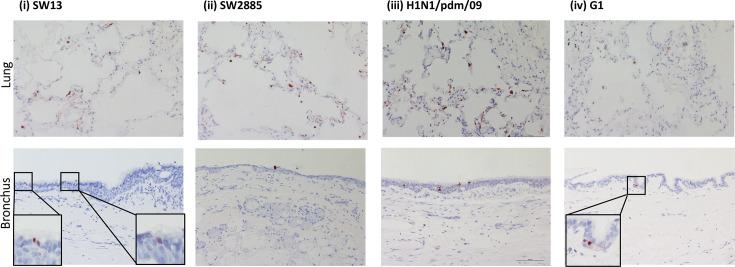
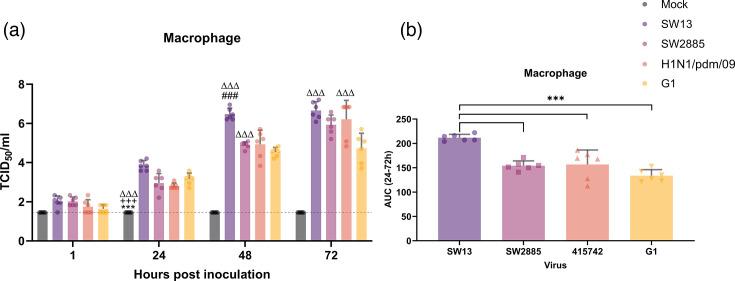
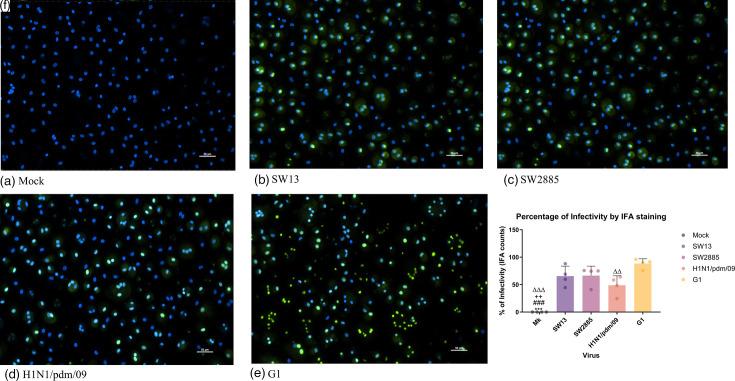
Recent studies have reported a genotype 4 (G4) reassortant Eurasian avian-like (EA) H1N1 virus in swine, demonstrating a potential pandemic threat in humans. Here, we have compared the tropism, replication competence and pro-inflammatory cytokine and chemokine induction of the two G4 EA H1N1 strains in parallel with 2009 pandemic H1N1 (H1N1/pdm/09) and A/Quail/HK/G1/1997 H9N2 (G1) using culture of the human respiratory tract and culture of human peripheral blood-derived macrophages. Our results showed that G4 strains could replicate in cultures of human lung and bronchus with a similar replication competence to H1N1/pdm/09. The cytokine induction levels of G4 were similar to H1N1/pdm/09 in macrophages. Taken together, we could extrapolate that the G4 EA H1N1 swine influenza may pose a notable public health threat towards human and should not underestimate this threat.
近期研究报告称,在猪身上发现了一种基因型4(G4)重配的欧亚禽源样(EA)H1N1病毒,这表明该病毒对人类具有潜在的大流行威胁。在此,我们使用人类呼吸道培养物和人类外周血来源的巨噬细胞培养物,将两种G4 EA H1N1毒株与2009年大流行H1N1(H1N1/pdm/09)和A/鹌鹑/香港/G1/1997 H9N2(G1)进行了平行比较,研究了它们的嗜性、复制能力以及促炎细胞因子和趋化因子的诱导情况。我们的结果表明,G4毒株能够在人肺和支气管培养物中复制,其复制能力与H1N1/pdm/09相似。G4在巨噬细胞中的细胞因子诱导水平与H1N1/pdm/09相似。综上所述,我们可以推断,G4 EA H1N1猪流感可能对人类构成重大的公共卫生威胁,不应低估这一威胁。


 Zotero 插件