
将严重急性呼吸综合征冠状病毒2(SARS-CoV-2)中和性LCB1肽与解淀粉芽孢杆菌核糖核酸酶融合可提高抗病毒疗效。
Fusion of SARS-CoV-2 neutralizing LCB1 peptide with Bacillus amyloliquefaciens RNase improves antiviral efficacy.
作者信息
Kostin Nikita N, Bobik Tatyana V, Konovalova Elena V, Kocharovskaya Milita V, Simonova Maria A, Rushkevich Natalia Yu, Mokrushina Yuliana A, Skryabin George A, Kalinin Roman S, Kovalchuk Sergey I, Ziganshin Rustam H, Kaluzhskiy Leonid A, Gnedenko Oksana V, Yablokov Evgeniy O, Ivanov Alexis S, Chernov Aleksandr S, Kazakov Vitaly A, Khokhlova Oksana N, Murashev Arkady N, Hong Senlian, Shramova Elena I, Schulga Alexey A, Lyukmanova Ekaterina N, Kirpichnikov Mikhail P, Smirnov Ivan V, Belogurov Alexey A, Rubtsov Yuri P, Stepanov Alexey V, Zhang Hongkai, Gabibov Alexander G, Deyev Sergey M
机构信息
M.M. Shemyakin and Yu.A. Ovchinnikov Institute of Bioorganic Chemistry of the Russian Academy of Sciences, Miklukho-Maklaya, 16/10, Moscow, Russia, 117997.
Department of Physiology and Cell Biology, College of Medicine, The Ohio State University, 1645 Neil Avenue, Columbus, OH, 43210, USA.
出版信息
Sci Rep. 2025 Jul 31;15(1):28039. doi: 10.1038/s41598-025-12444-2.
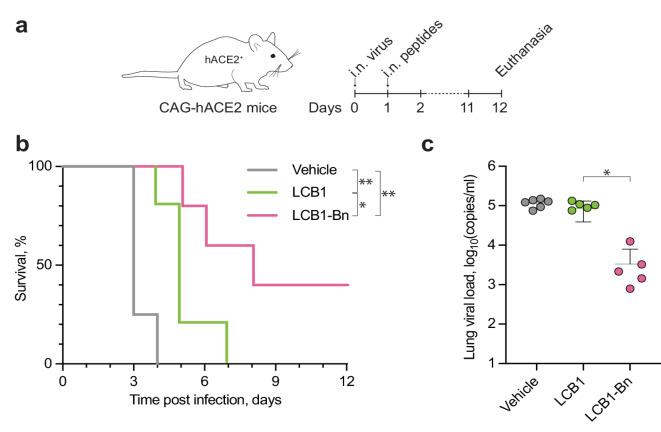
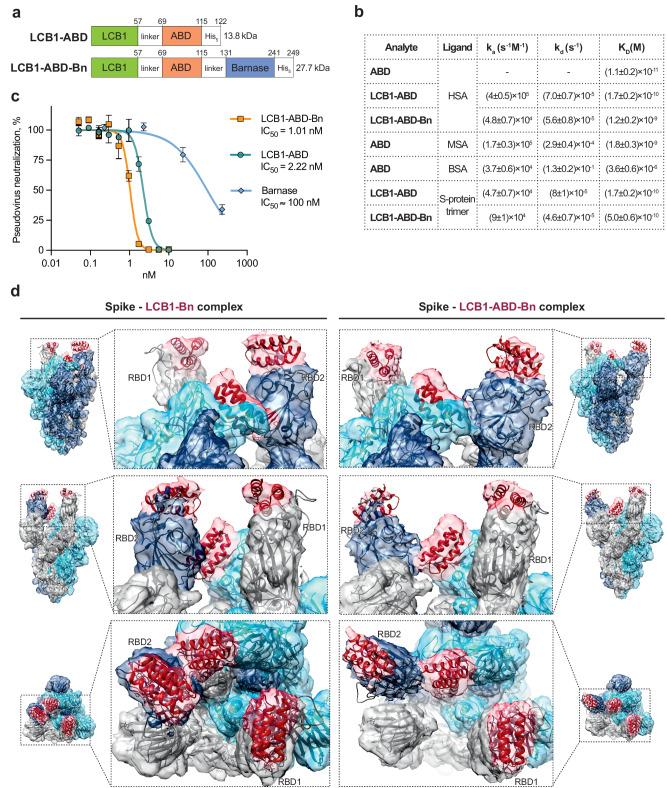
Virus-neutralizing peptides (VNPs) emerged as promising antiviral drug candidates with unprecedented specificity and cost-effectiveness during the recent COVID-19 pandemic. However, limited avidity, lack of effector functions, short circulatory half-life, and restricted administration routes make them inferior compared to neutralizing antibodies. To address these constraints, a potent VNP that targets the SARS-CoV-2 S protein is combined with Barnase, a highly active RNA-cleaving enzyme from Bacillus amyloliquefaciens. The resulting LCB1-Barnase (LCB1-Bn) chimera retains strong binding affinity for the SARS-CoV-2 S protein and demonstrates a fourfold reduction in IC compared to the LCB1 peptide alone in competitive ELISA and in in vitro neutralization tests. In transgenic CAG-hACE2 mice infected with wild-type SARS-CoV-2, intranasal administration of LCB1-Bn significantly improves survival and reduces viral load by 29-fold. To extend circulation life and allow systemic intravenous administration, an albumin-binding domain (ABD) from Streptococcus protein G is added to LCB1-Bn, producing LCB1-ABD-Bn fusion protein which displays a 95-fold increase in serum half-life. LCB1-ABD-Bn exhibits good tolerability at doses below 10 mg/kg and provides protection of SARS-CoV-2-infected CAG-hACE2 animals in 24-hour post-infection intraperitoneal treatment. Cryo-EM reveals the LCB1-ABD-Bn's tight interaction with S protein RBD domains, highlighting its potential as a promising drug candidate against SARS-CoV-2.
在最近的新冠疫情期间,病毒中和肽(VNPs)作为有前景的抗病毒药物候选物出现,具有前所未有的特异性和成本效益。然而,亲和力有限、缺乏效应功能、循环半衰期短以及给药途径受限,使得它们与中和抗体相比处于劣势。为了解决这些限制,一种靶向严重急性呼吸综合征冠状病毒2(SARS-CoV-2)刺突蛋白(S蛋白)的强效VNP与来自解淀粉芽孢杆菌的高活性RNA切割酶Barnase结合。由此产生的LCB1-Barnase(LCB1-Bn)嵌合体对SARS-CoV-2 S蛋白保持强烈的结合亲和力,并且在竞争性酶联免疫吸附测定(ELISA)和体外中和试验中,与单独的LCB1肽相比,半数抑制浓度(IC)降低了四倍。在感染野生型SARS-CoV-2的转基因CAG-hACE2小鼠中,经鼻内给予LCB1-Bn可显著提高存活率,并使病毒载量降低29倍。为了延长循环寿命并允许全身静脉给药,将来自链球菌蛋白G的白蛋白结合结构域(ABD)添加到LCB1-Bn中,产生LCB1-ABD-Bn融合蛋白,其血清半衰期增加了95倍。LCB1-ABD-Bn在剂量低于10 mg/kg时表现出良好的耐受性,并在感染后24小时腹腔内治疗中为感染SARS-CoV-2的CAG-hACE2动物提供保护。冷冻电镜显示LCB1-ABD-Bn与S蛋白受体结合结构域(RBD)紧密相互作用;突出了其作为抗SARS-CoV-2有前景的候选药物的潜力。



 Zotero 插件